Who funds Waymo’s hardware?
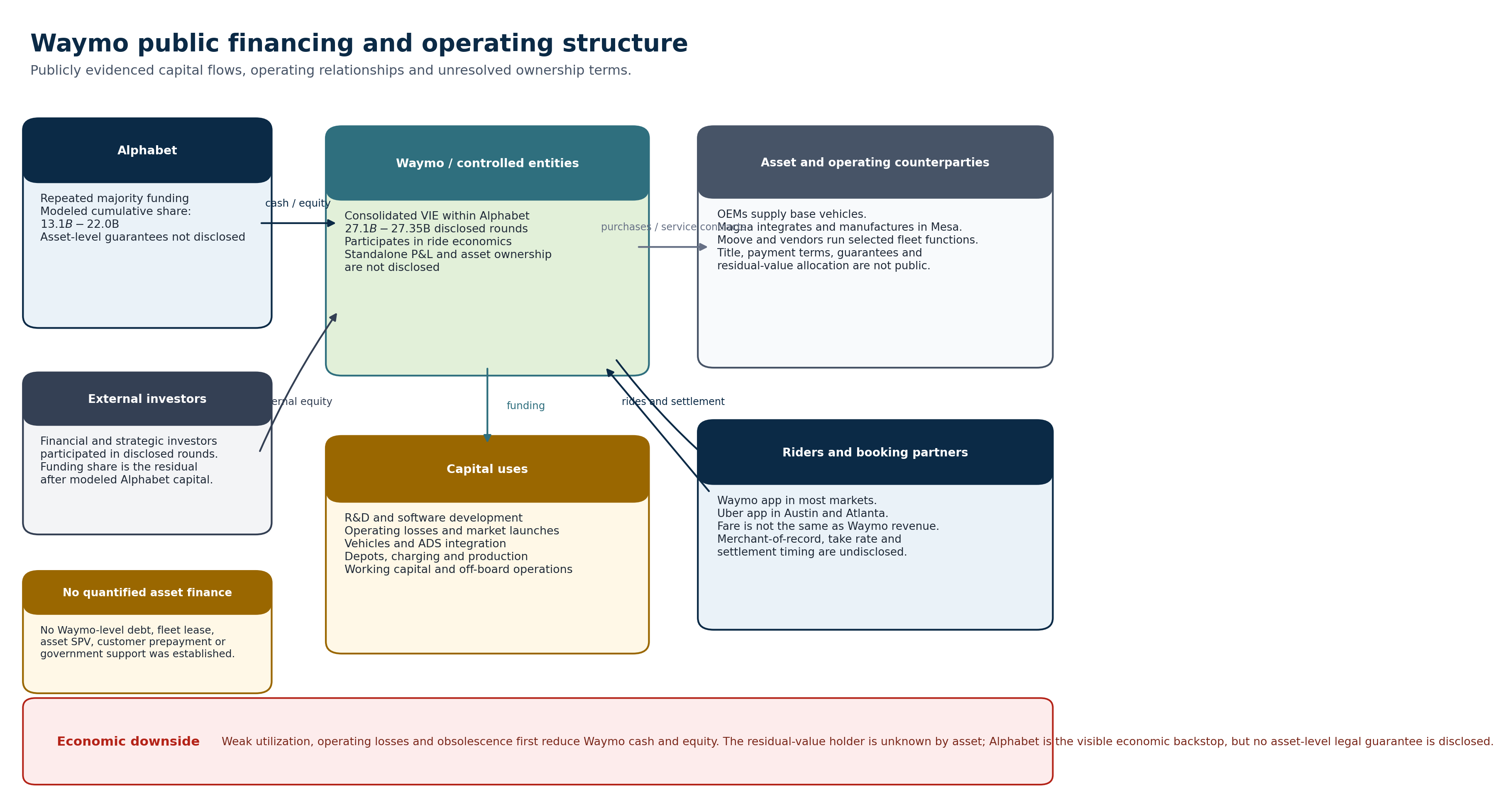
Alphabet funds the time needed to improve the fleet. The missing asset contracts and thin modeled cash coverage show why that patience matters.
Sulayman Bowles · · Updated

Waymo disclosed $27.1 billion to $27.35 billion of funded rounds through February 2026. I read that as a story about Alphabet financing time: time to improve the technology, build a network and make more paid use of each car. It is a much stronger funding position than an unproven fleet facing a lender’s repayment calendar.
The risk stays with the patient capital unless a contract moves it. The reviewed package identifies no quantified fleet-debt or leasing structure taking that risk from Waymo equity. Alphabet’s economic exposure is substantial; neither its ownership nor its past funding is a legal promise to cover every future fleet obligation.
The distinction matters because an autonomous fleet needs more than cars. Its hardware, depots and service operations must keep earning through maintenance and technology changes. The workbook’s base case estimates $777 million of physical capital but only $33.0 million of annual contribution after depreciation, before corporate research and overhead. A large funding round can carry that experiment. The modeled fleet has yet to show it can finance itself.
Method & limits
figures retain the July 22, 2026 report and workbook cutoff; sources were not independently refreshed for this rewrite. Standalone Waymo accounts, asset titles, lease schedules and lender documents remain unavailable. Fleet costs, revenue, utilization, recoveries and debt tests are author scenarios, not observed Waymo economics. A zero documented lower bound records an unquantified financing channel, not proof that it does not exist.
The funding total is much larger than the modeled fleet
The disclosed rounds are roughly $3.0 billion to $3.25 billion in 2020, $2.5 billion in 2021, $5.6 billion in 2024 and $16.0 billion in 2026. Their total is $27.1 billion to $27.35 billion, with a $27.225 billion midpoint in the workbook.
The same package reports more than 3,000 vehicles in February 2026 and weekly paid-trip snapshots above 400,000 and 500,000. Combining the assumed fleet and unit costs with infrastructure and working capital produces $380 million to $1.345 billion of physical capital at the report cutoff.
The difference is not spare cash waiting to be distributed. Software, mapping, safety work and earlier operating losses also draw on funding; without a standalone cash-flow statement, subtracting the modeled assets from rounds raised would invent a treasury balance. The table measures funding and installed capital on their own terms.
| Layer | Low | Base | High | Evidence treatment |
|---|---|---|---|---|
| Cumulative disclosed funded rounds | $27.10B | $27.225B | $27.35B | Public round announcements |
| Modeled Alphabet-funded capital | $13.131B | $17.451B | $21.990B | Scenario allocation; not a disclosed total |
| Strict Alphabet minimum in 2024 + 2026 | >$10.8B | >$10.8B | >$10.8B | Conservative lower bound from supplied evidence |
| Modeled current physical-asset capital | $0.380B | $0.777B | $1.345B | Fleet and infrastructure assumptions |
| Economic asset capital / revenue | 1.63× | 2.06× | 2.48× | Modeled capital intensity |
Alphabet carries the wait for a better fleet
Alphabet repeatedly funded Waymo and supplied a significant majority of its February 2026 round. The workbook’s strict minimum exceeds $10.8 billion across the 2024 and 2026 rounds; its wider estimates of cumulative Alphabet funding remain scenario allocations. Parent capital is the strongest evidenced backstop.
The source of that claim is precise. Waymo calls Alphabet its majority investor, an ownership statement. Alphabet’s FY2025 filing says it supplied a significant majority of the February round, a cash-funding statement. The latter supports the financing inference. Majority ownership alone would not.
Equity sets no fleet principal maturity. That gives Waymo room to tolerate idle vehicles or an early hardware generation that costs too much, while shareholders absorb burn and impairment. The economic constraint is Alphabet’s willingness to keep committing capital that has other uses.
Waymo’s consolidation as a variable-interest entity describes accounting control. It supplies no vehicle-title register or ring-fenced fleet security package. I would therefore treat the parent-funded interpretation as a view of who bears the operating investment, rather than evidence of a blanket parent guarantee.
| Observation | Supported conclusion | Still unknown |
|---|---|---|
| Repeated Alphabet participation | Alphabet is the principal economic backstop | Exact cumulative parent cash contribution |
| Majority Alphabet funding in 2026 | Parent willingness supports current scale | Future willingness and return threshold |
| Outside strategic and financial investors | Waymo has external equity validation | Special rights, preferences, guarantees, or recourse |
| Waymo consolidated as a VIE | Alphabet controls and consolidates Waymo | Whether any separate asset-owning SPVs exist |
| Large operating fleet and infrastructure | Material capital is deployed in physical operations | Vehicle titles, depot leases, liens, and residual holder |
More cars can produce less contribution
The scenarios turn fleet size into paid work using availability, trips and rides per paid hour, then apply fares, network charges and costs. They produce paid-hour utilization of 26.5% to 39.2% and annualized recognized revenue of $233.0 million to $543.4 million. These are modeled economics, not a reconstructed Waymo income statement.
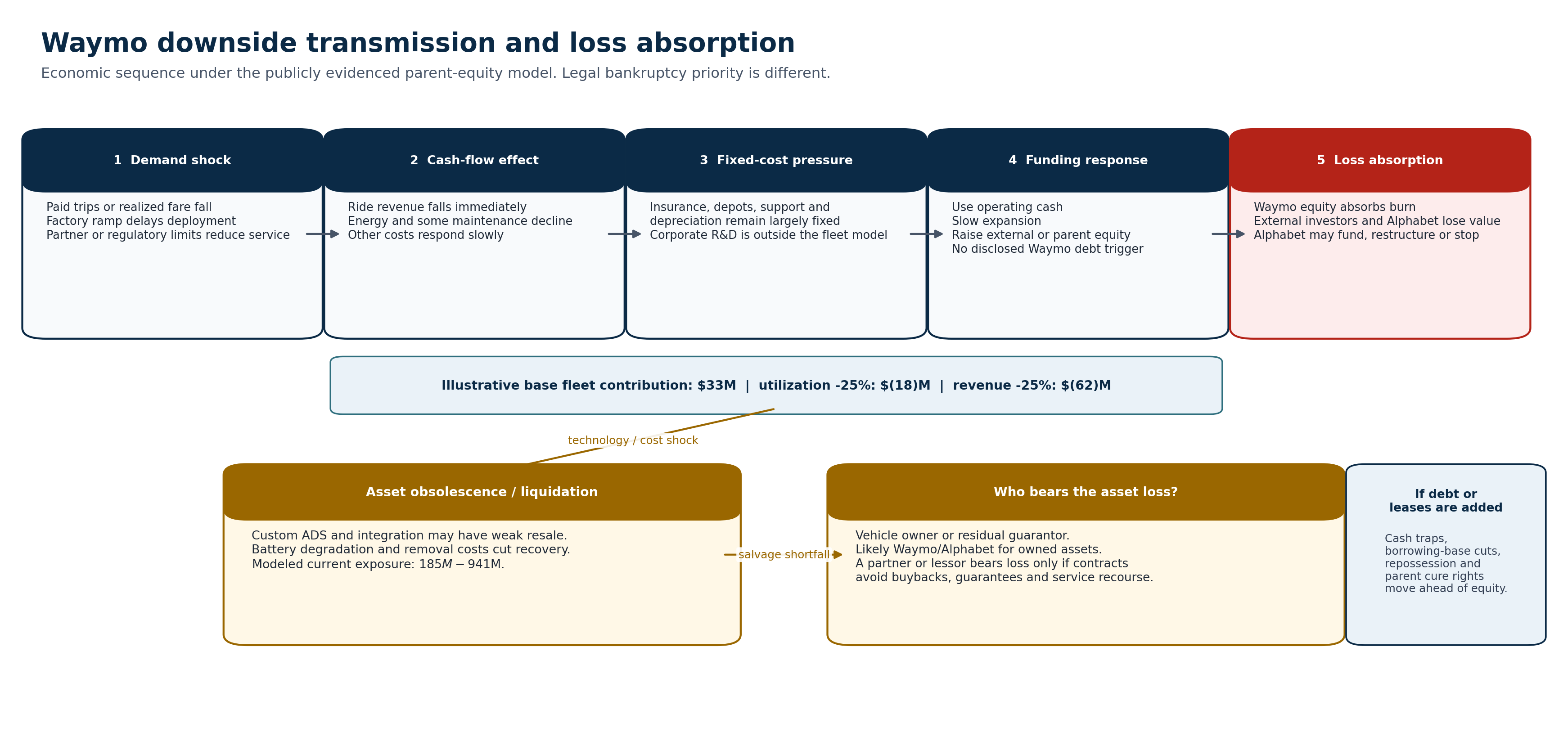
The base case earns $33.0 million after depreciation. Reducing utilization by 25% turns that into an $18.3 million loss. A separate 25% revenue shock produces a $61.5 million loss; raising asset cost and depreciation by 20% leaves $17.8 million of contribution.
The high-capital case has the most revenue and the largest loss: $543.4 million of recognized ride revenue but negative $268.9 million after depreciation. The scenario changes asset needs and costs as well as revenue. It illustrates why deploying a more expensive fleet can overwhelm the benefit of higher paid use.
That is the financial value of Alphabet’s patience. It can fund a period in which utilization and hardware cost are still being improved, with no disclosed fleet lender demanding that the base case already cover scheduled payments.
| Scenario | Paid-hour utilization | Recognized ride revenue | Contribution after depreciation | Contribution after 25% utilization shock |
|---|---|---|---|---|
| Low capital | 26.5% | $233.0M | $113.3M | $70.8M |
| Base | 33.8% | $377.9M | $33.0M | ($18.3M) |
| High capital | 39.2% | $543.4M | ($268.9M) | ($304.9M) |
- Demand shock
Paid trips or fares fall; factory delays or partner and regulatory limits reduce service.
- Cash-flow effect
Ride revenue falls immediately. Energy and some maintenance decline; other costs respond slowly.
- Fixed-cost pressure
Insurance, depots and support remain largely fixed. Depreciation persists; corporate R&D is outside this fleet model.
- Funding response
Use operating cash, slow expansion or raise equity. No Waymo debt trigger was disclosed in the record.
- Equity loss
Waymo equity absorbs burn; outside investors and Alphabet lose value. Alphabet may fund, restructure or stop.
- Base fleet contribution
- $33.0M
- 25% utilization shock
- −$18.3M
- 25% revenue shock
- −$61.5M
Custom autonomy hardware can have weak resale. Battery degradation and removal costs reduce recovery.
$185.3–940.5MModeled residual-value exposureLikely Waymo / Alphabet for owned assets. A partner or lessor bears loss only if contracts avoid buybacks, guarantees and service recourse.
Economic transmission differs from legal bankruptcy priority. Title, security and guarantees remain unresolved. If debt or leases are added, contracts can introduce cash traps, borrowing-base cuts, repossession and parent cure rights.
The base fleet barely covers an assumed loan
The workbook tests a loan that the reviewed record does not identify Waymo as having. Under its assumed financing terms, base fleet cash covers 0.94× annual debt service; a 25% utilization shock lowers coverage to 0.59×. Only the low-capital case produces comfortable modeled coverage.
The numerator deserves attention. Base recognized ride revenue of $377.91 million less $240.8328 million of modeled cash operating costs leaves $137.0772 million before depreciation. Against $145.299 million of assumed interest and principal, coverage is 0.9434×. The $104.1 million depreciation charge then explains the separate $32.9772 million contribution figure.
Adding back depreciation is correct for that year’s cash-service calculation. It does not cancel the eventual replacement bill, and subtracting it again from the cash numerator would count the same asset charge twice. Both views matter to a lender whose debt may remain after a hardware generation needs replacing.
The model also excludes corporate research, overhead and other standalone obligations. It is a fleet diagnostic, so even comfortable coverage in one scenario is narrower than cash available to shareholders. A real facility would need enforceable payments, eligible collateral and the agreement’s own coverage definition.
| Modeled scenario | Physical capital | Recognized ride revenue | Contribution after depreciation | Illustrative DSCR | DSCR after 25% utilization shock |
|---|---|---|---|---|---|
| Low capital | $380.0M | $233.0M | $113.3M | 3.59× | 2.55× |
| Base | $777.0M | $377.9M | $33.0M | 0.94× | 0.59× |
| High capital | $1.345B | $543.4M | ($268.9M) | (0.07×) | (0.16×) |
A second owner needs more than a working car
A standard vehicle has buyers beyond its first operator. An integrated autonomy kit can depend on proprietary software, calibration and regulatory approval. Its mechanical life may exceed the period in which that generation remains commercially useful.
The model’s residual exposures are $185.3 million, $448.8 million and $940.5 million in the low, base and high cases. These are modeled capital exposures after assumed recoveries, not liquidation quotes. Asset titles and partner agreements are needed to allocate them conclusively.
This limits a simple leasing solution. A lessor can own the car while requiring Waymo to guarantee the residual, maintain specialized equipment or cover return-condition costs. Moving title has financial value only to the extent that the other party accepts risk at an attractive price.
| Scenario | Physical-asset capital | Residual exposure | Core uncertainty |
|---|---|---|---|
| Low | $380.0M | $185.3M | Asset mix and recoverable standard-vehicle value |
| Base | $777.0M | $448.8M | Title, hardware reuse, and secondary-market depth |
| High | $1.345B | $940.5M | Large installed base with faster obsolescence or weak recovery |
A lessor would price the same obsolescence problem
A fleet lease could reduce Waymo’s first cash payment and organize replacement over time. In exchange, it would create rent due through weaker ride demand. The lessor would have to assess how readily the vehicles and their custom equipment could be sold or deployed elsewhere.
If that recovery case is weak, the protection can return through higher rent, a lower financed amount or residual guarantees. Software support and maintenance obligations also affect who can operate a repossessed vehicle. The apparent asset-light structure may leave the expensive part of the risk with Waymo.
The package quantifies no fleet lease schedule. Likely depot or property leases cannot answer the fleet question. I would need the vehicle owner, payment calendar, return conditions and guarantees before crediting a transfer of residual risk.
A frequent rider has not promised to fund the next car
Waymo’s customers pay for rides. In the reviewed record, they have made no identified fleet-funding prepayment or minimum-volume promise. Demand can be frequent and still be cancellable one trip at a time.
That is a weaker financing object than a customer contract that reserves capacity for years. An enterprise or network agreement with minimum revenue, deposits or termination payments could help fund assets before they earn retail fares, while imposing its own delivery, availability and refund obligations.
I would give that contract value when the payment commitment exists. A distribution partnership or high trip count alone leaves the next vehicle dependent on the operator’s cash and funding.
| Pathway | What funds the asset | Economic obligation | Status in supplied package |
|---|---|---|---|
| Retail ride payment | Cash paid after service | Complete the trip | Documented operating revenue; not fleet financing |
| Consumer deposit | Cash before future rides | Refund or future service | Not identified |
| Enterprise prepayment | Prepaid service block | Capacity and service-level delivery | Not identified |
| Minimum-volume contract | Committed recurring revenue | Availability, pricing, and performance terms | Not identified |
| Take-or-pay capacity | Payment for reserved capacity | Dedicated supply and termination protection | Not identified |
Permission supplies access, not an asset-funding check
California regulatory and safety records describe permission and oversight. The package identifies no quantified Waymo grant, public loan, guarantee or tax credit. Its documented lower bound is zero, with the unreported amount left unknown.
A public grant or loan could reduce initial cost or extend the repayment period, but the award and its conditions would determine the benefit. Jobs, eligible spending and clawbacks can return part of the obligation to the company. Road access alone supplies no such financing transfer.
| Mechanism | What it changes | Evidence needed | Package status |
|---|---|---|---|
| Operating permit or regulatory program | Legal ability to provide service | Authority, operating domain, reporting terms | Publicly evidenced |
| Grant | Reduces asset cost without scheduled repayment | Award, eligible spend, milestones, clawbacks | No quantified award identified |
| Government loan or guarantee | Lowers cost or extends tenor | Principal, security, guarantee, covenants | No quantified instrument identified |
| Tax credit or tax-equity structure | Monetizes eligible investment | Eligibility, transferability, recapture terms | No quantified value identified |
| Public purchase or capacity contract | Creates contracted demand | Volume, price, term, termination rights | Not identified |
Permission and paid service are separate from fleet funding. The Texas robotaxi service map distinguishes where a rider can actually book a trip from an announced operating footprint.
The next car needs a more repeatable funding source
Parent equity can finance the learning period. A more durable structure would let service cash repay the next deployment, give a lender collateral with value beyond Waymo, or bring a customer willing to commit to capacity before the car enters service.
Each path needs a different improvement. Better utilization supports collections; cheaper and more reusable hardware supports recovery; contractual demand supports underwriting. The existing funding record is strongest on Alphabet’s willingness, while the asset and operating documents that would substantiate the other paths remain missing.
I would judge progress by how much risk the next capital provider can independently price without relying on another large parent check. Until that changes, Waymo’s impressive access to equity finances the wait for scalable fleet economics.
| Archetype | What enables scale | Principal downside holder | Waymo fit from supplied evidence |
|---|---|---|---|
| Parent-funded platform | Parent balance sheet and strategic commitment | Parent and common equity | High |
| Leased-fleet operator | Reusable assets and lessor underwriting | Operator first; lessor on residual shortfall | Not established |
| SPV / asset-backed platform | Contracted cash flow and financeable collateral | SPV equity, then lender or guarantor | Not established |
| Customer-funded operator | Deposits, prepayments, or minimum volumes | Customer on deposit; operator on delivery recourse | Not established |
| Government-supported platform | Grant, guarantee, tax credit, or public contract | Shared; depends on clawback and guarantee terms | No quantified support identified |
| Partner-capital model | OEM, fleet, landlord, or network balance sheet | Partner or startup depending on recourse | Operational partners evidenced; financing transfer unclear |
Method and financing inventory
The report and downloadable workbook retain the evidence ledger and the assumed fleet scenarios. The inventory below records the financing channels considered, including those left unquantified. It describes their contractual mechanics, not offers available to Waymo.
The unresolved documents are consequential: vehicle titles and partner ownership agreements, lease and lien schedules, standalone operating accounts, and any guarantees. They would show whether an operating partner supplies services, capital or a legally enforceable backstop.
| Instrument | Capital provider | Repayment source | Principal advantage | Failure behavior | Waymo evidence in package |
|---|---|---|---|---|---|
| Equipment or finance lease | Bank, lessor, OEM captive | Fixed rentals from operating cash | Reduces upfront cash | Repossession plus deficiency or guarantor claim | No quantified facility identified |
| Operating lease | Property or equipment lessor | Straight-line rent | Flexibility and lower initial cash | Eviction or repossession; unpaid-rent claim | Depot or property leases likely; not quantified |
| Sale-leaseback | Asset buyer and lessor | Lease rentals | Monetizes installed assets | Lessor takes asset; operator may retain shortfall risk | Not identified |
| Venture debt | Bank or fund | Future equity, cash burn runway, revenue | Delays equity issuance | Acceleration and claim on company or IP | No facility identified |
| Asset-backed facility | Bank or ABS investors | Asset cash flow and liquidation proceeds | Scales with eligible collateral | Cash sweep, foreclosure, and possible parent cure | No facility identified; DSCR modeled counterfactually |
| SPV or project finance | Sponsor and project investors | Contracted project or fleet cash flow | Matches long-lived capital to assets | SPV equity wiped first; secured creditors follow | No asset SPV or project-finance structure identified |
| Customer prepayment | Customer | Future delivery or service | Funds production without lender priority | Refund and performance obligations | No fleet-funding deposits or prepayments identified |
| Government support | Public agency or tax investor | Project cash flow or policy compliance | Can lower cost and extend tenor | Clawback, political review, or guarantee claim | No quantified grant, loan, guarantee, or credit identified |
Alphabet is underwriting the learning period
I would underwrite Waymo’s hardware as a parent-funded deployment bet at this cutoff. Alphabet’s capital gives the company time to improve paid use and lower the cost of an autonomous mile. The next financing milestone would be a fleet whose collections and reusable assets support repeat investment without asking shareholders to absorb every miss. The reviewed record has yet to reach that milestone.
Sources
- Waymo — first external investment round (2020)
- Waymo — world-class investors financing update (2021)
- Waymo — $5.6 billion investment round (2024)
- Waymo — $16 billion investment round (2026)
- Alphabet 2024 Form 10-K
- Alphabet 2025 Form 10-K
- Alphabet Q2 2024 Form 10-Q
- Waymo response to Senator Markey
- Waymo Driver overview
- Waymo — sixth-generation Waymo Driver (2024)
- Waymo — sixth-generation production and Mesa update (2026)
- NHTSA preliminary evaluation PE25-013
- NHTSA recall report 25E-084
- Waymo rider and service FAQ
- Obi report — Waymo, Uber, and Lyft pricing
- Jaguar Land Rover — long-term Waymo partnership
- Reuters — Waymo, Moove, and London operations
- California Public Utilities Commission — autonomous vehicle programs
- California Public Utilities Commission — Waymo TCP filing
- Waymo — charging and green transportation
Supporting material
- Full research report
The complete 27-page report, including appendices, methodology, and selected source register.
- Editable report
The supplied editable document used as the source for this web edition.
- Hardware financing model
The 21-sheet assumption book, scenario model, dashboard, scorecard, and financing toolkit.
- Capital-stack figure
Full-resolution view of evidenced capital, modeled asset capital, and unresolved financing channels.
- Downside waterfall figure
Full-resolution utilization, asset-write-down, and residual-value downside illustration.