Where do online returns go?
A refund settles the customer’s claim. Freight, inspection, condition, and resale eligibility decide whether retrieving the product is worth the cost.
Sulayman Bowles · · Updated

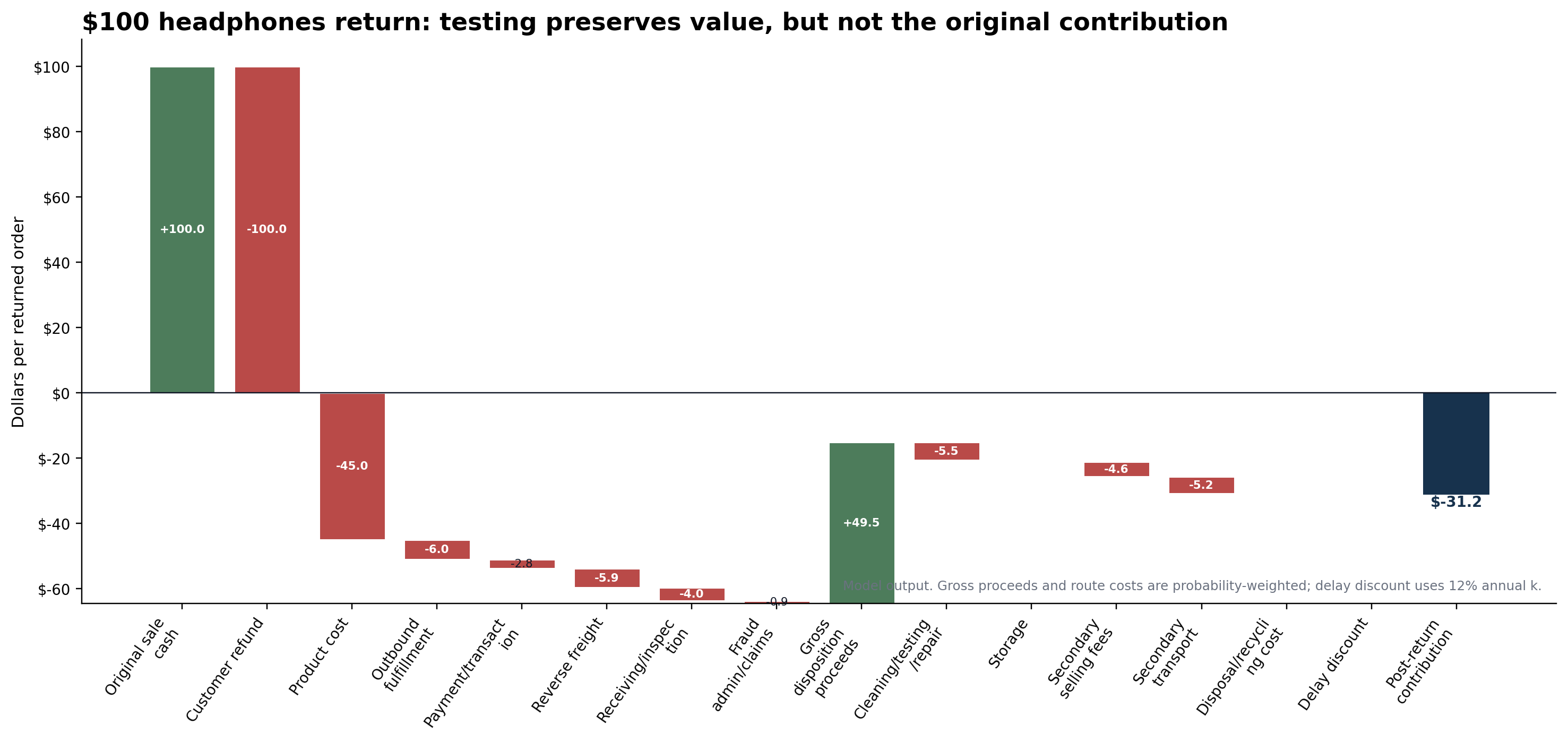
The modeled $100 headphones are worth retrieving: $33.37 of expected net disposition recovery exceeds $5.91 of weighted reverse freight, $4.00 of intake and inspection, and fraud administration by $22.56. Recovery still leaves a $77.44 return tax relative to the kept sale. Bringing the item back reduces the loss; it does not undo the return.
The refund and the product follow separate paths. Goods may be restocked, sold open-box or never retrieved. The headphones might be refunded before arrival, then consolidated, serial-matched, tested and cleaned. Inspection has to unlock enough resale value to cover the work.
At the same $100 price, packaging and testing leave the small appliance with $3.77 of retrieval value after fraud administration. Footwear retains $41.70 after fraud administration because it moves cheaply and can often be restocked or sold through an outlet. Price does not identify the best route.
Method & limits
Based on the July 22, 2026 investigation and reverse-logistics workbook; the underlying source ledger was not independently refreshed for this article. Product-level values are analytical scenarios, not disclosed retailer averages, forecasts, accounting measures or environmental disposition rates. The public auction sample contains two completed lots and is descriptive only.
The refund can happen without a physical return
Customer cash can move while merchandise stays put. Walmart sellers can set Keep It rules; Amazon offers returnless resolutions and liquidation programs. Marketplace policies can settle a claim without recovering the product.
Amazon reports a return-allowance liability separately from its asset for recovering products. Nike separates its sales-returns reserve from its inventory reserve. Refund obligations and returned-goods value are related, but distinct balances and events.
Inventory ownership determines exposure. An integrated retailer usually controls disposition; a marketplace may handle refunds and returns while its seller bears the loss. Vendor credits, consignment, carrier claims, insurance, and platform protections can reallocate loss without changing the customer experience.
| Record | What it measures | Typical decision owner | Common analytical error |
|---|---|---|---|
| Customer refund | Cash or credit returned to the buyer | Retailer, seller, or platform policy | Treating the refund as proof the product came back |
| Retailer exposure | Contribution after refund, costs, fees, and recovery | Inventory owner and contractual counterparties | Calling a unit model GAAP profit or loss |
| Physical recovery | Whether the correct item or material remains available | Return center, seller, retailer, or 3PL | Equating possession with resale eligibility |
| Environmental disposition | Reuse, donation, recycling, destruction, or an unobserved downstream route | Inventory owner and downstream processor | Counting liquidation transfer as proven reuse |
The best eligible route wins
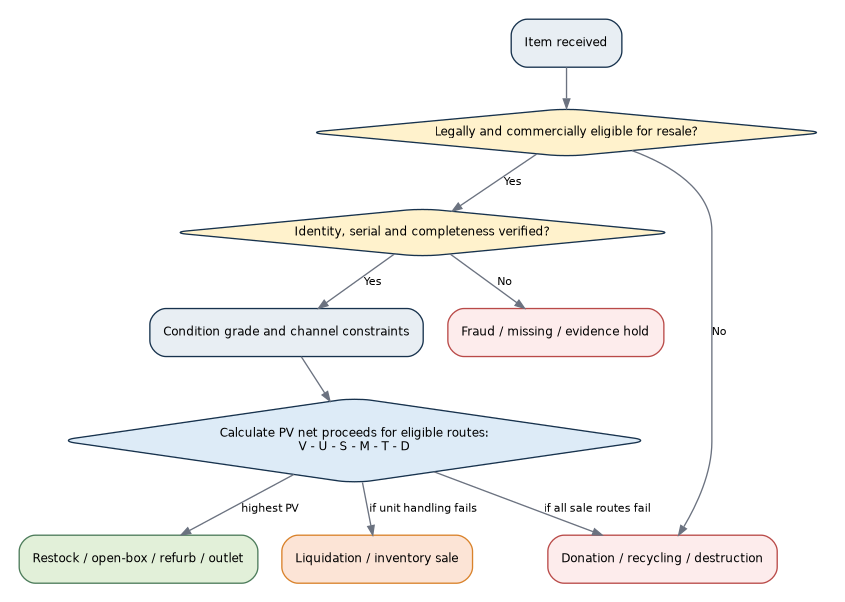
First compare expected disposition recovery with reverse freight, inspection, and fraud administration. If retrieval pays, choose the legally and commercially available route with the highest present-value net proceeds after cleaning, testing, storage, selling fees, secondary transport, disposal, and delay.
Condition changes both proceeds and eligibility. Unopened goods may support primary restock; lightly used devices, refurbishment. An opened cosmetic can retain material value but lose resale eligibility. A substituted laptop may have little legitimate recovery yet high evidentiary value.
Safety, recalls, identity, abuse prevention, customer service, brand restrictions, vendor agreements, and environmental duties can require possession or block an otherwise profitable route.
Inspection must earn its cost
Consolidation can lower freight and receiving costs while delaying resale. Inspection depends on the product: tags and wear for apparel, identity and function for electronics, seals for beauty. The extra work is valuable when it changes the route.
At the assumed labor rate, the $100 headphones support roughly 55 minutes of inspection before retrieval turns negative. The $20 household item cannot support even the two-minute base inspection under its weighted parcel route. Deeper inspection can pay when it opens a stronger resale channel.
Testing helps preserve $33.37 of expected headphone recovery. Refund, product cost, outbound fulfillment, freight, intake, fraud administration, secondary costs, and failed-unit risk nevertheless leave post-return contribution at negative $31.24.
Inspection earns the value of a better decision, not the whole resale price. Consider a separate hypothetical with equal chances of high and low grade. One eligible resale route nets $40 for high grade and $0 for low grade; an eligible liquidation route nets $10 in either state. Before learning the grade, resale has expected proceeds of $20. A perfect test lets the operator choose $40 for the high grade and $10 for the low, averaging $25.
The information is therefore worth at most $5 before its own cost. A $4 test adds $1 of expected value; a $6 test destroys $1, even though either fee is far below the item’s potential resale price. Common transport and intake costs are excluded from both alternatives in this illustration. Real tests are imperfect, so I would measure their errors and the routes they actually change before buying deeper inspection.
The same price buys very different logistics
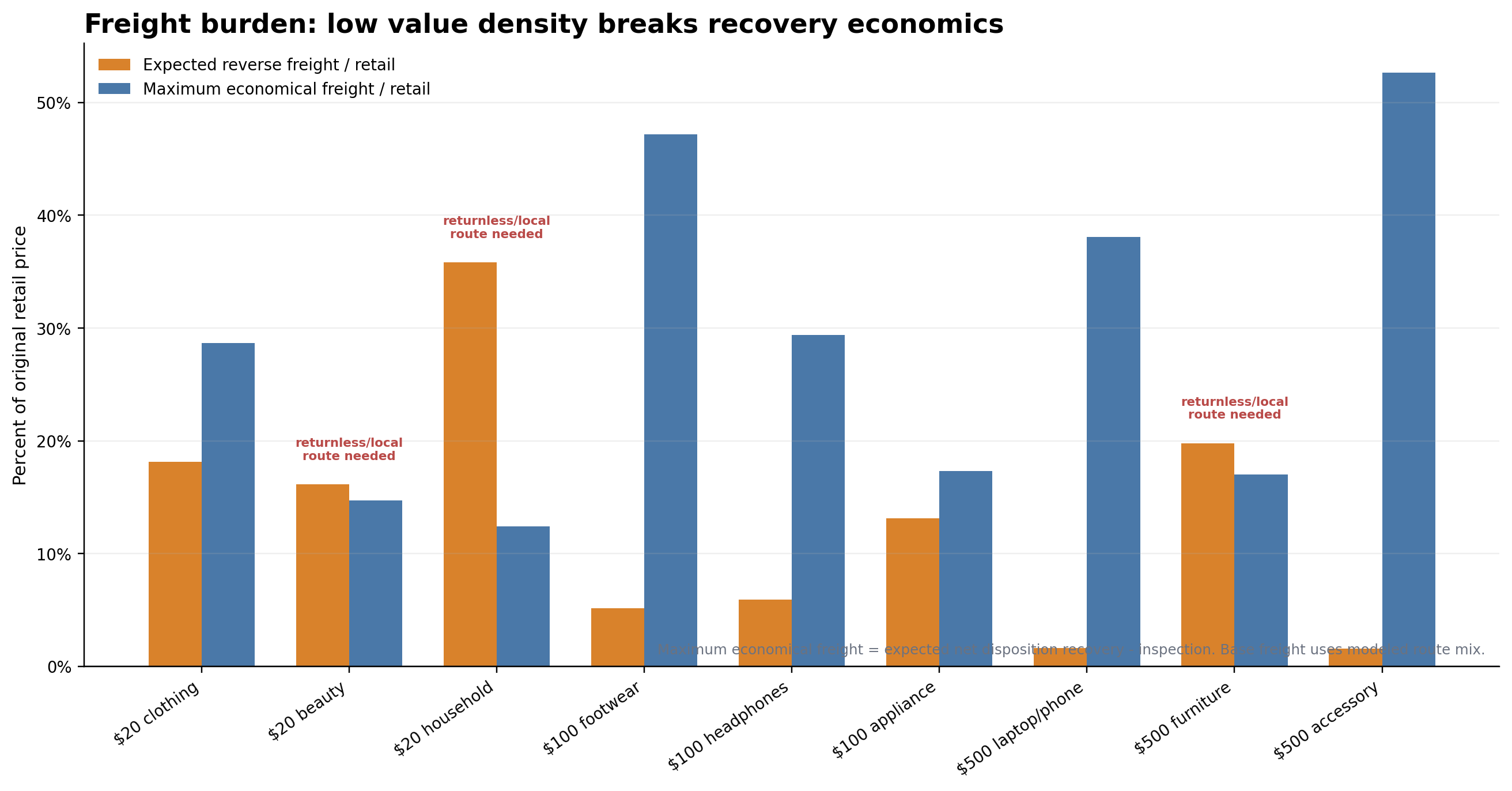
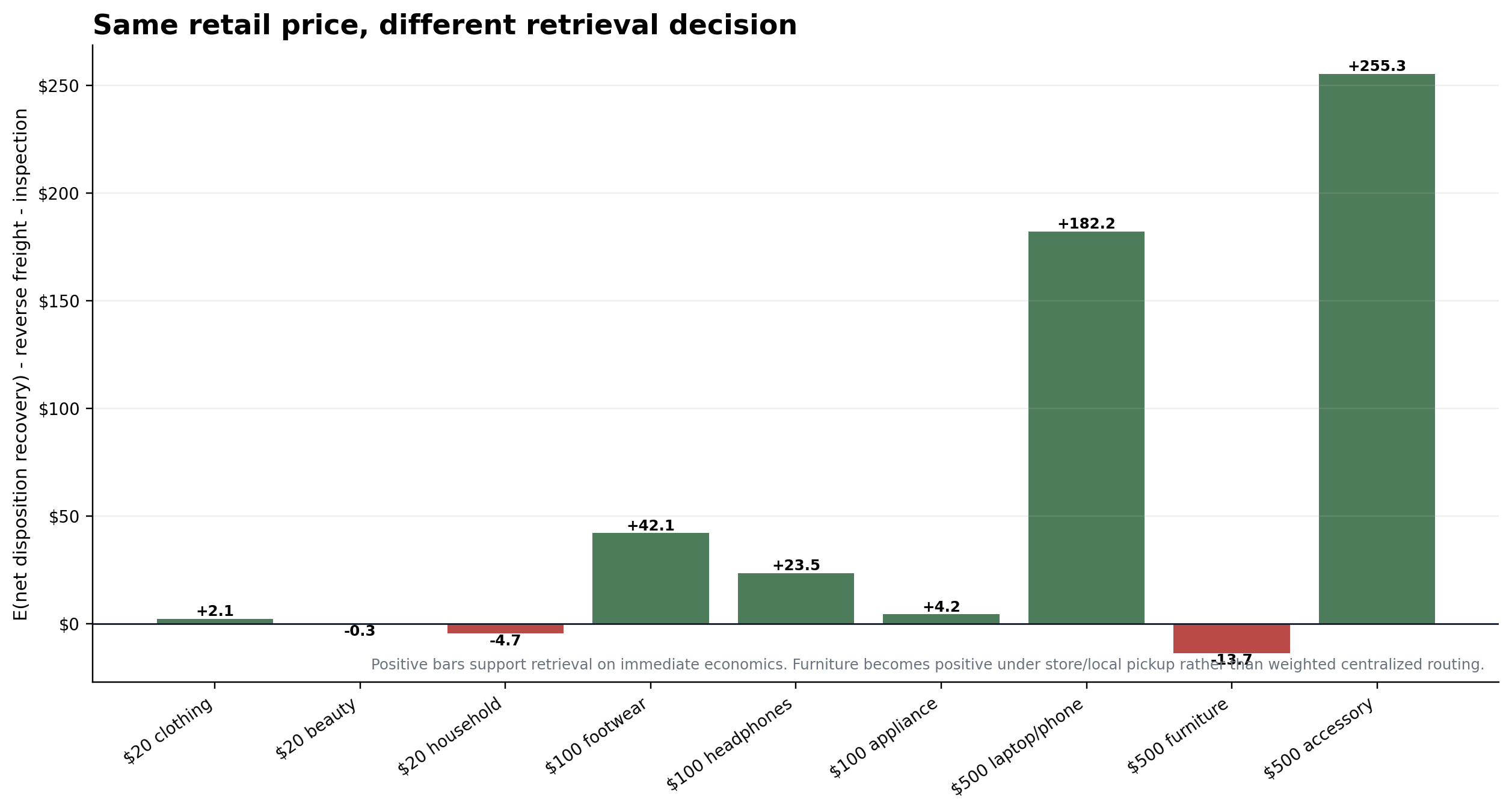
Holding price at $20, $100, or $500 exposes the effect of package geometry, condition, inspection, eligibility, fraud, and recovery. Store retrieval can work where parcel retrieval fails. Premium goods can incur a large return tax while retaining enough value to retrieve.
Return tax equals kept-sale contribution minus post-return contribution. Landed product cost, original fulfillment, and original payment expense appear on both sides and cancel from this incremental tax. They still determine the post-return loss and the share of kept-sale contribution consumed.
| Archetype | Price | Retrieval value after fraud admin | Return tax / returned order | Base operating decision |
|---|---|---|---|---|
| $20 clothing | $20 | $2.03 | $17.97 | Retrieve through store/drop-off; returnless for long parcel |
| $20 beauty | $20 | −$0.31 | $20.31 | Returnless for parcel; retrieve through store |
| $20 household | $20 | −$4.71 | $24.71 | Returnless for parcel; retrieve through store |
| $100 footwear | $100 | $41.70 | $58.30 | Retrieve |
| $100 headphones | $100 | $22.56 | $77.44 | Retrieve |
| $100 appliance | $100 | $3.77 | $96.23 | Retrieve; low-recovery case turns negative |
| $500 laptop/phone | $500 | $177.28 | $322.72 | Retrieve |
| $500 furniture | $500 | −$14.04 | $514.04 | Use store/local route; avoid centralized oversize |
| $500 accessory | $500 | $251.43 | $248.57 | Retrieve |
Bulky goods can retain value but fail parcel retrieval
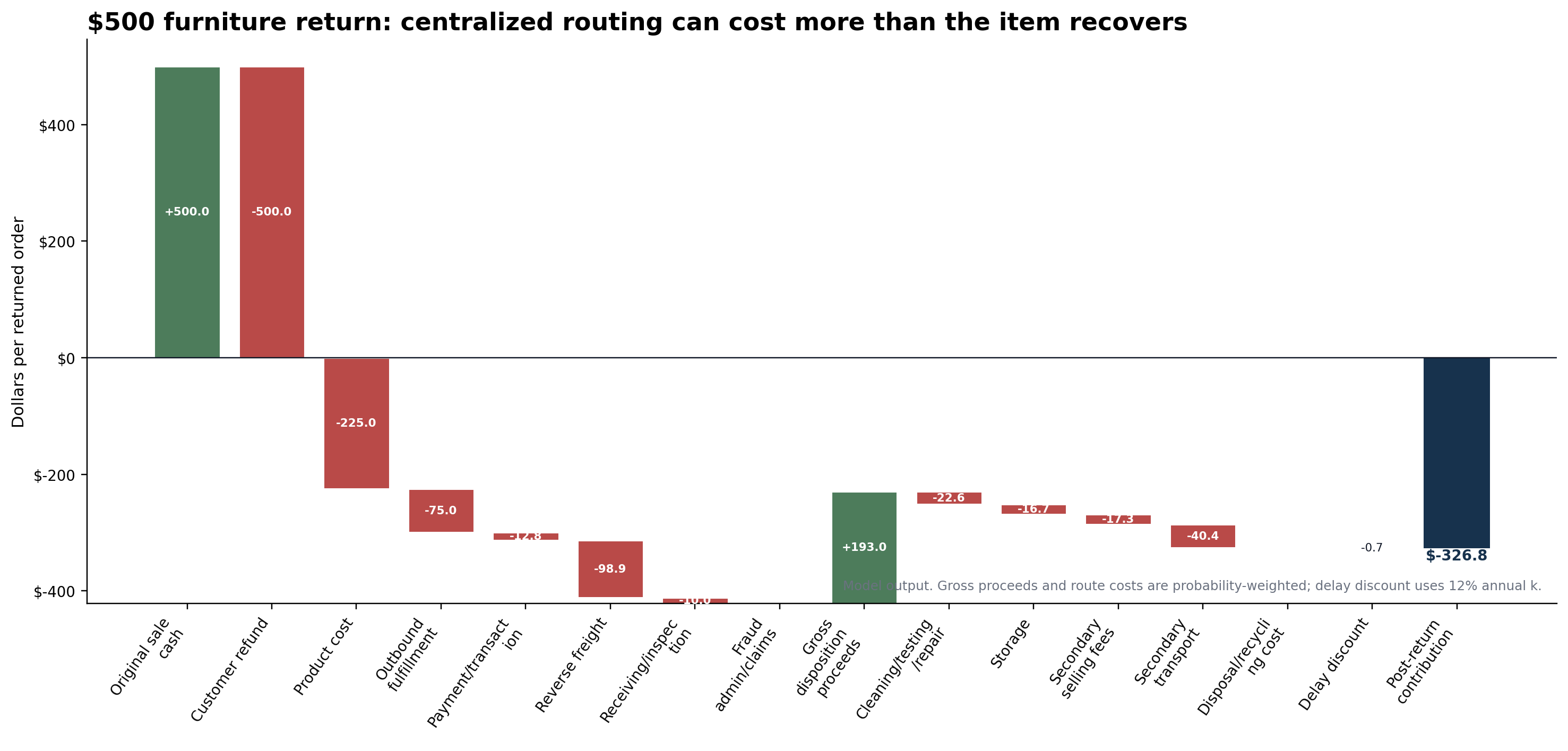
The modeled $500 furniture item has about $3.60 of retail value per billable pound, versus more than $71 for the $500 laptop or phone. Its 48 × 20 × 20 inch package produces 138 pounds of dimensional weight before rounding. Weighted reverse freight of $98.90 exceeds the $85.16 economical maximum.
Centralized retrieval is therefore negative; store intake, short-distance movement, and local pickup remain positive. The local-routing proxy breaks even at about 48 miles. The consumer value survives, but the network cannot move it cheaply enough.
At $20, beauty and household returns likewise can work through stores or consolidated drop-off while failing by parcel. Returnless refunds can reflect logistics rather than worthless products.
A liquidation bid leaves costs on both sides
Liquidation passes goods through wholesalers, local auctions and secondary sellers. A lot may mix customer returns with overstock or salvage, which changes what the buyer can recover.
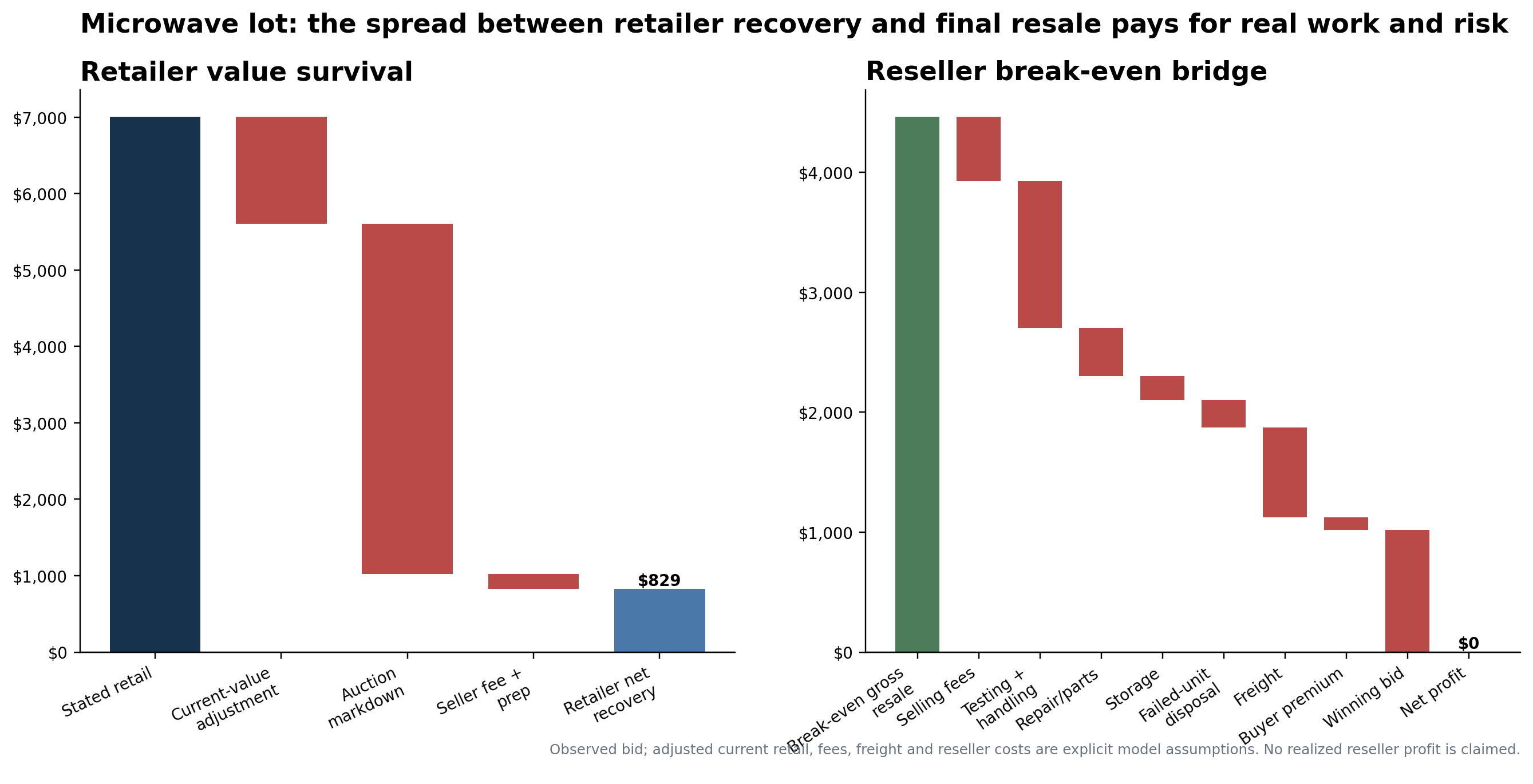
The winning bidder still has to bring the goods in, inspect them and sell what survives. Freight, repair, fees and another customer’s return sit between the bid and the margin. The original retailer has its own seller-side costs.
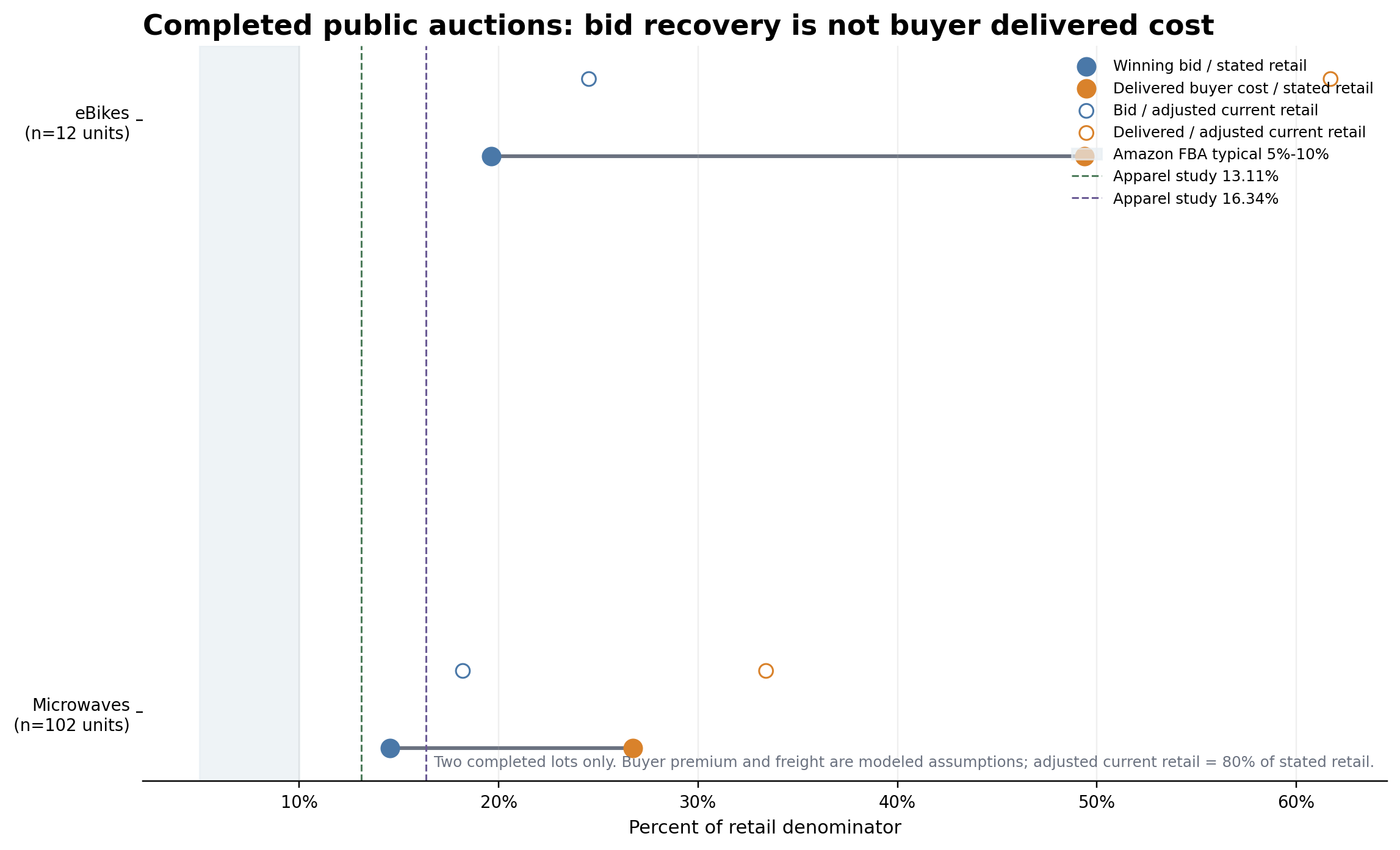
The sample contains two completed Walmart/B-Stock lots. The microwave lot implies a bid near 14.6% of stated retail; the eBike lot, about 19.6%. Assumed buyer premiums and freight raise delivered cost to 26.7% and 49.4%; estimated retailer recovery after seller-side fees and preparation is roughly 10% to 12%. These lots do not estimate the market.
A sale and its eventual retained economics are separate events. The Crocs model connects brand demand, channel costs and the cash left for shareholders.
A fraud control has to pay for the harm it causes
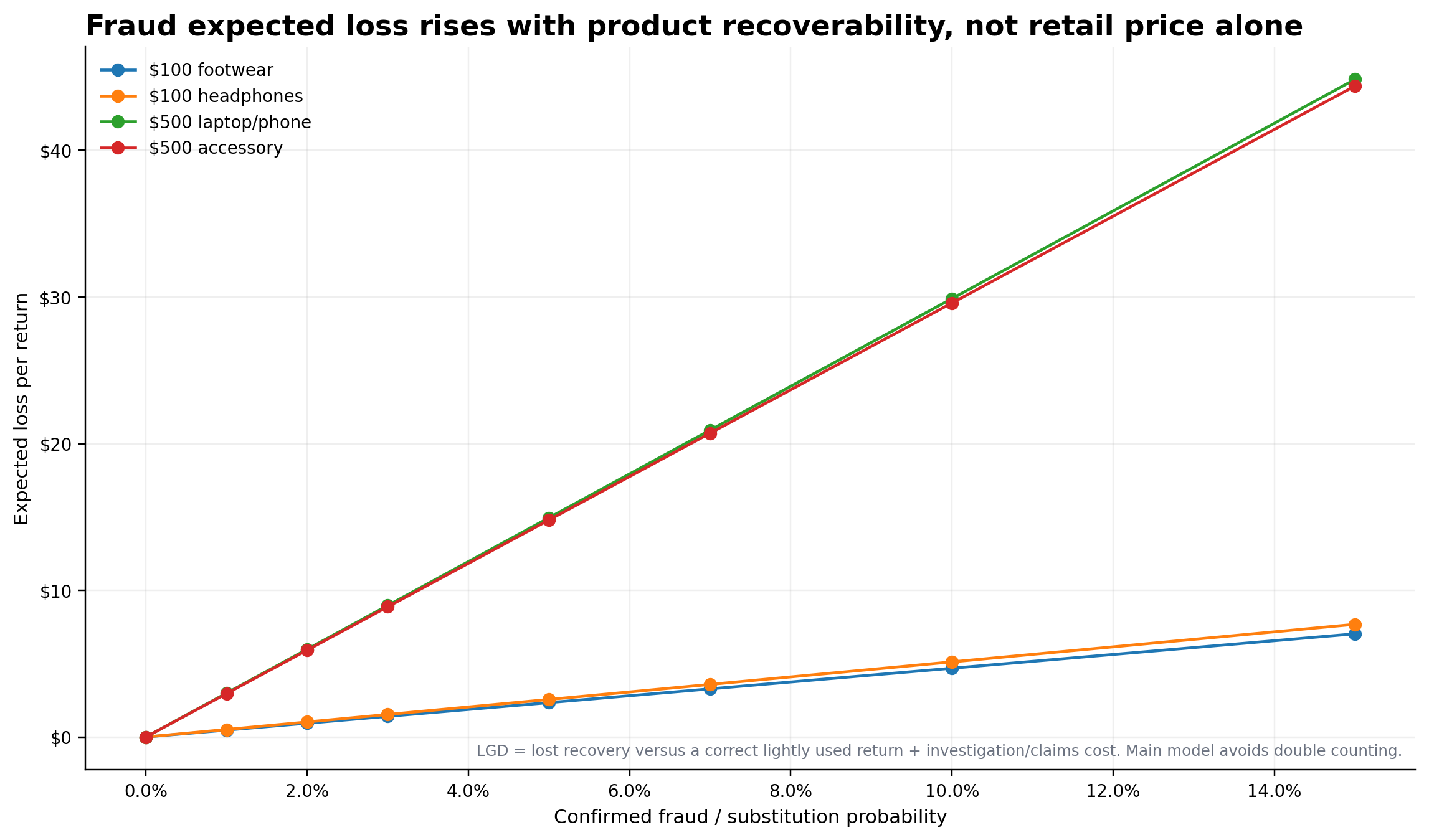
Substituted or missing goods receive zero legitimate recovery through the condition probabilities. The separate administration allowance covers only added investigation and claims work, avoiding a second charge for the lost product.
The illustrative control adds inspection, false-positive customer-service cost, and refund delay. It loses money on $100 footwear and headphones but pays on $500 electronics and accessories, where substitution destroys more value.
The assumed fraud rates let the model test how recoverable value, identity risk and customer harm change the decision. I would calibrate those inputs from the goods and claims the operator actually sees.
A sale to the next owner leaves reuse unobserved
Sustainability claims need denominators and endpoints. Resale or donation counts can establish scale without revealing their share of returns, third-party inventory, or all network intake. “Proper disposal” need not distinguish recycling, hazardous handling, incineration, energy recovery, and landfill.
Liquidation establishes a sale to the next owner. That buyer may resell, repair, export, harvest parts, recycle, or discard the goods. Without observing the next step, the transfer cannot be counted automatically as reuse.
The model separates direct resale or reuse, downstream-unobserved liquidation, donation, recycling or material recovery, destruction or disposal, and fraudulent or missing units. These are scenario routes, not measured retailer diversion rates.
Modeled routes, not measured environmental outcomes.
- Direct resale/reuse
- Liquidation transfer (downstream unobserved)
- Donation
- Recycling/material recovery
- Direct destruction/disposal
- Fraudulent/missing/not physically recovered
- Clothing$20
- Resale / reuse 83%
- Liquidation 8%
- Disposal 7%
- Unrecovered 2%
- Beauty$20
- Resale / reuse 32%
- Disposal 67%
- Unrecovered 1%
- Household$20
- Resale / reuse 78%
- Liquidation 8%
- Disposal 13%
- Unrecovered 1%
- Footwear$100
- Resale / reuse 88%
- Recycling 9%
- Unrecovered 3%
- Headphones$100
- Resale / reuse 83%
- Recycling 12%
- Unrecovered 5%
- Appliance$100
- Resale / reuse 67%
- Liquidation 15%
- Recycling 15%
- Unrecovered 3%
- Laptop / phone$500
- Resale / reuse 84%
- Recycling 9%
- Unrecovered 7%
- Furniture$500
- Resale / reuse 82%
- Donation 17%
- Unrecovered 1%
- Accessory$500
- Resale / reuse 84%
- Recycling 9%
- Unrecovered 7%
Inside the decision model
Nine product archetypes and seven condition states feed the workbook’s present-value engine. It compares store intake, parcel routes and other retrieval designs, then varies the costs and recovery assumptions that change the preferred route.
The workbook preserves inputs, formulas, evidence and fact checks. Its two completed auction lots give concrete secondary-market examples; negotiated merchant terms and observed downstream use would be needed to turn the model into a retailer’s operating record.
The route has to earn the recovery
I would retrieve the headphones because the modeled recovery pays for the work. I would ask a second question before claiming an environmental benefit: what happened to the item after the next buyer took it? The resale invoice closes one transaction and opens that inquiry.
Sources
- Amazon 2025 Form 10-K — return liability and recovery asset
Verified Jul 22, 2026
- Walmart Marketplace — Add a Keep It Rule
Verified Jul 22, 2026
- Target — current Reverse Logistics Expert role description (replacement for expired listing)
Verified Jul 22, 2026
Access rechecked October 19, 2026. The original vacancy expired. This current posting describes the same reverse-logistics role; it is a replacement for the July 2026 listing.
- eBay — Refunding buyers
Verified Jul 22, 2026
- Ulta Beauty — returns and returned-merchandise disposition
Verified Jul 22, 2026
- Best Buy — return and exchange policy
Verified Jul 22, 2026
- Wayfair 2025 Form 10-K — bulky-product handling and returns risk
Verified Jul 22, 2026
- FDA — cosmetics and U.S. law
Verified Jul 22, 2026
- UPS — shipping dimensions and weight
Verified Jul 22, 2026
- Walmart Fulfillment Services fee schedule
Verified Jul 22, 2026
- UPS 2026 daily rates
Verified Jul 22, 2026
- FedEx 2026 Service Guide
Verified Jul 22, 2026
- CPSC — stop online sale of recalled products
Verified Jul 22, 2026
- Amazon 2024 Sustainability Report
Verified Jul 22, 2026
- Online-auction field study of end-of-life apparel inventory
Verified Jul 22, 2026
- Amazon seller communication — FBA Liquidations typical recovery
Verified Jul 22, 2026
- B-Stock Walmart eBikes lot 150245
Verified Jul 22, 2026
- B-Stock Walmart microwaves lot 150184
Verified Jul 22, 2026
- Liquidation.com terms and conditions
Verified Jul 22, 2026
- Amazon U.S. Liquidation Auctions shipping terms
Verified Jul 22, 2026
Supporting material
- Full reverse-logistics investigation
The complete 49-page report with the investigative article, methodology, model appendix, evidence register, limitations, and source ledger.
- Editable investigation
The supplied editable report used as the source document for this web edition.
- Reverse-logistics tax model
The 36-sheet model covering product assumptions, route engines, unit economics, thresholds, fraud, sustainability, auctions, and sensitivities.
- Retrieval-decision chart
A downloadable chart showing when expected recovery supports retrieving a returned product instead of issuing a returnless refund.
Source access notes
Checked . These notes distinguish recovered documents, replacement sources and unavailable originals. The investigation retains its original evidence dates.
Target — reverse logistics role
The original vacancy expired. This current posting describes the same reverse-logistics role; it is a replacement for the July 2026 listing.
The original citation was unavailable at this access check.