How airlines borrow against loyalty programs.
Bank payments reach the airline before many awards are redeemed. Contracts and controlled accounts determine how lenders can claim that cash.
Sulayman Bowles · · Updated

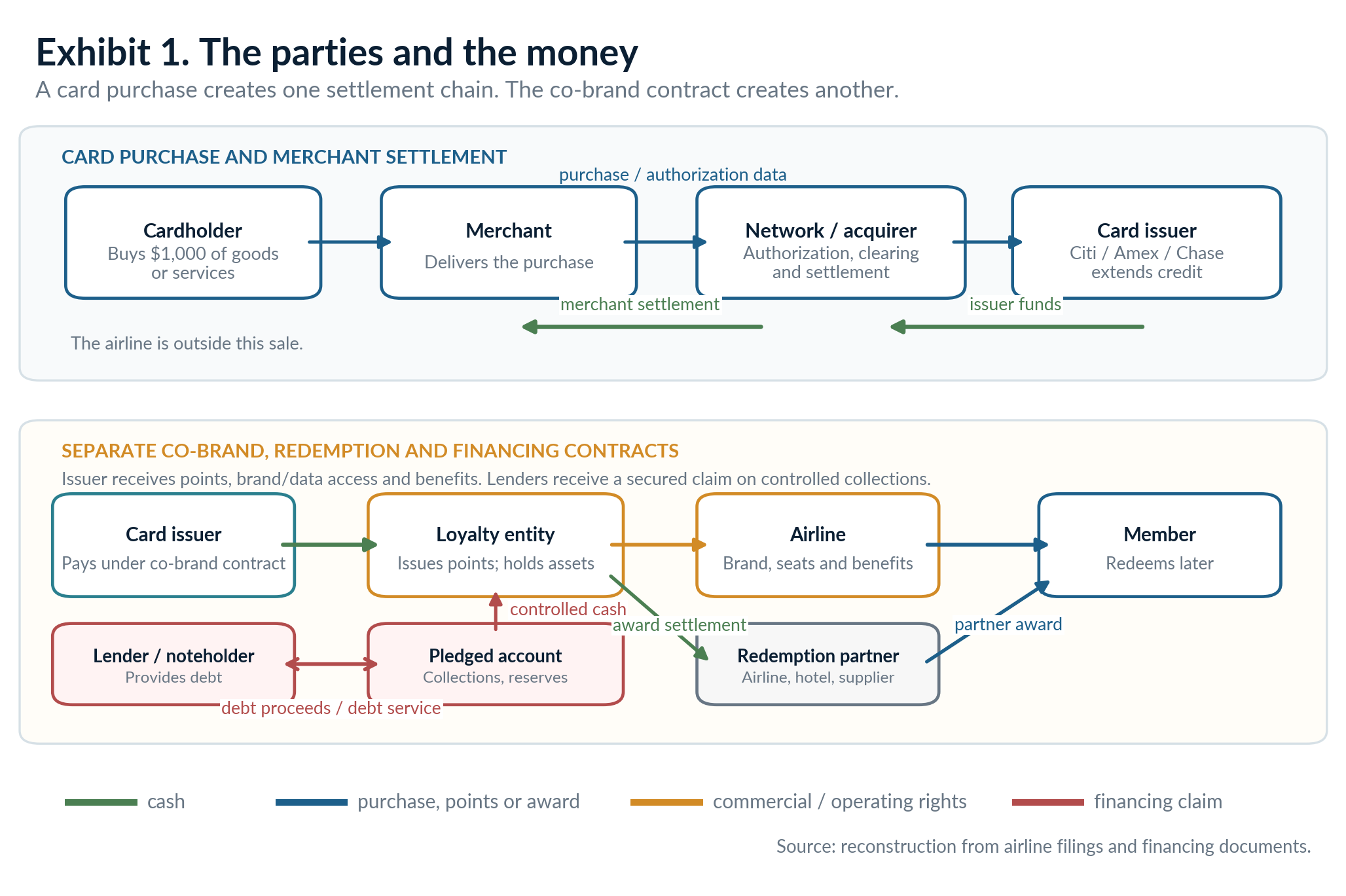
A $1,000 hotel charge on an AAdvantage card pays the hotel through the card network. The bank buys miles from American in a second transaction. I follow that second payment: it can reach the airline well before the member flies, and a lender can claim it before the airline spends it.
That structure works across mismatched cash clocks. Bank cash can arrive within weeks, while awards may be claimed years later or never. Debt service and reserves can be trapped before excess collections reach the airline.
American AAdvantage anchors the comparison with Delta SkyMiles, United MileagePlus and Air Canada Aeroplan. The payment timing makes these programs unusually financeable. The contracts decide how much of the cash remains available to the airline.
Method & limits
Based on the July 23, 2026 investigation, with the collateral companion’s separately dated filing evidence retained. Sources were not independently refreshed for this edit. Reported, derived, estimated, management-defined and pro forma values keep their labels. Point prices, allocations, redemption costs and valuation ranges are analytical estimates. Stress cases use stated assumptions and do not reconstruct contractual covenants or appraised recovery values.
A card purchase and a mile sale are separate transactions
A $1,000 hotel purchase on an AAdvantage card settles among the cardholder, merchant, acquirer, network, and issuer—not American. Separately, the issuer calculates the account’s miles and pays the airline or loyalty vehicle under the co-brand agreement.
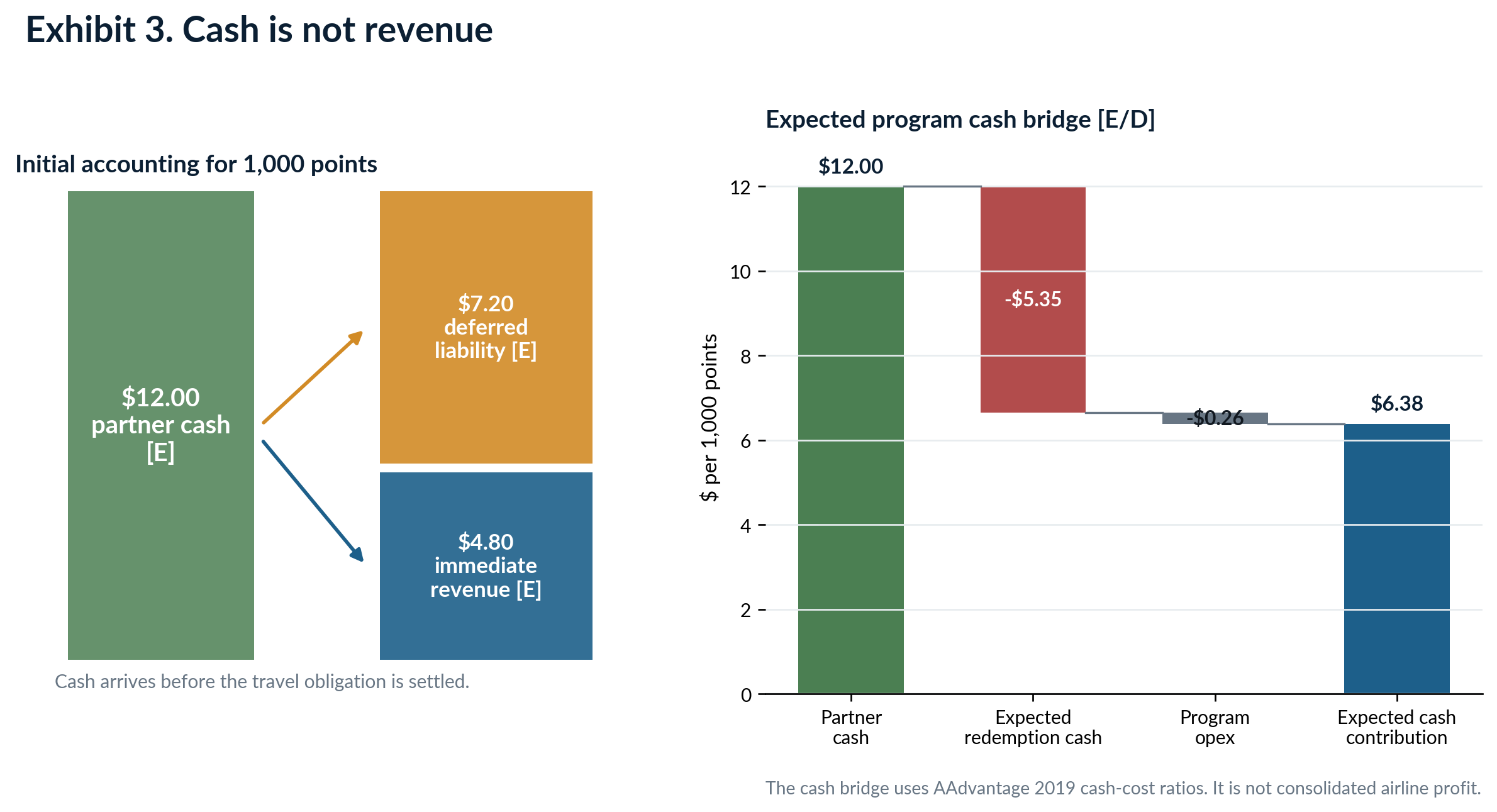
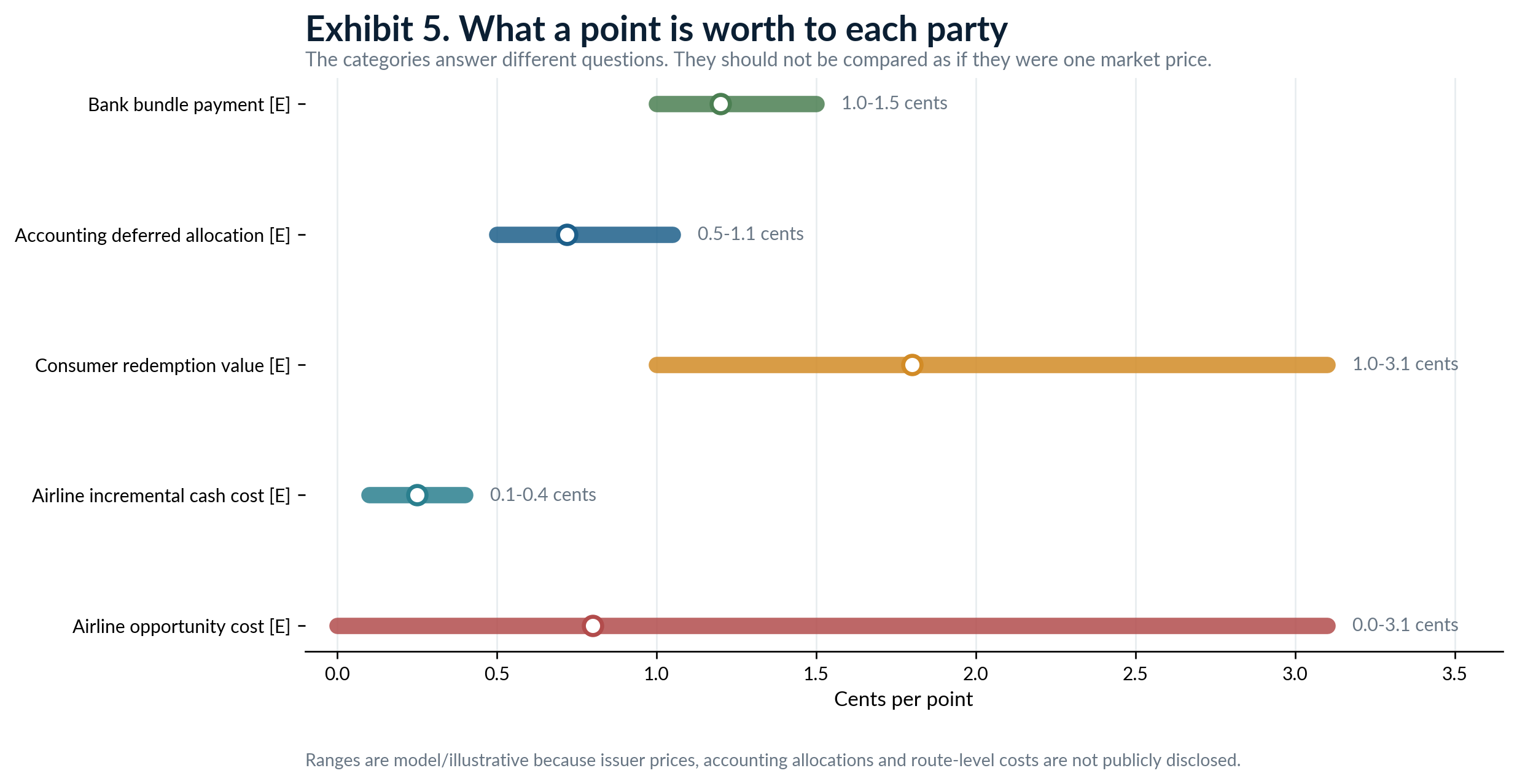
The model assumes 1,000 points yield $12 of partner cash, or 1.2 cents per point. Filings disclose the bundle and settlement cadence, but not the net point price at the report cutoff after fixed payments, benefits, volume terms, and other contract economics.
The member receives 1,000 miles; the issuer incurs a reward cost and gains a retention asset. The airline receives cash with current performance obligations and a future award claim. A secured lender may receive the same cash in a pledged account. These clocks remain separate.
1,000 points · Base-model estimates; issuer prices and contract allocation are not publicly disclosed.
- Day 0
- Cash
- Card purchase; no airline cash.
- Accounting
- No airline entry.
- Fulfillment
- 1,000 points post to the member.
- Financing
- No lender event.
- Month +1
- Cash
- Issuer pays about $12.Estimated
- Accounting
- $4.80 current revenue; $7.20 contract liability.Estimated
- Fulfillment
- No travel yet.
- Financing
- Cash may enter a pledged account.
- Years 0–2
- Cash
- Cash is held or deployed.
- Accounting
- Award liability remains outstanding.
- Fulfillment
- Expected wait about 1.7 years, conditional on redemption.Estimated
- Financing
- Debt service and reserves come first within the pledged cash waterfall.
- Resolution
- Cash
- No new issuer cash; fulfillment costs can arise.
- Accounting
- Passenger / other revenue or proportional breakage recognition.
- Fulfillment
- Airline flight, partner award or never redeemed.
- Financing
- Excess cash release or early amortization, per financing terms.
Card spending, partner payment, revenue recognition, award delivery and lender collections are separate events. The contract liability usually settles through service; it is not a conventional loan. Breakage estimates nonredemption rather than legal expiration.
The issuer buys more than the award mile
Co-brand agreements bundle miles with brand rights, customer access, card acquisition, exclusivity, marketing inventory, airport and in-flight placements, and benefits such as checked bags, priority boarding, upgrades, and lounge access. Points measure the bundle; they are not the whole product.
The modeled $12 payment for 1,000 points bundles brand access, acquisition, benefits, data, and the award obligation. Public filings identify those components but do not isolate the net bank price per mile at the report cutoff.
Monthly point sales also differ from partner prepayments. Aeroplan’s acquisition materials disclosed C$1.212 billion of deferred partner consideration for long-term agreements and C$400 million of bank prepayments against future mile purchases: future participation and services versus purchase credits.
| Mechanism | What creates cash today | Accounting | Provider claim |
|---|---|---|---|
| Operating float | Recurring point sales and co-brand consideration | Current revenue plus contract liability | Commercial rights; no principal-and-interest claim |
| Explicit partner prepayment | Upfront renewal, exclusivity, transition, or future-purchase money | Deferred and amortized or applied against later purchases | Future services or contractual purchase credits |
| Loyalty-backed debt | Loan or note proceeds | Financial debt with interest, maturity, and covenants | Liens on contracts, IP, accounts, reserves, and SPV equity |
Receipt, recognition, and redemption happen at different times
The model allocates the $12 receipt for 1,000 points 40% to current marketing and benefits and 60% to future awards: $4.80 of revenue and $7.20 of contract liability. This split is estimated. Filings disclose relative-standalone-selling-price methods, expected redemption, equivalent-ticket values, breakage, and brand valuation inputs—not the contract-specific allocation at the report cutoff.
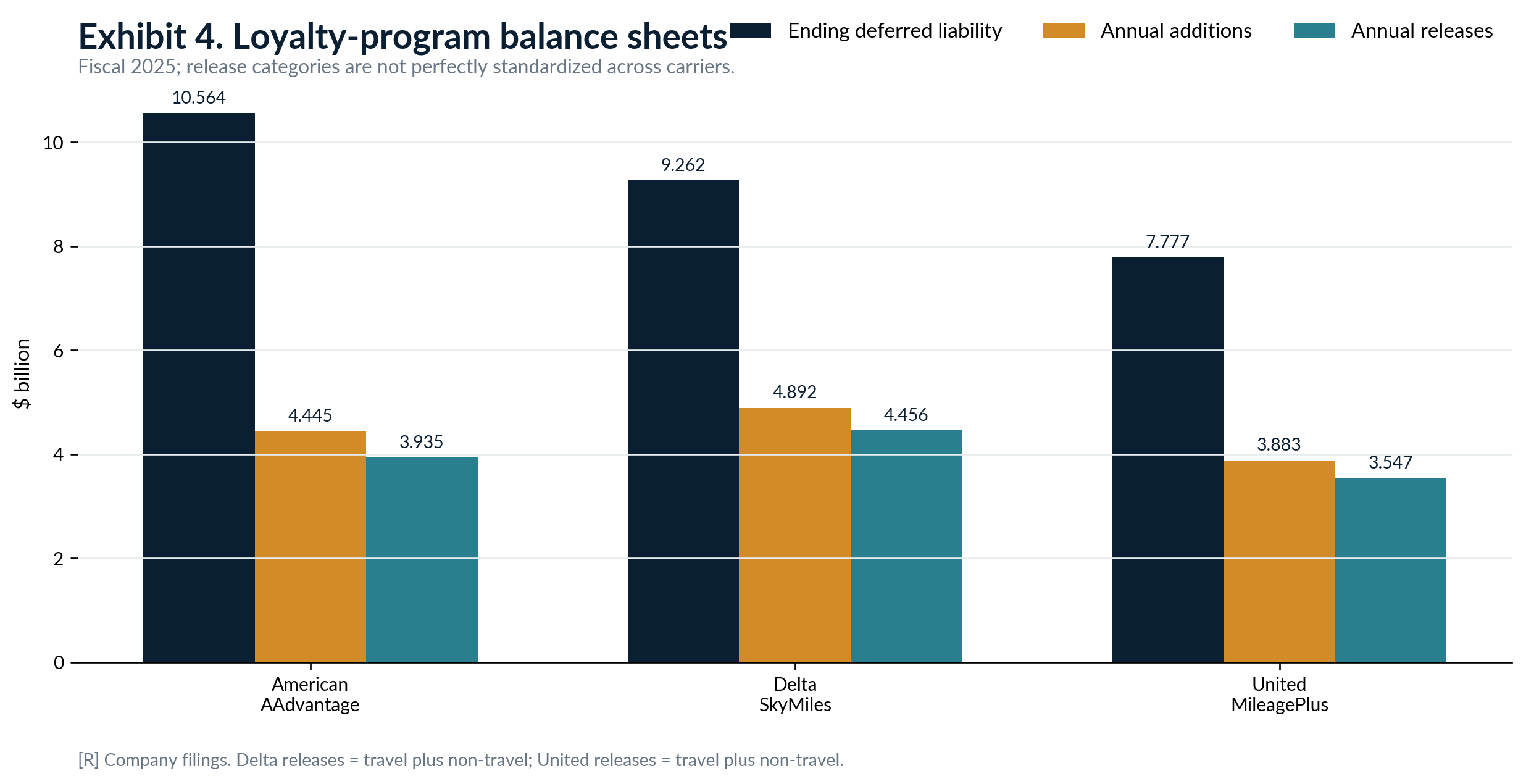
American reported $6.2 billion of 2025 co-brand and other partner cash. Loyalty-liability additions were $4.445 billion, releases $3.935 billion, and the ending balance $10.564 billion. Marketing-services revenue was $3.511 billion; loyalty travel revenue, including prior-cohort releases, was $4.036 billion. These figures are not interchangeable.
Delta and United show the same timing mismatch. A contract liability measures consideration allocated to future performance, not expected award cash cost. It normally settles through service, with no conventional coupon or principal maturity.
| Program | Ending liability | Annual additions | Annual releases | Current / partner-related revenue |
|---|---|---|---|---|
| American AAdvantage | $10.564B | $4.445B | $3.935B | $3.511B marketing services; $4.036B loyalty travel |
| Delta SkyMiles | $9.262B | $4.892B | $4.456B total | $3.362B other-revenue loyalty; $4.237B award travel |
| United MileagePlus | $7.777B | $3.883B | $3.547B total | $3.2B marketing, advertising, non-travel, and benefits |
Award delay creates float, with redemption risk
The issuance-to-redemption delay creates operating float. Delta and United say most new miles are redeemed within two years. The cohort model assigns 25% to Year 0, 35% to Year 1, 20% to Year 2, 8% later, and 12% to expected breakage. Those percentages do not specify a mean waiting time: the later bucket and placement within annual intervals need timing assumptions. I would model redemptions by date alongside partner collections before estimating how long that cash can fund operations.
Breakage estimates nonredemption, not legal expiration; even a no-expiration program can recognize it proportionally from account behavior and expected redemption. Longer waits extend cash use. A confidence shock can reverse that benefit with a redemption wave during weak partner spending or constrained seat inventory.
Bank bundle price, accounting allocation, member avoided fare, airline incremental cash cost, and displaced-passenger opportunity cost can differ by multiples. An empty off-peak seat can cost little incremental cash; a scarce premium award can displace thousands of dollars of fare contribution.
Pledged collections pass through the lender waterfall
Secured debt adds a legal claim to operating float. American and United placed loyalty rights and payment paths in bankruptcy-remote structures, contributed or licensed IP and data rights, pledged collection and reserve accounts, and protected partner and intercompany agreements.
American targeted direct deposit of at least 90% of quarterly AAdvantage revenue, with off-account receipts swept in. Fees, interest, required principal, and reserves preceded releases to the airline. Coverage or reserve failures could trigger early amortization and faster cash trapping.
Defined collections, contracts, accounts, IP, reserves, and SPV equity give lenders claims they can enforce. Those controls may protect cash during restructuring; they do not detach the program from the airline’s routes, seats, employees, airports, or brand experience.
A simple hypothetical shows why gross collections are an incomplete comfort. Suppose $100 reaches a controlled account, with $30 required for current delivery, $10 for other senior operating payments and $20 for a reserve. That leaves $40 before an assumed $50 of debt service: 0.8 times on that available-cash definition, although gross collections are twice debt service. The figures are illustrative and do not reconstruct an AAdvantage covenant.
Actual financing documents determine the payment priority, eligible receipts, coverage tests and reserve releases. I would calculate their contractual measure and a separate parent-distribution bridge from the same receipts. A reserve draw can support debt service without producing repeatable excess cash, and a high gross receipt ratio can coexist with a trapped account. Neither the miles balance nor the partner-cash headline resolves those claims.
American’s September 2021 filing describes commercially reasonable efforts to direct at least 90% of specified quarterly receipts into the collections account. I treat that as the documented routing obligation; actual compliance and the cash left for equity require the period’s account and waterfall records. Filed structure.
Exhibit 6. Loyalty-backed financing structures
American and United used the same core design: isolate assets, direct collections, service debt, then release excess cash.
American AAdvantage
Co-brand + intercompany agreements
IP, data, licenses, SPV equity
Pledged collection account
90% direct-deposit target
Waterfall
fees -> interest -> principal -> reserve
Excess cash to airline
unless DSCR / reserve trigger
- 2021: $10.0bn financing [R]
- 2025: +$1.0bn term loan [R]
- Peak DSCR test: 2.0x [R]
- Status: active at March 31, 2026 [R]
United MileagePlus
Co-brand + intercompany agreements
Contributed IP, member data, license-back
Revenue / collection accounts
90% collections; daily sweep
Waterfall
fees -> interest -> principal -> reserve
Excess cash to United
unless DSCR / reserve trigger
- 2020: $6.8bn financing [R]
- Peak DSCR test: 2.0x [R]
- Term loan repaid July 2024 [R]
- Notes redeemed July 2025 [R]
American retained loyalty debt; United repaid it
American raised $10.0 billion in 2021: $3.5 billion of 5.50% notes, $3.0 billion of 5.75% notes, and a $3.5 billion term loan. A $1.0 billion incremental term loan followed in 2025. Disclosed balances across the two note series and two loans totaled about $6.543 billion at March 31, 2026.
United raised $6.8 billion in 2020: $3.8 billion of 6.50% notes and a $3.0 billion term loan. It prepaid the loan in July 2024 and redeemed the remaining $1.52 billion of notes in July 2025, ending that debt’s claim on MileagePlus assets.
Partner cash and card spending proved more resilient than flying during the pandemic; legal controls limited leakage. Borrowing capacity establishes what designated cash flows supported under reserves and covenants, not the program’s value.
| Program | Initial financing | Core controls | Status in supplied evidence |
|---|---|---|---|
| American AAdvantage | $10.0B in 2021; $1.0B incremental term loan in 2025 | ≥90% direct-deposit target; collection and reserve accounts; coverage test up to 2.0× | Approximately $6.543B visible at March 31, 2026 |
| United MileagePlus | $6.8B in 2020 | 90% collections; daily sweep; coverage test up to 2.0×; intercompany restrictions | Term loan repaid July 2024; remaining notes redeemed July 2025 |
Program value and debt capacity use different claims
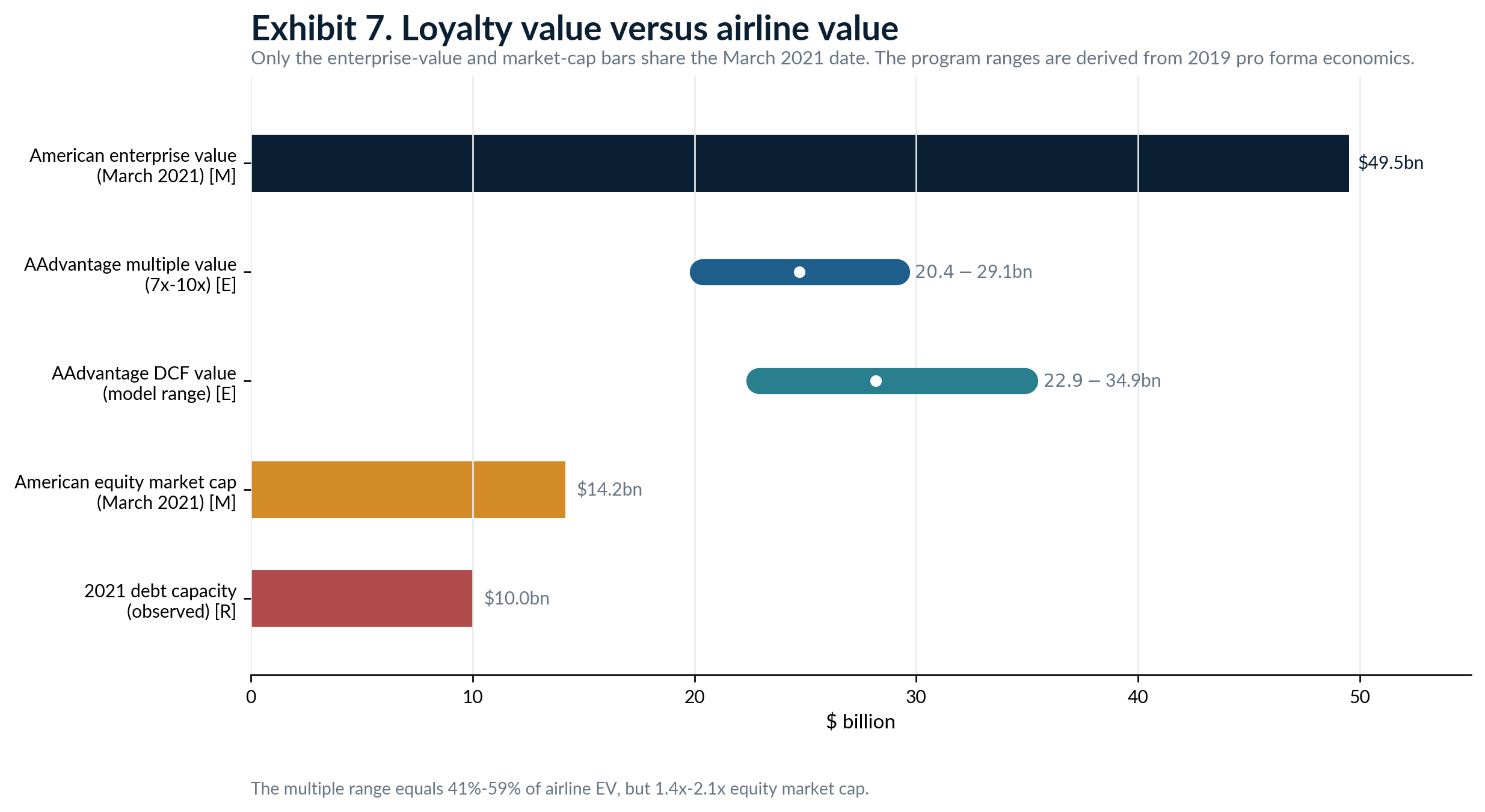
American’s March 2021 presentation reported $49.521 billion of airline enterprise value, $14.182 billion of equity market capitalization, and $2.911 billion of 2019 pro forma AAdvantage adjusted EBITDA. An estimated 7× to 10× multiple gives gross program value of $20.4 billion to $29.1 billion.
That is 41% to 59% of matching-date airline enterprise value, but 1.44× to 2.05× its equity value. “Worth more than the airline” compares gross program enterprise value with distressed airline equity—different claims on the same system.
The DCF estimates $22.9 billion to $34.9 billion. Both methods depend on durable card spending, partner concentration, pricing, member behavior, and the airline platform. Deduct loyalty-backed debt to reach program equity value.
An assumed $900 million of cash available under a lender’s definition, divided by a required 1.5× coverage ratio, permits $600 million of annual debt service. It still leaves principal to be sized against interest, amortization and maturity. That scenario from the collateral companion shows why the prudent loan and the program’s enterprise value are different outputs.
New partner cash can end before old awards are redeemed
Air Canada announced plans to leave externally owned Aeroplan, then bought it back for cash consideration and assumption of roughly C$1.9 billion of redemption liability. Bank and network partners supplied long-term agreement consideration and future-mile prepayments to preserve continuity.
An outgoing issuer can stop new cash before the last funded point is redeemed. The airline may own the loyalty brand while the bank owns or services the card portfolio. Points remain owed, and the airline controls much high-value award inventory.
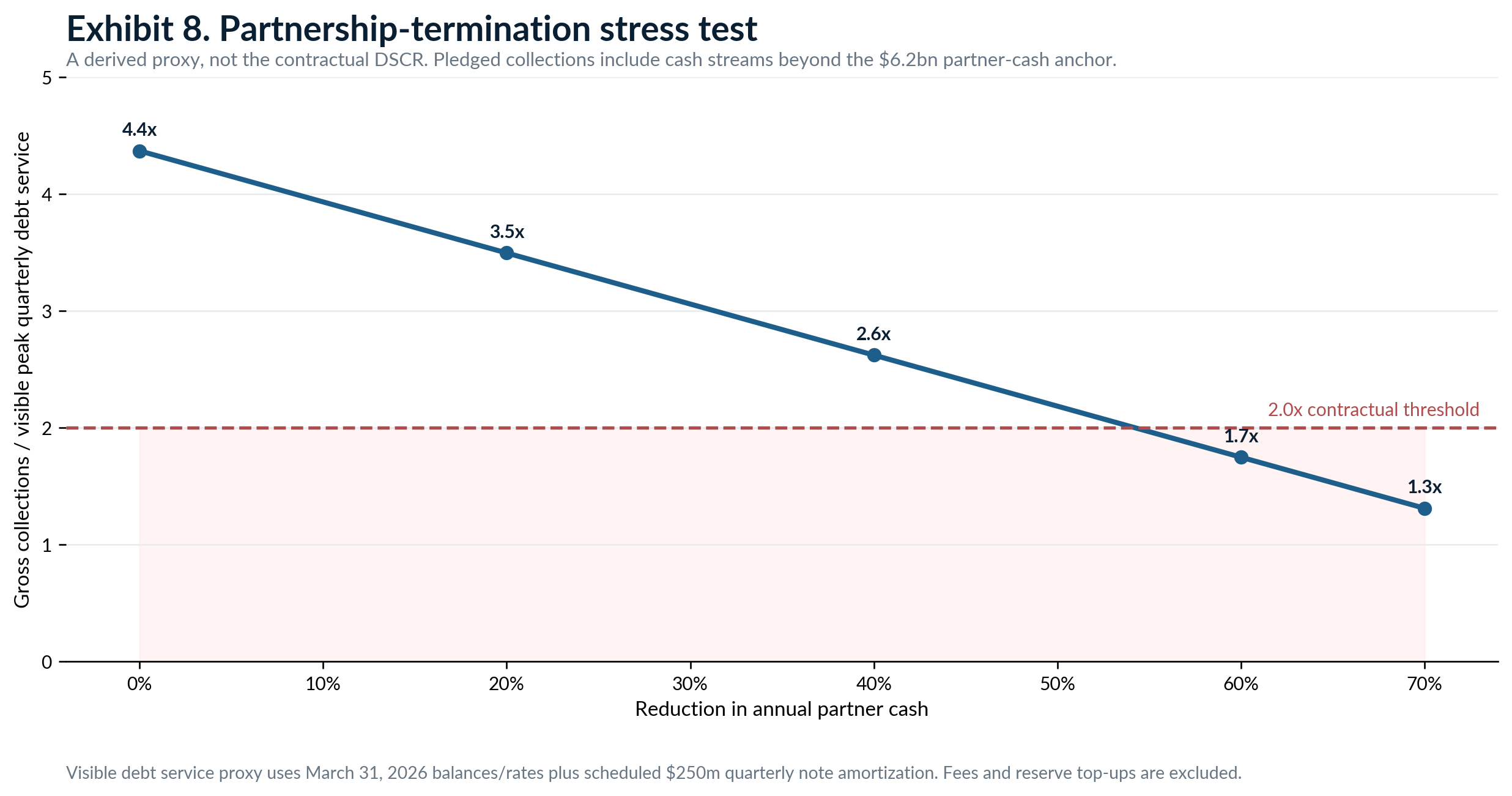
The mechanical American stress test uses $6.2 billion of 2025 partner cash and a visible peak quarterly debt-service proxy, not contractual DSCR. A modeled 60% partner-cash reduction takes gross coverage from 4.4× to 1.7× and modeled program cash contribution below zero, while ending loyalty liability remains $7.82 billion.
New partner purchases can stop while members keep redeeming awards earned earlier. Cutting fulfillment cost in lockstep with new mile sales would make a stress case too easy. I would carry the old award cohorts through the lower-receipts case before calculating the money available to service debt.
| Scenario | Partner cash | Gross coverage proxy | Program cash contribution | Ending loyalty liability |
|---|---|---|---|---|
| Base | $6.20B | 4.4× | $3.30B | $11.07B |
| Recession | $4.96B | 3.5× | $1.79B | $9.79B |
| Severe spend shock | $3.72B | 2.6× | $0.50B | $8.82B |
| Issuer disruption | $2.48B | 1.7× | −$0.82B | $7.82B |
| Near-termination | $1.86B | 1.3× | −$1.58B | $7.18B |
Partner receipts are not attributable airline profit
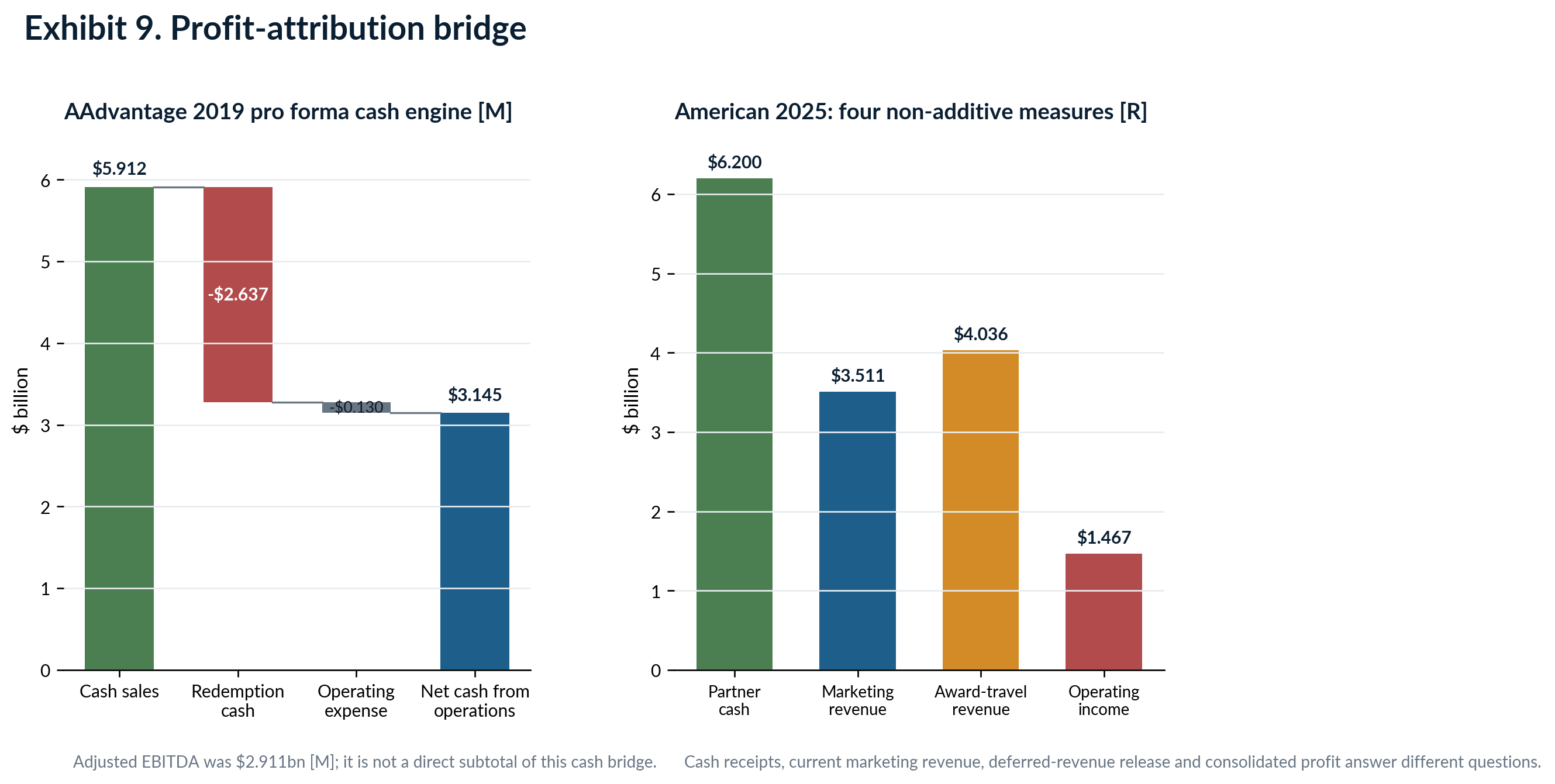
No single percentage is defensible. American’s $6.2 billion of 2025 partner cash was 11.3% of operating revenue, but can be deferred. Its $3.511 billion of marketing revenue exceeded operating income, but revenue is not profit. Its $4.036 billion of award-travel revenue released prior liabilities, not fresh bank cash.
The 2021 presentation reported $2.911 billion of 2019 AAdvantage adjusted EBITDA and $3.145 billion of net operating cash. These management-defined, pro forma measures depend on intercompany mechanics. They aid financing analysis without isolating the consolidated profit American would lose without AAdvantage.
The model estimates $6.38 of contribution per 1,000 points sold for $12. It does not isolate profit from points. That attribution needs confidential issuer pricing, allocation at the cutoff, flight and partner mix, displaced fares, acquisition and benefit costs, incremental demand, transfer pricing, breakage, and overhead.
Reported figures and model inputs
The record comprises the executive memo, dossiers, financing documents, audited reports, quarterly filings, transaction materials, and reconstructed point model. Investor-presentation measures retain their management-defined and pro forma labels.
The labels below distinguish disclosed facts, arithmetic, estimates, inferences, pro forma outputs, and management definitions.
The main unknowns are the bank’s net point price, the timing and cost of awards, and the terms that allow either partner to leave. The model keeps those gaps visible so that a chosen assumption stays recognizable when it reaches the valuation.
| Label | Meaning |
|---|---|
| Reported [R] | Directly disclosed in an audited filing, transaction document, or company record |
| Derived [D] | Arithmetic using reported inputs |
| Estimated [E] | Model input or range used because public disclosure is unavailable |
| Inferred [I] | Conclusion drawn from the interaction of disclosed facts and stated as an inference |
| Pro forma [PF] | Scenario output or company presentation adjusted outside audited consolidated results |
| Management-defined [M] | Company metric, valuation, or presentation definition that is not an independent market measure |
The airline still has to deliver the flight
The early bank payment is valuable because the award comes later. The lender’s protection is valuable because the money passes through accounts it can control. I would price both advantages alongside the same dependency: an airline with seats and a loyalty currency people still want to use.
Sources
- American Airlines 2025 Form 10-K
Verified Jul 23, 2026
- American Airlines Form 10-Q for the quarter ended March 31, 2026
Verified Jul 23, 2026
- AAdvantage Financing Investor Presentation, March 2021
Verified Jul 23, 2026
- AAdvantage 2021 Term Loan Credit Agreement
Verified Jul 23, 2026
- American Airlines 2019 Form 10-K
Verified Jul 23, 2026
- American and Citi exclusive co-brand agreement announcement
Verified Jul 23, 2026
- AAdvantage terms and conditions
Verified Jul 23, 2026
- Delta Air Lines 2025 Form 10-K
Verified Jul 23, 2026
- American Express 2025 Annual Report
Verified Jul 23, 2026
- United Airlines 2025 Form 10-K
Verified Jul 23, 2026
- United MileagePlus Financing Form 8-K and investor materials
Verified Jul 23, 2026
- United MileagePlus Credit Agreement
Verified Jul 23, 2026
- Air Canada Aeroplan acquisition accounting presentation
Verified Jul 23, 2026
- Air Canada loyalty-program transition announcement
Verified Jul 23, 2026
- Aimia and Air Canada definitive Aeroplan sale agreement
Verified Jul 23, 2026
- Air Canada 2020 Annual Report
Verified Jul 23, 2026
- American Airlines Group — 2025 Form 10-K
Verified Sep 23, 2026
- American Airlines — $10 billion AAdvantage financing announcement
Verified Sep 23, 2026
- American Airlines — AAdvantage financing collateral and intercompany structure
Verified Sep 23, 2026
Supporting material
- Full airline loyalty financing investigation
The complete 22-page report covering partner cash, accounting, fulfillment, loyalty-backed debt, valuation, issuer risk, methodology, and the source ledger. Retained original edition; use the current article’s redemption-timing qualification rather than its unsubstantiated precise mean wait.
- Original July investigation
Archived report and embedded exhibits. The current essay includes the later collateral companion and preserves the redemption-timing qualification.
- Loyalty parties and money map
A downloadable map separating the cardholder, merchant, issuer, airline, loyalty vehicle, award claim, and lender-controlled cash flow.