Financial systems
When an index decides a company matters.
Tracking funds turn index changes into trades. Net demand, execution, and anticipation determine what reaches the market—and whether price effects last.

Tesla traded approximately $154 billion on the day S&P 500 trackers needed to match its effective close. It finished its first constituent day down 6.5%. I read that episode as a very large ownership transfer whose timing mattered enormously to the people executing it. Index admission did not make the effective-close price a floor.
The selection process differs by provider. S&P combines published screens with confidential committee choice. Russell relies mainly on capitalization ranks, preliminary lists, and retention bands. Nasdaq-100 uses ranks and buffers with limited special-case discretion. MSCI tests size, liquidity, free float, foreign room, and market access.
Expected purchases start with assets that physically replicate the index. Source-index sales, overlapping mandates and early trades can offset the destination funds’ demand. The closing auction brings much of the remaining handoff together.
Method & limits
Based on the July 23, 2026 institutional and quantitative evidence audit; underlying sources were not independently refreshed for this article. The reviewed material does not include the event-level database, model outputs, exchange auction files, product-level holdings or reproducible code for a new multi-index event study. It therefore supplies no new event-study means, confidence intervals, auction fractions, arbitrage returns or persistence estimates.
Tesla’s effective close shows the scale and limits of demand
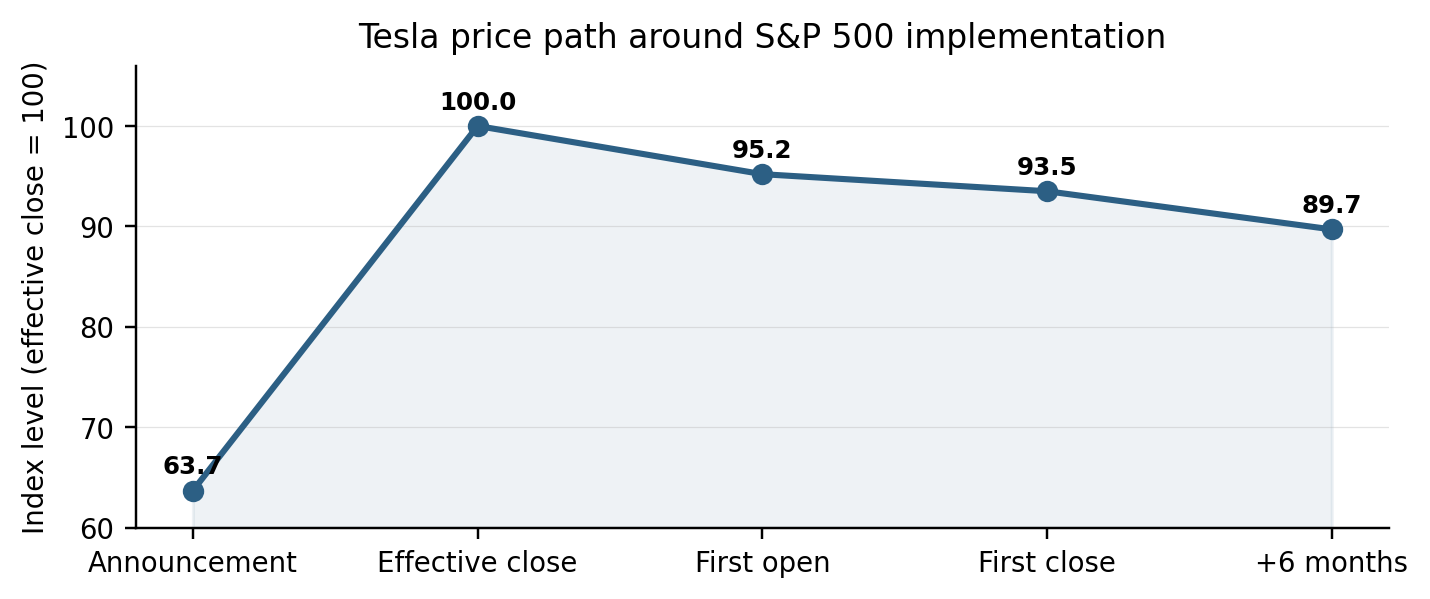
S&P announced Tesla’s addition after the market closed on November 16, 2020, then chose a one-tranche implementation at Tesla’s full float-adjusted weight. The change became effective before the December 21 open, making the December 18 official close the benchmark price that tracking portfolios needed to match.
Published estimates placed destination demand from S&P 500 trackers at roughly $78–$85 billion. Tesla was not migrating from the S&P MidCap 400 or SmallCap 600, so there was no same-stock sale by a related S&P size-index tracker to offset that buying. It was an unusually concentrated case, not a normal addition template.
Tesla traded approximately $154 billion on the effective day—about 4.7 times its preceding ten-day average dollar volume. Yet it opened nearly 5% below the effective close, finished its first constituent day down 6.5%, and stood at $89.70 for each $100 invested at the effective close six months later. The provider’s decision created a large ownership transfer without guaranteeing a persistent premium.
Selection and retention locate discretion differently
Eligibility, selection, retention, weighting, rebalancing, reconstitution, and maintenance are separate decisions. A provider may use a mechanical rule at one stage and judgment at another. “Rules-based” describes where judgment is applied; it does not eliminate it.
S&P’s screens determine who can be considered, but they do not create a right to admission. Russell makes ordinary membership more rank-driven and publishes a timetable that traders can model. Nasdaq-100 adds incumbent buffers and fast-entry rules. MSCI starts from international investability, including free float, foreign room, liquidity, and market-access constraints.
| Index family | Ordinary entry logic | Primary judgment point | Predictability |
|---|---|---|---|
| S&P 500 | Eligibility screens plus committee selection | Confidential constituent choice, timing, and exceptions | Lower for ordinary additions |
| Russell 1000/2000 | Investability screens, capitalization ranks, and bands | Input definitions, timetable, and exceptional treatment | High around scheduled reviews |
| Nasdaq-100 | Capitalization ranks, retention buffers, and fast entry | Eligibility interpretation and special-case discretion | High for annual ranks; lower for exceptions |
| MSCI GIMI | Country, size, float, liquidity, and foreign-access screens | Market classification and investability inputs | Varies by market and review event |
A benchmark earns fees without owning its constituents
Index providers sell licenses, data, subscriptions, analytics, custom indexes, and rights tied to exchange-traded products and derivatives. The same benchmark can support many products at once, allowing the provider to earn recurring revenue without purchasing the constituent securities.
S&P Global reported $1.850 billion of Indices revenue in 2025: $1.206 billion of asset-linked fees, $320 million of subscriptions, and $324 million of usage-based royalties. The segment reported $1.271 billion of operating profit, or a 68.7% margin. The margin shows why a widely adopted benchmark is a valuable franchise.
Adoption, premium data and custom design create commercial incentives. I would examine the methodology, committee duties and conflict controls before drawing a conclusion about any selection decision.
S&P Global Indices · 2025 revenue$1.850B
- Asset-linked fees
- $1.206B65.2%
- Subscriptions
- $320M17.3%
- Usage-based royalties
- $324M17.5%
An issuer can alter eligibility, but cannot order admission
An issuer can influence eligibility inputs through profitability, float, voting rights, liquidity, listing venue, corporate structure, and financial reporting. It can split shares, simplify a dual-class structure, issue stock, repurchase shares, or choose an eligible exchange. Those actions can make a company more likely to qualify without guaranteeing admission.
Tesla accumulated the profitable quarters required by S&P’s methodology and entered the eligible universe. It could not observe the committee’s candidate slate, set the announcement time, choose one tranche instead of two, or order passive funds to buy at a chosen price.
Gross destination buying can hide net selling
A target weight is not a headline asset figure. For each product, predicted purchases should start with replicating assets and the fraction expected to be implemented in physical securities. The model must then subtract source-index selling, overlapping umbrella exposure, internal crossing, derivative substitution, sampling, and positions established before the close.
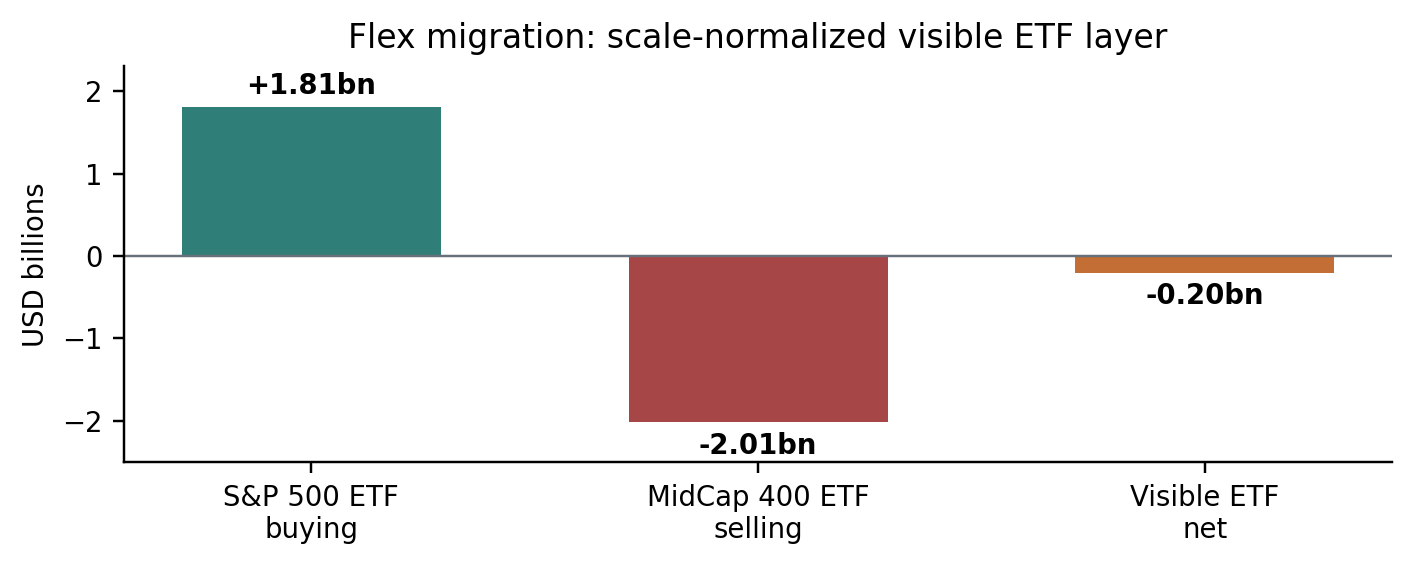
A promotion from the S&P MidCap 400 to the S&P 500 illustrates the offset. Public ETF snapshots in the supplied audit imply about $1.81 billion of visible S&P 500 ETF buying and $2.01 billion of MidCap 400 ETF selling, for approximately $200 million of net visible ETF supply. That is not a complete flow estimate; it shows why gross destination assets can be directionally wrong.
Portfolio managers can trade early, use futures or swaps, cross orders internally, work with transition managers, or accept temporary tracking error. The exchange auction concentrates the final handoff because the official close is the benchmark price, but it does not reveal every route by which exposure changed.
“Net demand” here means the residual order requirement of the tracking portfolios under study, not a claim that the whole market has more buyers than sellers. Every executed share has both. The question is which investors must change inventory, when they must do it and at what price other holders will take the opposite side. A large auction turnover does not identify the tracking component on its own.
The average price effect weakened across eras
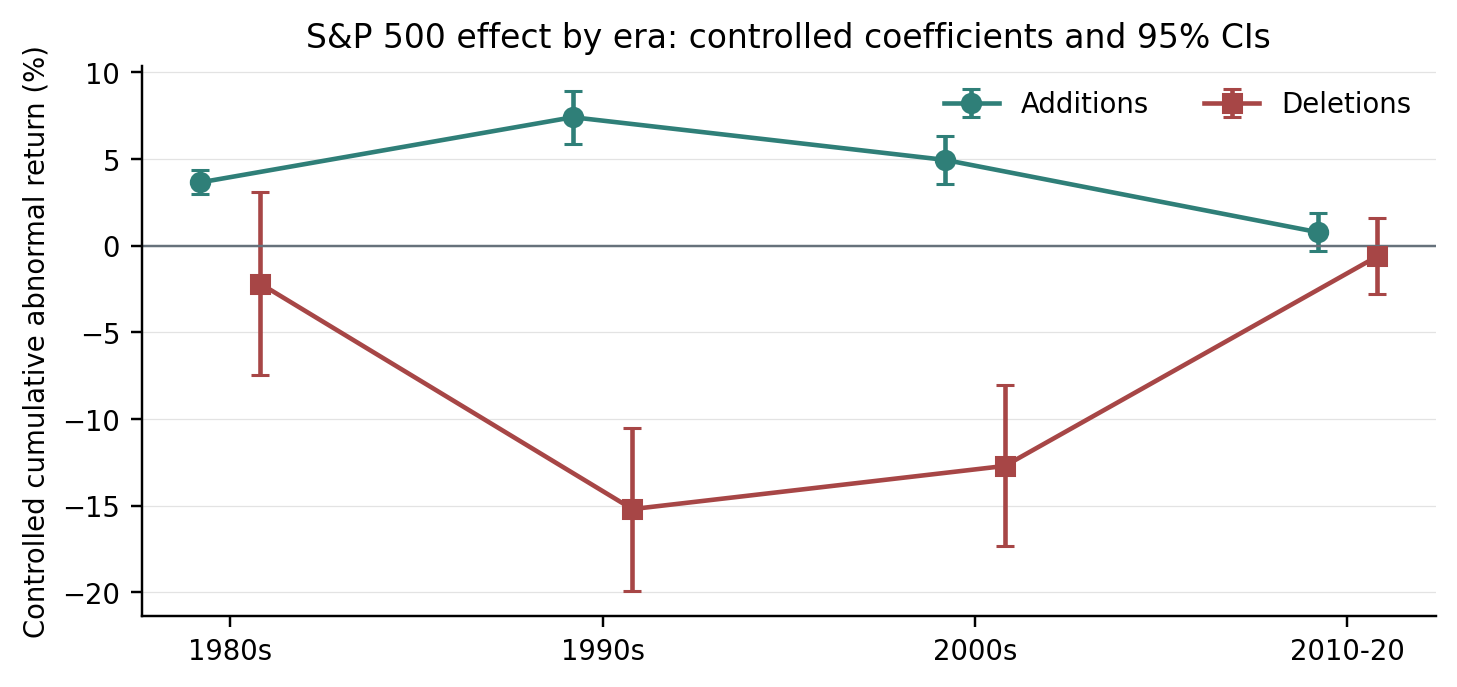
Published evidence rejects a single timeless “index effect.” Greenwood and Sammon report an S&P 500 addition announcement-period mean of 7.39% for 134 events in the 1990s and 0.83% for 153 events in 2010–2020. Their broader headline estimate for the study’s latest decade is approximately 0.3%. Deletion effects also moved toward zero.
The historical record still supports a sequence: anticipation, announcement, pre-effective positioning, the effective-session trade, closing-auction concentration, overnight reversal, and longer-run ownership or liquidity change. Different studies measure different links in that chain, so an announcement return should not be averaged with an auction-volume spike or treated as a permanent valuation effect.
Tesla combined unusual size, no source-index offset, momentum and one-tranche implementation. It is a useful case precisely because those conditions explain why its scale can coexist with a shrinking average effect.
Fees, execution costs, and inventory risk fall to different actors
The index provider earns licensing, subscription, data, and asset-linked revenue. A fund sponsor earns management fees and may share in securities-lending revenue, while bearing responsibility for tracking. Exchanges and liquidity suppliers earn transaction or market-data revenue and absorb operational risk around a concentrated close.
Managers choose execution. Arbitrageurs forecast changes, build or short inventory, hedge market exposure, and try to transfer positions at the benchmark price. Existing shareholders may sell into temporary demand; holders of deleted companies can face price pressure and lower liquidity.
The transfer is distributed across institutions rather than controlled by one actor. The provider defines; the sponsor promises; the manager trades; the exchange clears a price; arbitrageurs warehouse risk; and the issuer controls only its own eligibility inputs.
Benchmark performance also differs from the owner’s subsequent return. In a hypothetical example, a fund buys at $105 before an inclusion close of $110. It gains $5 relative to buying at the benchmark close. If the stock later falls to $100, that early execution advantage does not turn the position into an economic gain. Conversely, buying exactly at the close can minimize benchmark execution error while exposing shareholders to any later reversal. These are different objectives, so the study should report them separately.
| Participant | Potential receipt | Primary risk or cost |
|---|---|---|
| Index provider | Licensing, data, subscriptions, and asset-linked fees | Reputation, methodology, and regulatory risk |
| Fund sponsor | Management and securities-lending revenue | Tracking error, trading cost, and transition governance |
| Portfolio manager | Execution performance within mandate | Benchmark slippage and inventory risk |
| Exchange / liquidity supplier | Auction, spread, and market-data revenue | Imbalance, resilience, and inventory loss |
| Index arbitrageur | Convergence or liquidity premium | Prediction error, borrow cost, crowding, and reversal |
| Existing shareholder | Opportunity to sell into demand | Pressure can be temporary; future upside is surrendered |
Committee controls deserve scrutiny
S&P places constituent selection and methodology oversight inside its benchmark-administration governance. Committee deliberations are confidential, announcements follow a controlled timetable, and separate functions address integrity and conflict management. FTSE Russell, MSCI, and Nasdaq locate discretion differently but also publish governance and consultation structures.
Potential conflicts remain around premium data, pro forma files, custom indexes, client input, and commercial incentives tied to benchmark adoption. Timely operational detail can be more valuable than the public headline as the effective close approaches.
Commercial incentives and nonpublic decisions make those controls consequential. Their adequacy is a question for evidence about how the committee works.
A trading effect is not a financing outcome
A one-day price increase cannot answer a financing question. Temporary inelastic demand transfers value among investors. Better liquidity can reduce transaction costs. Broader ownership and analyst attention can reduce segmentation or information frictions. Committee selection can also be interpreted as certification. These are separate mechanisms.
A credible cost-of-capital test needs longer-horizon outcomes: seasoned-equity discounts, issuance likelihood, debt yields, credit spreads, implied cost of equity, financing mix, or investment. It also needs a counterfactual that separates inclusion from size, profitability, momentum, liquidity, and concurrent news.
The evidence supports temporary price pressure in some cases and eras, and credible ownership and liquidity changes. Permanent valuation effects are mixed. A lower corporate cost of capital remains plausible but unproven without an observed financing outcome and a credible counterfactual.
| Mechanism | Observable measure | What it can establish | Primary limit |
|---|---|---|---|
| Temporary demand | Effective-close return and reversal | A transfer among investors | Not a durable financing benefit |
| Liquidity | Spreads, depth, turnover, lending, price impact | Lower trading friction | Firm and market trends also change |
| Ownership / recognition | Passive ownership, breadth, analyst coverage | A different investor base | Selection and concurrent growth |
| Permanent valuation | Matched long-horizon abnormal return | Possible discount-rate change | Identification is weak |
| Financing cost | Debt spreads, issuance, implied cost of equity | Direct corporate outcome | No matched panel in the supplied package |
The broader financing distinction is visible in airline loyalty collateral: a valuable contractual cash stream and the debt it can support are different quantities.
The event windows and flows an extension would need
An empirical extension would need one record per security-level membership or weight event, with permanent identifiers, dated methodologies and exact announcement and effective timestamps. Product holdings and auction files would connect the planned weight change to the trade.
Event windows should separate announcement, anticipation, effective session, auction, overnight reversal, and +5, +20, +60, and +120 trading-day persistence. Net replication demand should be reconstructed product by product and reconciled with observed holdings rather than inferred from headline benchmarked assets.
- Missing event-level package: the upload did not include the event master, return series, auction files, holdings, model outputs, or code.
- Selection and contamination: S&P additions are selected from strong candidates, and company news can overlap event windows.
- Anticipation is hard to date: Russell, Nasdaq, S&P, and MSCI information becomes tradable at different stages.
- Flow estimates remain ranges: public ETF assets omit many funds, derivatives, internal crosses, and early execution.
- Cost-of-capital identification is weak: short-run returns, liquidity, ownership, valuation, and financing outcomes are different variables.
The trade is where the claim becomes expensive
I would reconstruct the tracking portfolios’ remaining orders before betting on an inclusion headline. The investor who forecasts the handoff is solving a different problem from the investor who owns the company afterward.
Sources
- S&P U.S. Indices Methodology
Verified Jul 23, 2026
- S&P Dow Jones Indices governance policies
Verified Jul 23, 2026
- Nasdaq-100 Index Methodology
Verified Jul 23, 2026
- MSCI Global Investable Market Indexes Methodology
Verified Jul 23, 2026
- NYSE Opening and Closing Auctions Fact Sheet
Verified Jul 23, 2026
- Nasdaq Closing Cross FAQ
Verified Jul 23, 2026
- Tesla set to join the S&P 500
Verified Jul 23, 2026
- What Happened to the Index Effect?
Verified Jul 23, 2026
- Revisiting Tesla’s Addition to the S&P 500
Verified Jul 23, 2026
- Lynch and Mendenhall: New Evidence on S&P 500 Changes
Verified Jul 23, 2026
- Kasch and Sarkar: Is There an S&P 500 Index Effect?
Verified Jul 23, 2026
- Wurgler: On the Economic Consequences of Index-Linked Investing
Verified Jul 23, 2026
- Chang, Hong, and Liskovich — Regression Discontinuity and the Price Effects of Stock Market Indexing (2015)
Verified Jul 23, 2026
Access rechecked October 19, 2026. The DOI identifies the exact 2015 published paper. Full text may require publisher access.
- Ben-David, Franzoni, and Moussawi: Russell Assignment Note
Verified Jul 23, 2026
Supporting material
- Full index-decision evidence audit
The complete 32-page investigation, including methodology comparisons, event evidence, participant economics, interpretation limits, fact checks, and the master source ledger.
- Editable evidence audit
The supplied editable report used as the primary source document for this web edition.
Source access notes
Checked . These notes distinguish recovered documents, replacement sources and unavailable originals. The investigation retains its original evidence dates.
Chang, Hong and Liskovich — Russell index assignment
The DOI identifies the exact 2015 published paper. Full text may require publisher access.
The original citation was unavailable at this access check.