Who keeps the risk in hardware finance?
CoreWeave, Waymo, Serve, Anduril and Northvolt show where the bill lands when physical capacity earns less than planned.
Sulayman Bowles · · Updated

In August 2026, CoreWeave arranged a $2.6 billion GPU-financing facility through a subsidiary. The parent unconditionally guaranteed it. I would start with that guarantee before celebrating the subsidiary: the vehicle organizes the lender’s collateral, while CoreWeave still promises to pay if the financed deployments cannot. CW1
This is the central question in hardware finance: who keeps paying when the equipment stops earning? A company can raise less equity for each robot or GPU it deploys and still carry the cost of idle capacity, obsolete equipment and replacement hardware. A smaller upfront check says little about the eventual loss.
The five capital stacks below move that risk in different ways. Waymo relies heavily on patient parent equity; Serve adds equipment payments to an early fleet; CoreWeave combines secured borrowing with leases and customer cash; Anduril receives conditional public support; Northvolt shows what happens when an industrial ramp fails. Pre-scale humanoid companies offer a useful sixth comparison because their equity is funding the experiment as well as the machine.
Method & limits
comparative figures retain the supplied July 22, 2026 report and workbook cutoff. The CoreWeave DDTL and humanoid additions use sources reviewed on September 23, 2026; they do not refresh the earlier company comparisons. Models and assumed examples are labeled beside their inputs. They are analytical scenarios, not company guidance, covenant calculations, appraisals or investment recommendations. Unquantified facilities and asset ownership remain unresolved.
The company’s funder may never own the machine
A venture round funds the company. A lease funds an asset. A customer prepayment helps fund delivery. The same deployment can use all three, and each provider receives a different claim on what the business earns or owns.
Those claims matter most together. A fleet operator can owe rent to a lessor, service to a prepaid customer and a return to shareholders; a funding announcement that names only the shareholders leaves most of the operating bargain out of view.
The payment survives the growth plan
Equity absorbs a disappointing deployment through a lower return. Debt and rent introduce a payment calendar. The operator must meet it even when paid use falls, unless the contract gives it a way out.
Customer and public funding have their own clocks. A customer who pays early is buying delivery; a grant may require jobs, spending or milestones before the company can keep the benefit. Cash arrives with a job to do.
I therefore follow the payment from the operating asset to the claimant who can enforce it. Written guarantees decide legal recourse. A parent may also choose to rescue a legally nonrecourse vehicle to protect customers or future funding, which creates a commercial incentive beyond the signed promise.
Waymo buys time with parent equity
Waymo’s 2024 and 2026 rounds total $21.6 billion of visible equity, with Alphabet supplying a significant majority in 2026. In the July comparison, that is a patient parent backstop without an identified large fleet facility setting the refinancing calendar.
The cars still consume capital. Charging and depots have to be built, vehicles maintained, and autonomy hardware refreshed before a growing fleet can pay its way. With no quantified transfer of those obligations in the reviewed package, operating losses and impairment remain with Waymo equity and, economically, Alphabet.
That is flexibility purchased by concentration. Alphabet can tolerate a longer ramp than a lender demanding scheduled repayment, but it also carries the opportunity cost and can change its willingness to fund the next one. The package leaves vehicle titles, depot leases, liens and hardware ownership unresolved.
Capital providers
- Alphabet
- Significant majority of the $16.0B 2026 round; exact contribution undisclosed.
- Outside equity
- $21.6B total visible equity across the 2024 and 2026 rounds, including parent funding.
Entity & physical assets
- Waymo LLC / consolidated VIE
- Technology control and service brand.
- Robotaxis, Mesa, depots
- Waymo + Magna integration; vehicle title by city and depot ownership or lease signers are undisclosed.
Operators & customers
- Uber
- Austin / Atlanta fleet management, dispatch and depot operations.
- Moove & Magna
- Moove: Phoenix / Miami fleet operations and charging. Magna: vehicle integration.
- Riders
- Uber app or Waymo One; fare allocation partly undisclosed.
Operating losses and asset write-downs fall economically on Waymo equity and continued parent support. No disclosed asset lender; city-specific title, insurance, leases and guarantees remain unknown.
Serve’s robot has to earn its equipment payment
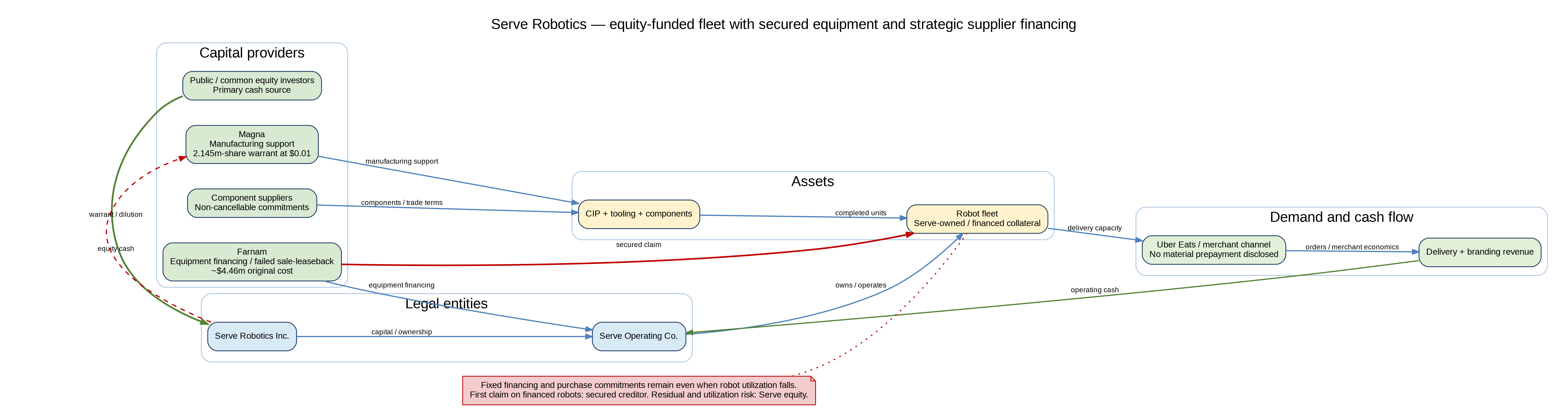
Serve layers Farnam secured equipment financing and a Magna supplier warrant onto corporate equity. It can deploy a robot with less purchase cash from shareholders, while the lender receives collateral and the supplier receives equity economics.
The July model exposes the early mismatch. FY2024 cash capex was 5.66× revenue. At modeled base utilization of 48.2%, fleet revenue is about 0.28× the Farnam payment, before field operations, maintenance or replacement. That is a revenue-to-payment diagnostic, not a coverage covenant; even on that narrow comparison, the fleet needs more paid work.
A supplier warrant can help secure production and align incentives, but its economic cost includes dilution. Concentration and minimum-volume dependencies also belong in the assessment where the agreement imposes them. Financing the next robot becomes attractive when its service cash grows faster than the fixed claims, rather than merely because another robot can be financed.
Capital providers
- Common equity
- Primary cash source for operations and fleet growth.
- Farnam
- $4.46M original equipment-financing cost, mostly repaid by 2025; not a year-end liability.
- Magna & component suppliers
- 2.145M-share warrant at $0.01; manufacturing support and non-cancellable component commitments.
Entities & assets
- Serve Robotics Inc.
- Corporate equity and supplier warrant.
- Serve Operating Co.
- Owns and operates the robot fleet; tooling and components become completed units.
- Financed robots
- Serve-owned collateral. The failed sale-leaseback was secured financing.
Demand & cash flow
- Uber Eats / merchants
- Orders and delivery demand; no material prepayment disclosed.
- Delivery & branding revenue
- Operating cash returns to Serve Operating Co.; scheduled finance and purchase commitments persist when utilization falls.
The secured creditor has first claim on financed robot collateral while its claim remains outstanding. Serve equity retains utilization and residual-value risk; the Magna warrant represents dilution, not cash proceeds.
CoreWeave borrows against work it still has to perform
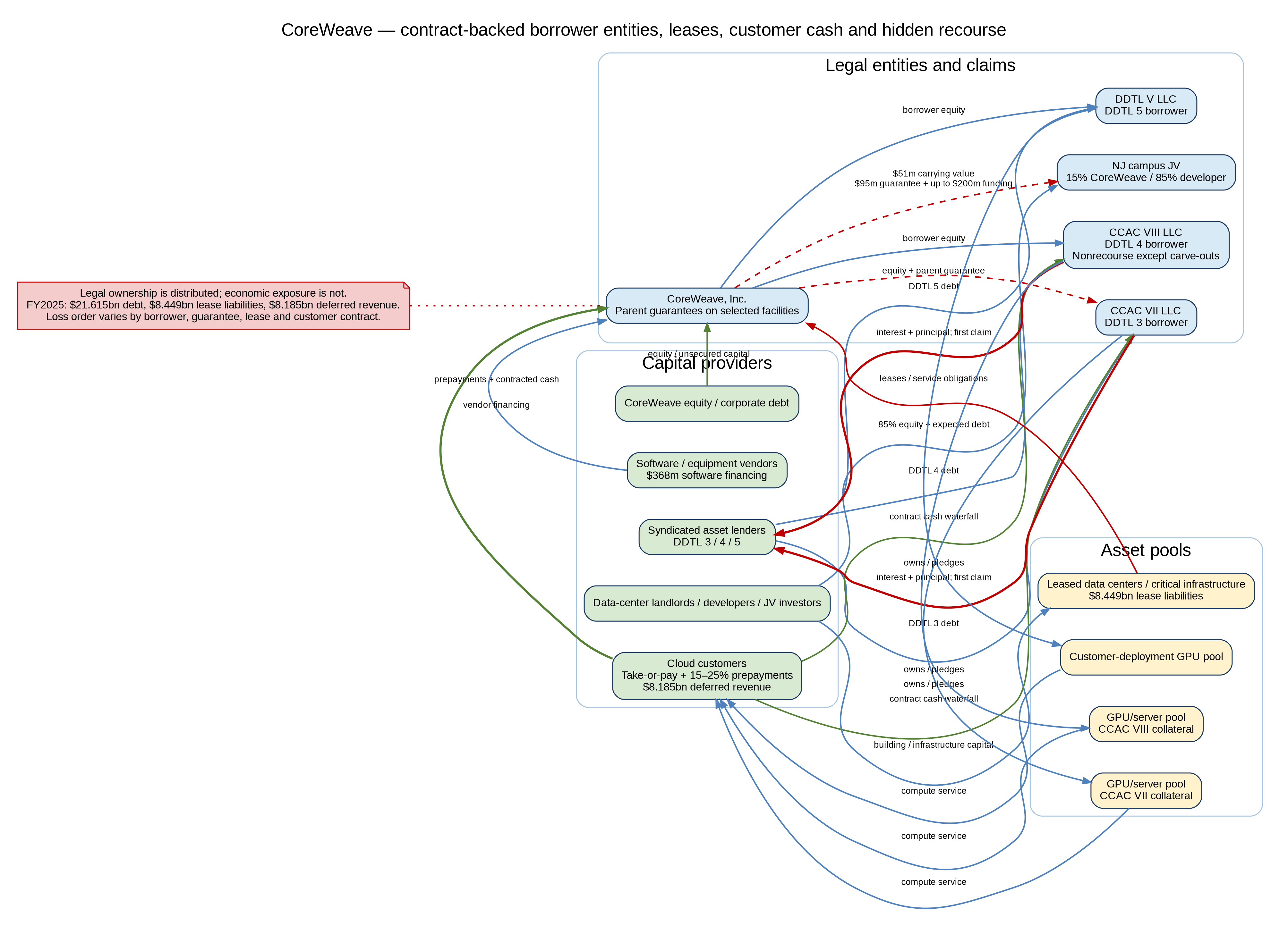
CoreWeave’s FY2025 model records $21.615 billion of debt principal, $8.195 billion of operating-lease obligations, $254 million of finance leases and $8.185 billion of deferred revenue. Selected asset financing equals 78.6% of gross property and equipment; capex is 2.01× revenue.
This stack finances capacity before all of its service revenue is earned. Lenders have secured claims, landlords have rent due, and customers who prepaid expect working capacity. Deferred revenue brings cash forward without releasing CoreWeave from the cost of delivery.
The model’s operating-cash-flow debt-service coverage is 0.70×. Removing the deferred-revenue increase leaves negative $1.116 billion of operating cash flow. These analytical adjustments show how much the funding depends on customer cash arriving early; they use no governing covenant definition.
The credit question therefore reaches beyond whether the GPU has a customer today. A delay between equipment delivery and customer acceptance can start financing charges before billing begins, while a later technology change can reduce the price of the next contract before the old debt is repaid.
- Debt principal
- $21.615B
- Lease liabilities
- $8.449B
- Deferred revenue
- $8.185B
- CCAC VII LLC / DDTL 3
- GPU / server collateralParent guarantee
- CCAC VIII LLC / DDTL 4
- GPU / server collateralNon-recourse except carve-outs
- DDTL V LLC / DDTL 5
- Customer-deployment GPU poolBorrower-specific assets and cash waterfall
- New Jersey campus JV
- 15% CoreWeave / 85% developer$51M carrying value; $95M guarantee and up to $200M funding
- Asset lenders
- Interest and principal; first claim on the relevant collateral pool.
- Landlords & vendors
- Leased infrastructure and $368M software financing create fixed claims.
- Cloud customers
- Take-or-pay plus 15–25% prepayments; compute delivery obligations remain.
Parent guarantees, leases, customer contracts and borrower waterfalls determine recourse and loss order. Consolidated totals do not allocate balances to each entity.
A five-year loan outlasts a three-year customer contract
DDTL 5.5 makes that timing visible. The August 2026 facility provides $2.6 billion of committed delayed-draw capacity to CoreWeave Financing DDTL V-V, LLC, an indirect subsidiary, primarily for GPU servers and related infrastructure needed to perform customer contracts. Committed capacity is available borrowing, not an amount fully drawn at closing. CW1
The loan matures September 1, 2031, roughly five years after closing; underlying customer contracts average about three years. The initial customer can pay exactly as promised and leave debt outstanding when its contract ends. CoreWeave’s closing release explicitly includes renewal or re-leasing in the repayment story. CW3
The June filing describes DDTL collateral generally as assets underlying contributed customer contracts and pledged contractual cash flows, often involving investment-grade counterparties. That gives a lender a defined customer and asset pool to underwrite. The remaining years require a second judgment about what the equipment can earn after the first contract. CW2
The 8-K summarizes a minimum 1.35× debt-service coverage covenant beginning after its specified commitment-related trigger. Its defined cash-flow numerator, debt-service denominator and start date control the test. Headline revenue divided by interest would answer a different question. CW1
Delayed draws reduce the cost of borrowing before qualifying equipment needs to be paid for. They do not erase it. In the assumed example below, an unused commitment costs money, and a drawn balance costs the benchmark plus the margin before amortization, reserves, hedging and transaction costs.
The debt can outlast the first customer contract.
Years of duration · each band measured from its own start
The initial customer term does not necessarily cover the debt’s whole life. The parent also guarantees this facility.
| Item | Term or calculation | Meaning for the risk |
|---|---|---|
| Facility capacity | $2.6B | Commitment; draws depend on qualifying purchases |
| Borrower | CoreWeave Financing DDTL V-V, LLC | Dedicated subsidiary with an unconditional parent guarantee |
| Maturity | September 1, 2031 | About five years versus average initial customer contracts of about three years |
| SOFR borrowing price | Term SOFR + 5.50% | Floating benchmark plus margin |
| Base-rate alternative | Base rate + 4.50% | Alternative borrowing convention |
| Undrawn fee | 0.50% annually on average daily unused capacity | A commitment has a cost before it is drawn |
| Coverage summary | Minimum 1.35× after the specified trigger | Agreement definitions and start date govern |
| Assumed $100M draw at 4.00% SOFR | 9.50% coupon; $9.5M annual interest | Simple scenario before amortization and other costs |
| Assumed $100M unused commitment | $0.5M annually at 0.50% | Constant-balance scenario |
Facility terms: CW1; contract duration: CW3. The last two rows assume balances and a benchmark rate; they are not observed CoreWeave expense.
Cash can be trapped while the parent remains exposed
CoreWeave describes certain financing vehicles as bankruptcy-remote, special-purpose consolidated subsidiaries. Their pledged assets still appear in consolidated accounts. A legal restriction on an asset and accounting consolidation can coexist. CW2
Recourse varies across the same company’s facilities. The June filing classifies DDTL 4.0 as nonrecourse apart from specified carve-outs; DDTL 5.5 carries an unconditional parent guarantee. Calling both “SPV debt” would conceal the difference that matters when collections fall short. CW2 CW1
The cash path matters as much as the asset path. Receipts in a restricted vehicle may have to pay operating costs, replenish reserves and service debt before any remainder reaches the parent’s next build, even while a parent guarantee exposes the wider company to a shortfall inside that vehicle.
A recovered GPU also needs an operating home. Power, networking and a replacement customer affect what it can earn, while CoreWeave supplies the software and operations that make the financed equipment productive. The lender is underwriting that dependency alongside the customer’s payment obligation. A collateral pool organizes the claim; it cannot manufacture a second customer.
Anduril has to earn the right to keep public support
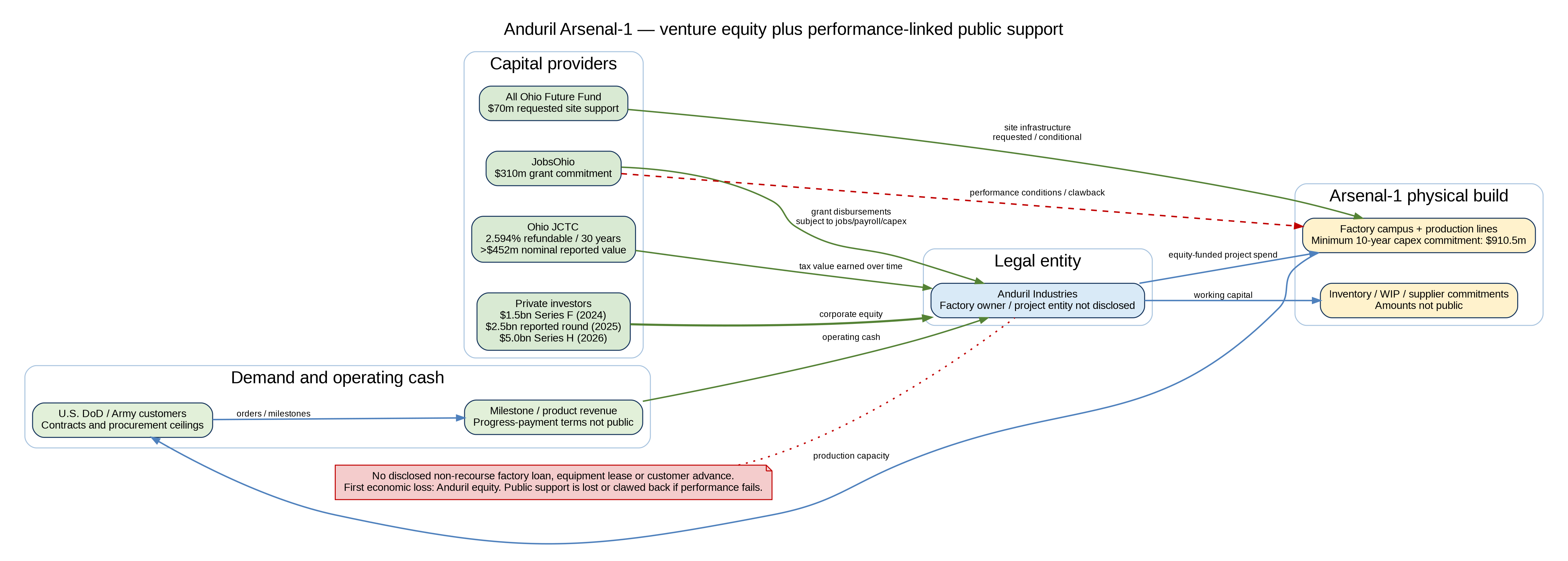
Anduril combines venture capital, customer-linked demand and public support. The July model compares a $310 million JobsOhio grant with $910.5 million of capex, or 34.0%. It estimates $426.1 million of base net public benefit and about 0.88× public support to private capital.
Those figures describe announced or modeled economics. The company benefits when support is funded, collectible and retained after compliance and clawback conditions. A grant, a tax credit and a public guarantee help through different mechanisms and on different dates.
A customer contract can support factory demand without paying the construction bill. A grant can reduce that bill without ensuring a profitable product. Anduril still needs private capital to bridge the dates and qualified output to justify the capacity; a delayed or resized program can weaken the business even after incentives have made the factory cheaper.
Capital & support
- Private equity
- $1.5B in 2024, $2.5B reported in 2025 and $5.0B in 2026; corporate uses are not allocated publicly.
- JobsOhio
- $310M grant commitment, subject to jobs, payroll and capex conditions.
- Ohio incentives
- $70M requested site support. The 2.594% refundable credit runs for 30 years; $452.3M nominal future value is conditional.
Arsenal-1 investment
- Anduril Industries
- Factory owner and project entity not disclosed.
- Factory & production lines
- $910.5M minimum ten-year capex commitment; inventory, work in progress and supplier amounts are not public.
Demand & operating cash
- U.S. DoD / Army
- Customer contracts and procurement ceilings support demand.
- Milestone / product revenue
- Progress-payment terms are not public. A contract ceiling is not prepaid asset capital.
Equity bears the first economic loss. Public support depends on collection, compliance and clawback terms; committed grants and future credits are not all cash received. No factory loan, equipment lease or customer advance was disclosed in this record.
Northvolt’s rescue cash could not refill the old stack
Northvolt financed factories with equity, project debt, customer commitments and prepayments, public finance, supplier exposure and bridge capital. When the ramp disappointed, those sources became competing claims on a weaker operating asset.
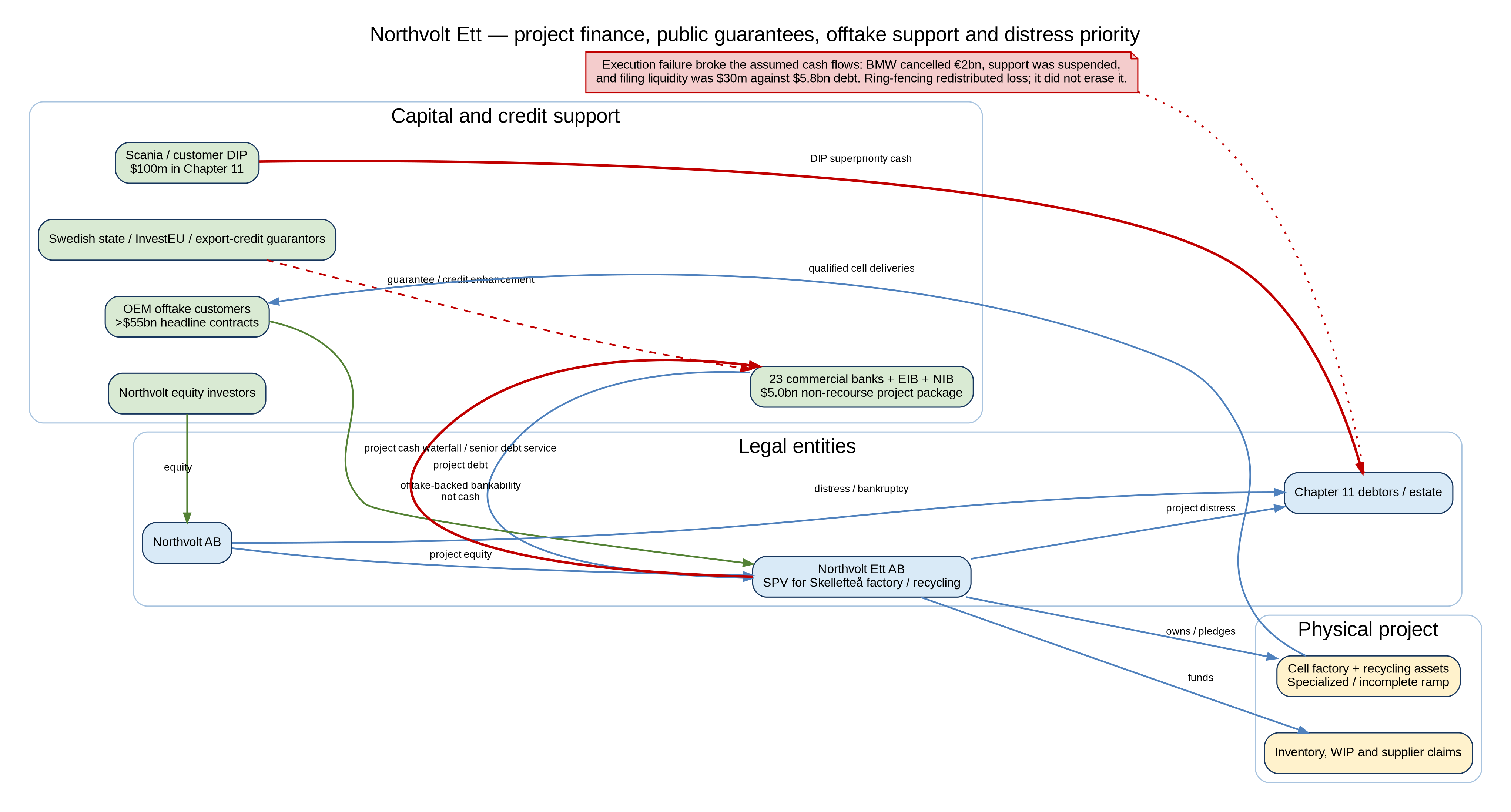
The July model places a $100 million debtor-in-possession facility beside $5.8 billion of filing debt: 1.7%. Bridge liquidity is 4.22% of debt; modeled base residual exposure is $4.4 billion. Rescue money can preserve the option to operate or sell while leaving a large loss in the existing capital stack.
An offtake agreement promises a buyer. The factory still has to make acceptable batteries at an economic yield and cost. Customer prepayments may become delivery or refund claims, project lenders retain security, and suppliers can have liens or enough operating leverage to shape a rescue.
Recovery then depends on what the unfinished plant can be sold for, what it costs to complete, and which contracts transfer with it. The $4.4 billion is a modeled exposure, not a recovery appraisal. Financial closing bought the chance to execute; it never guaranteed the ramp.
Capital & credit support
- Equity & project lenders
- 23 commercial banks, EIB and NIB: $5.0B non-recourse project package committed; draw amount unknown.
- OEM offtakes
- More than $55B headline contracts support bankability, not financing cash.
- Public guarantors
- Swedish state, InvestEU and export-credit support; guarantee exposure is contingent.
Entities & physical project
- Northvolt AB → Northvolt Ett AB
- Parent equity funds the project entity for the Skellefteå factory and recycling assets.
- Factory, inventory & work in progress
- Specialized assets and incomplete ramp; project lenders hold security over project assets and cash.
Distress & rescue liquidity
- Chapter 11 debtors / estate
- $30M filing cash against $5.8B debt. BMW cancelled a €2B order; support was suspended.
- Scania / customer DIP
- $100M approved / available rescue facility with superpriority; not evidence that the old stack recovered its value.
Project and parent equity absorb losses; recoveries of secured lenders, guarantors, suppliers and customers depend on collateral, contracts and jurisdiction. Ring-fencing reallocates loss. It does not remove execution risk.
Humanoid equity is financing the experiment and the machine
Apptronik’s February 2026 announcement combined a $520 million Series A-X extension with a $415 million initial Series A, taking the round above $935 million and total capital raised to nearly $1 billion. Figure announced more than $1 billion of Series C commitments in September 2025 at a $39 billion post-money valuation. These are venture and strategic equity rounds carrying technology and deployment uncertainty. HR1 HR2
A mature equipment lender wants a machine whose service life and collections it can estimate. A pre-scale humanoid can change between generations and depend on proprietary controls, repairs and customer integration. Equity can bear that uncertainty because it participates in the upside. Figure’s equity valuation says nothing directly about what a lender could recover from its robots.
The use of funds explains the scale. Figure said the round would expand BotQ manufacturing, deployment into homes and commercial operations, GPU infrastructure for Helix training and simulation, and data collection. Apptronik described production and deployment of Apollo. The same capital is paying for a factory learning curve and an AI learning curve. HR1 HR2
Apptronik’s disclosed investors include Google, Mercedes-Benz, AT&T Ventures and John Deere. A strategic investor can bring manufacturing knowledge or a route to a customer, but an investment is still a different commitment from a paid fleet order. A pilot can end before purchase, and an order can require acceptance before payment.
Eventually, accepted fleets could support debt while equity funds the next generation. I would want a cohort’s installed cost, billable hours, collections and repair history before assigning that debt capacity. Factory capacity and demonstration videos supply neither the collections nor the recovery record.
| Item | USD per robot-month |
|---|---|
| Collectible service payments | 3,000 |
| Field service and maintenance | −1,000 |
| Insurance and idle/collection reserve | −500 |
| Remaining for asset debt service and omitted fleet costs | 1,500 |
Author scenario carried from the humanoid financing analysis; no Apptronik or Figure unit economics are implied. Central R&D is outside the example. Lower productive use or higher repair cost reduces the cushion.
The loss follows the promise, not just the title
A lessor may hold title while the operator guarantees residual value. A lender may hold a first lien on equipment that has little resale value. Ownership is a starting point; the enforceable promise determines who is asked to make good on the loss.
Lower paid use hits operating contribution before it changes principal. Reserves can absorb the first shortfall, then a sponsor cure or guarantee can move it back to the parent. Foreclosure changes control of the equipment without necessarily repairing the unpaid balance.
The indicators below measure different pressures. They are worth comparing as failure mechanisms, not ranking as though a grant ratio and debt-service coverage were versions of the same accounting measure.
| Case | Indicator | Value | What it tests | Evidence treatment |
|---|---|---|---|---|
| Waymo | Visible 2024 + 2026 equity | $21.6B | Parent and external equity capacity | Reported in supplied package |
| Serve | FY2024 cash capex / revenue | 5.66× | Early revenue support for physical deployment | Calculated from supplied inputs |
| Serve | Base fleet revenue / Farnam payment | ~0.28× | Service cash flow beside equipment claim | Modeled |
| CoreWeave | Actual OCF debt-service coverage | 0.70× | Current cash generation beside debt service | Analytical; not a covenant calculation |
| CoreWeave | OCF before deferred-revenue increase | ($1.116B) | Dependence on customer-funded working capital | Analytical adjustment |
| Anduril | JobsOhio grant / capex | 34.0% | Announced public support beside project cost | Calculated; collection and retention still matter |
| Northvolt | DIP / filing debt | 1.7% | Rescue liquidity beside legacy claims | Calculated from supplied inputs |
| Northvolt | Base residual exposure | $4.4B | Capital left exposed after modeled recoveries | Modeled |
Replacement can arrive before the old debt is gone
Consider an assumed $100 asset financed with $20 of equity and $80 of debt repaid evenly over four years. After two years, $40 of principal remains. If a technology shock makes the asset unusable with no resale value and a replacement still costs $100, the operator needs the new machine while carrying the old $40 claim, before interest and operating costs.
The debt schedule has not extended the machine’s economic life. Insurance, transferable customers, reserves or a restructuring can change the outcome, but each needs an identified contract or funded source.
I would put the replacement date, remaining principal and committed service cash on the same timeline. The strongest structure is the one that can survive a reasonable miss in paid use and asset life without requiring shareholders to keep refinancing the same experiment.
| Archetype | Scales when | Breaks when | First loss usually lands with |
|---|---|---|---|
| Parent-funded platform | Parent has patience and the platform creates strategic or financial value | Burn, losses, or opportunity cost exceed parent tolerance | Corporate equity and parent |
| Leased or equipment-financed fleet | Utilization and contribution cover fixed service; collateral is reusable | Use falls, assets become specialized, or residual support returns | Operator equity, guarantor, then lender or lessor |
| Asset-financed or SPV infrastructure | Contracted demand and asset life match tenor and amortization | Capacity, concentration, refinancing, or obsolescence breaks coverage | SPV equity, reserves, guarantor, then secured creditors |
| Customer-financed industrial capacity | Deposits and contracts match deliverable milestones and capacity | Delivery fails or refund and performance duties exceed liquidity | Sponsor equity, then customers and lenders by contract priority |
| Government-supported factory | Support is funded and retained beside a viable private-capital case | Incentives are delayed, clawed back, or mask weak unit economics | Private equity, guarantee providers, creditors, and public balance sheet |
Method and unresolved ownership
The report and workbook classify evidence as confirmed, strongly supported, modeled, plausible but unproven, or unknown. That hierarchy matters here because a disclosed facility can support a precise claim about recourse while leaving title, collateral eligibility or recovery unresolved.
The July comparative inputs were not refreshed for this rewrite. The September-reviewed CoreWeave and humanoid sources add named structures at their own dates. Governing loan documents, asset titles and customer terms would be needed to close the remaining ownership and repayment gaps.
| Level | Meaning | Permitted claim |
|---|---|---|
| Confirmed | Directly documented in the supplied source package | State the value or structure with its source and date |
| Strongly supported | Multiple consistent facts support the inference | State the inference and identify the remaining boundary |
| Modeled | Calculated from disclosed inputs and explicit assumptions | Describe as a scenario or analytical output, never a reported fact |
| Plausible but unproven | Commercially possible but not established by the package | Name as a diligence question, not a current instrument |
| Unknown | Evidence is insufficient to allocate the amount, owner, recourse, or recovery | Preserve the gap and identify the document needed to close it |
A cheaper deployment can leave the same loss
I prefer financing that follows a proven asset’s collections to financing that asks future growth to rescue old equipment. A good lender can be protected while the operator remains fragile. The attractive hardware business is the one whose capacity pays for service, replacement and its capital claims through a weaker year—not simply the one that deploys the most machines per dollar of new equity.
Sources
- The Hidden Financing Behind Hardware Startups — supplied comparative report
Verified Jul 22, 2026
- Hidden financing comparative model — supplied 29-sheet workbook
Verified Jul 22, 2026
- Capital-stack diagrams — supplied PNG and Graphviz source package
Verified Jul 22, 2026
- CoreWeave 2025 Form 10-K
- CoreWeave Q1 2026 Form 10-Q
- Fitch — CoreWeave DDTL 5.5 rating action
- Serve Robotics 2024 Form 10-K
- Serve Robotics FY2025 earnings exhibit
- Alphabet 2025 fourth-quarter earnings materials
- CoreWeave August 7, 2026 DDTL 5.5 guarantee and security terms
Verified Oct 16, 2026
Dated supplemental primary record: parent unconditionally guarantees this facility. Does not recertify all historical comparative inputs.
- CoreWeave June 2026 Form 10-Q — DDTL collateral, consolidation and recourse
Verified Sep 23, 2026
- CoreWeave DDTL 5.5 closing release — maturity and customer contract duration
Verified Sep 23, 2026
- Apptronik — more than $935 million Series A financing
Verified Sep 23, 2026
- Figure — more than $1 billion Series C at $39 billion post-money valuation
Verified Sep 23, 2026
Supporting material
- Full comparative report
The complete 19-page investigation, including methodology, findings hierarchy, appendices, and source register.
- Editable comparative report
The supplied editable report used as the source document for this web edition.
- Comparative financing model
The 29-sheet evidence ledger, assumption book, company comparison, scenarios, waterfalls, and findings workbook.
- Capital-stack diagram package
The original full-resolution PNG and Graphviz DOT files for all five company capital stacks.
- Waymo capital stack
Full-resolution parent-funded platform diagram.
- Serve Robotics capital stack
Full-resolution equity, equipment-financing, and supplier-warrant diagram.
- CoreWeave capital stack
Full-resolution secured-debt, lease, and customer-prepayment diagram.
- Anduril capital stack
Full-resolution equity, customer-contract, and public-support diagram.
- Northvolt capital stack
Full-resolution equity, project-debt, offtake, public-support, and distress diagram.

Source access notes
Checked . These notes distinguish recovered documents, replacement sources and unavailable originals. The investigation retains its original evidence dates.
CoreWeave — first-quarter 2026 Form 10-Q
The original link uses a different EDGAR accession and returned 404. The working filing is CoreWeave’s Form 10-Q for March 31, 2026, filed May 8, 2026, accession 0001769628-26-000222. This corrects access to the cited filing; the report’s quantities and research cutoff are retained.
The original citation was unavailable at this access check.