Financial systems
Who owns West Campus student housing?
Six properties show how student lease obligations become property cash flow—and why rent levels cannot identify an owner’s return.

At the study cutoff, The Callaway House’s $1,959 advertised installment meant a $19,590 school-year obligation paid in ten parts, before parking and required liability coverage. Furniture, meals, utilities, internet, housekeeping, and amenities were included. A student unable to show income above three times the installment needed a guarantor. Comparing the installment alone hides both the contract term and the services bought.
Callaway has the highest modeled effective gross income in the six-property sample and the lowest modeled NOI margin because those services cost money. SkyLoft presents a different problem: strong property margins leave little for common equity after whole-loan interest, preferred pay, and reserves. At 26 West, an older acquisition basis drives the largest modeled return. Expensive rent and high owner returns are not the same finding.
Before signing, students can compare university housing, cooperatives, older apartments, shared bedrooms, and commuting. After signing, guarantees, full-term obligations, controlled relets, and early cancellation deadlines narrow their options. The evidence supports post-signing lock-in more strongly than a market-wide monopoly claim.
Method & limits
Based on the July 2026 report, analytical memo, workbook and claims appendix; linked public sources were not independently refreshed for this article. The six-property sample is incomplete and cannot support a West Campus concentration ratio. Only SkyLoft has a disclosed property-level mortgage stack in the reviewed evidence; current debt for the other five properties is illustrative. Normalized NOI, values, returns and stress outcomes are model outputs, rather than audited property results, realized sponsor returns, appraisals or forecasts.
Compare the full term, not one installment
Individual-bed leasing generally protects one resident from liability for another resident’s unpaid rent. It also prices bedrooms, bathrooms, views, and floor premiums separately. Website prices may refer to an installment, a contracted month, or an academic-use month; comparisons need the same term and service basis.
The comparison is clearest at 2400 Nueces. Its 12-month 4×4 rate has the lower advertised installment, but the nine-month contract costs $2,703 less in total and is cheaper for a student who only values the academic year. Callaway's ten-installment structure is more expensive, but it also includes food, housekeeping, utilities, internet, and furnishings. A price comparison that ignores term and service mix overstates precision.
Reletting terms create the sharper boundary. The archived Torre lease required full-term rent whether the unit was occupied or not and imposed a reletting fee. Callaway places the replacement burden on the resident after defined deadlines. A guarantor or prepayment requirement can make a signed obligation more collectible; it does not make an unsigned bed generate rent.
The study’s $2,703 difference is a useful decision threshold. For a student who needs only the academic year, the longer term needs at least that much additional value from summer use or net recovery before it becomes cheaper on the same service basis. Count only rent genuinely covered by a replacement resident or cash received, less incremental fees and costs. Check permission, vacancy, collection risk and any continuing legal liability separately; the full-term total already includes the resident’s contractual rent, so do not deduct that same rent again from recovery. A hoped-for replacement tenant is not cash already received.
I would compare both the total obligation and the largest near-term payment. Equal installments do not ensure evenly spaced cash needs: UT’s current billing description, for example, places the first two installments on September 1. The quoted historical study rates remain dated; a new leasing decision needs the actual offered term, mandatory charges, deposit treatment and payment calendar alongside the advertised installment.
| Product | Advertised installment | Installments | Contract total | Effective / contracted month | Per academic-use month | Interpretation |
|---|---|---|---|---|---|---|
| 2400 Nueces 4×4, 12-month | $1,141 | 12 | $13,792 | $1,149 | $1,532 | Lower sticker; includes summer cost for a nine-month user |
| 2400 Nueces 4×4, 9-month | $1,221 | 9 | $11,089 | $1,232 | $1,232 | Higher installment; lower total obligation |
| Callaway entry private-dorm rate | $1,959 | 10 | $19,590 | $1,959 | $2,062 | Meals and service bundle included; parking and insurance extra |
| College Houses private room control | $955 | 9 | $8,595 | $955 | $955 | Lower-cost academic-term cooperative control |
Six buildings and 4,805 beds expose different capital structures
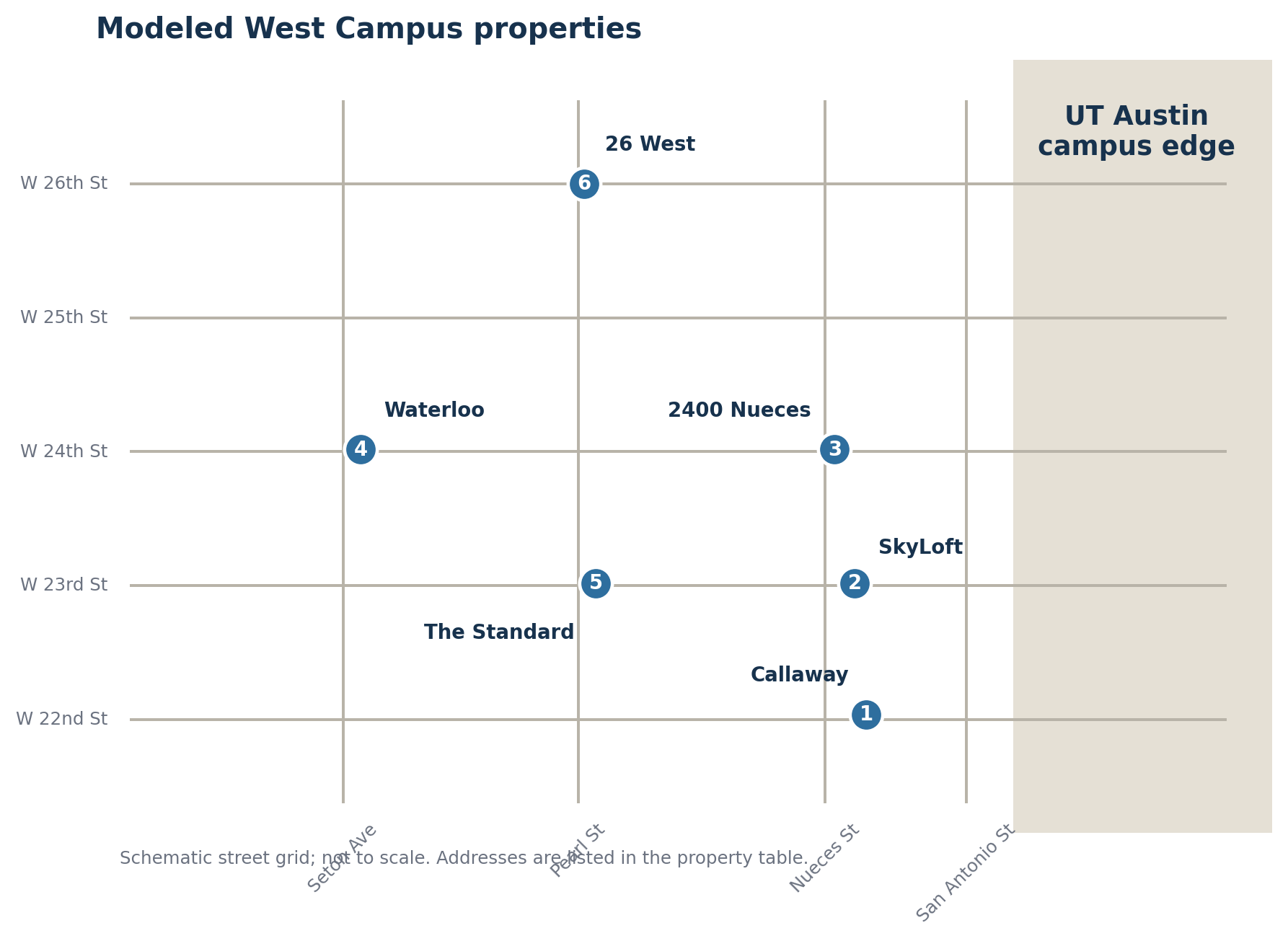
The sample was chosen for the quality of the available ownership and financing evidence. SkyLoft exposes a 2019 securitized mortgage and preferred-equity stack. 2400 Nueces records a private ground-lease development followed by a university purchase. Waterloo connects a 0.45-acre site, a density bonus, a 796-bed tower, and a sale to Global Student Accommodation. The Standard shows construction debt followed by a recapitalization. Callaway provides a service-heavy private-dorm product. 26 West supplies an older asset with a reported acquisition price.
The rent collector need not own the real estate. A special-purpose borrower can hold title, another entity can be master tenant, mortgage notes can split senior and subordinate claims, and preferred capital can gain intervention rights before losing its principal. Follow those layers beyond the leasing-office name.
The sample also cannot prove market concentration. At the study cutoff, American Campus Communities, part of Blackstone, and Landmark controlled multiple properties, while UT, Global Student Accommodation, and the SkyLoft borrower represent other forms of ownership. Unresolved parcel entities and bed counts make a precise concentration ratio indefensible.
| Property | Beds | Owner / sponsor | Manager / brand | Evidence status |
|---|---|---|---|---|
| SkyLoft | 674 | NP Skyloft, DST at 2019 origination; current control unresolved | SkyLoft brand; NP Skyloft Leaseco at origination | High for 2019; incomplete currently |
| 2400 Nueces | 622 | Board of Regents of The University of Texas System | UT University Housing and Dining | High purchase evidence; asset debt allocation unresolved |
| Waterloo | 796 | Global Student Accommodation | Yugo Austin Waterloo | High sale chronology; low current debt and basis precision |
| The Standard | 934 | Landmark Properties | Landmark Properties | High sponsor evidence; recap balance and maturity undisclosed |
| Callaway | 753 | American Campus Communities / Blackstone platform | American Campus Communities | High sponsor and revenue evidence; low basis and debt precision |
| 26 West | 1,026 | American Campus Communities / Blackstone platform | American Campus Communities | High acquisition evidence; current debt unresolved |
NOI stops before the owner’s financing costs
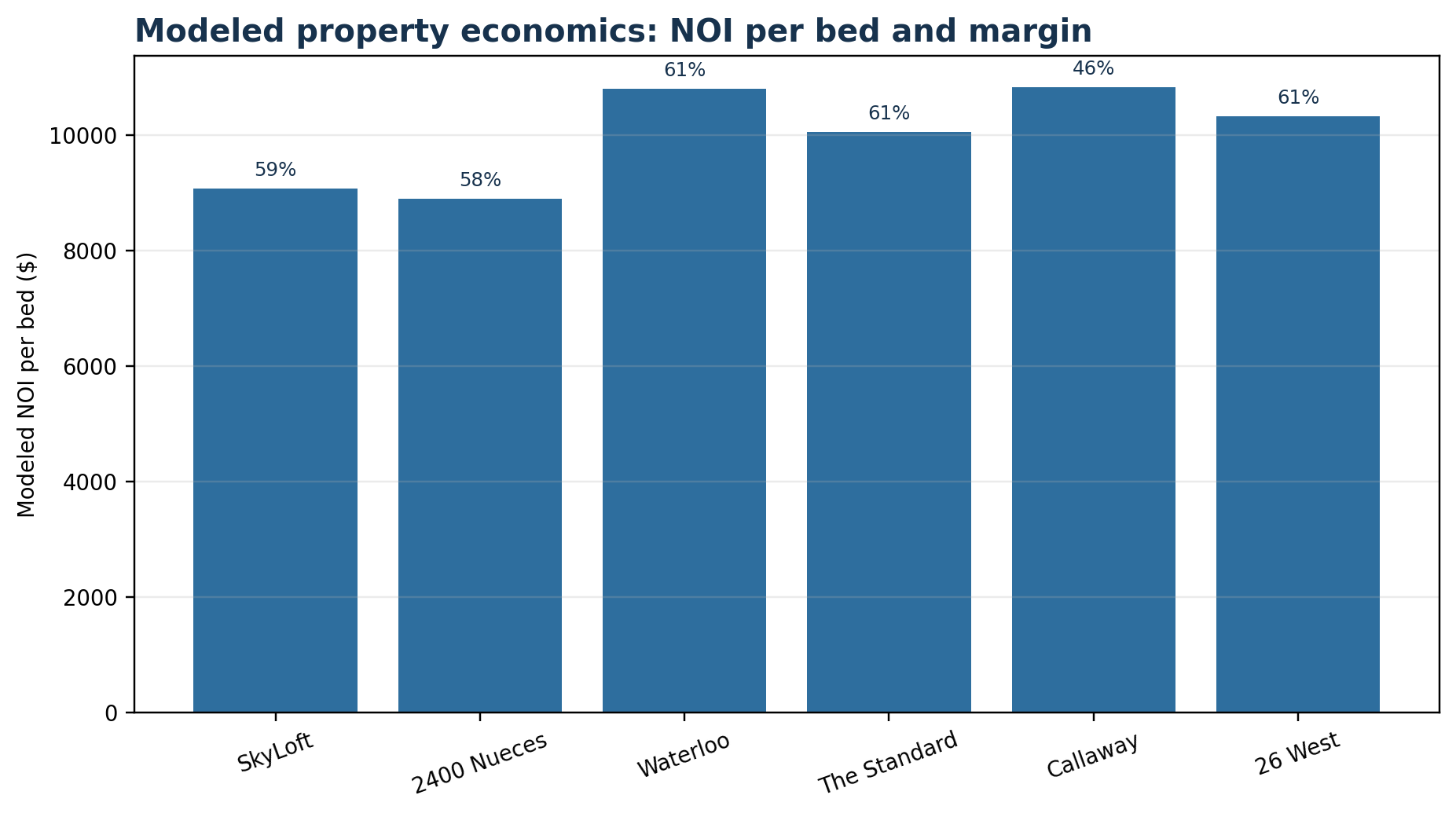
The workbook deducts vacancy, unleased beds, bad debt, and concessions from face rent, adds ancillary income, and subtracts property costs and reserves. Only SkyLoft’s 2019 operating statement is directly reported. The six modeled cases at the study cutoff use public physical data, asking rates, concessions, and documented expense controls.
Five properties produce modeled NOI margins between 58.4% and 61.5%. Callaway produces 46.0% because food, housekeeping, utilities, payroll, and contracted services lift expense per bed to roughly $12,725, versus about $6,300 to $6,800 at the other properties. The student-facing price is highest there, but a smaller share becomes property NOI.
The gap widens below NOI. Debt service, preferred returns, replacement reserves, refinancing constraints, taxes at ownership entities, and nonrecurring capital separate property performance from common-equity performance. The modeled levered IRRs span from negative 10.3% at SkyLoft to 25.5% at 26 West. Those are normalized scenarios, not realized sponsor statements.
| Property | Effective gross income | NOI | NOI margin | Modeled levered IRR | Combined-stress refi paydown | Capital-structure boundary |
|---|---|---|---|---|---|---|
| SkyLoft | $10.35M | $6.12M | 59.1% | –10.3% | $38.1M | 2019 whole loan and preferred stack disclosed |
| 2400 Nueces | $9.48M | $5.54M | 58.4% | 17.6% | $7.8M | Actual purchase; debt allocation illustrative |
| Waterloo | $13.99M | $8.60M | 61.5% | 8.3% | $41.6M | Owner known; current debt illustrative |
| The Standard | $15.44M | $9.39M | 60.8% | 10.6% | $46.3M | Recap known; current balance illustrative |
| Callaway | $17.74M | $8.15M | 46.0% | 13.0% | $26.3M | Platform ownership known; debt and basis illustrative |
| 26 West | $17.24M | $10.60M | 61.4% | 25.5% | $0.0M | Actual 2011 purchase; current debt illustrative |
SkyLoft’s preferred claim leaves little for common equity
NP Skyloft, DST acquired the 212-unit, 674-bed tower for $119.55 million. Disclosed uses, including reserves and closing costs, totaled about $124.37 million. A $66.125 million whole mortgage sat above the property: $36 million of senior notes and a $30.125 million subordinate companion note. A $35 million preferred-equity position sat above common sponsor capital.
The preferred security earned a 14% return—8% current pay and 6% accrual—and held change-of-control and loan-purchase rights under a recognition agreement. The mortgage itself appeared conservative at origination, but its reported LTV and DSCR did not treat the preferred claim as property debt.
At normalized NOI of $6.12 million, whole-loan interest consumes about $2.94 million, preferred current pay consumes $2.8 million, and replacement reserves consume about $202,000. Approximately $171,000 remains for common equity before ownership-level costs and taxes. The central modeled value of $87.4 million covers the mortgage but not the mortgage plus preferred principal. In this modeled case, common equity is out of the money and the preferred layer is impaired before accrued return.
Fitch reported special servicing in March 2024 and 42% occupancy in March 2025. An active leasing page does not resolve that capital distress: operations can continue while control and recovery claims change.
| Layer | Amount | Economic position | Key term or right |
|---|---|---|---|
| Senior mortgage notes | $36.0M | Last property debt layer to lose value | Part of 120-month interest-only whole loan |
| Subordinate companion note | $30.125M | Impaired after junior capital and before senior notes | Part of the same $66.125M whole loan |
| Preferred equity | $35.0M | Ahead of common economically | 14% return; control and loan-purchase rights |
| Implied common sponsor capital | $23.24M | First capital layer to lose residual value | Derived from disclosed total uses |
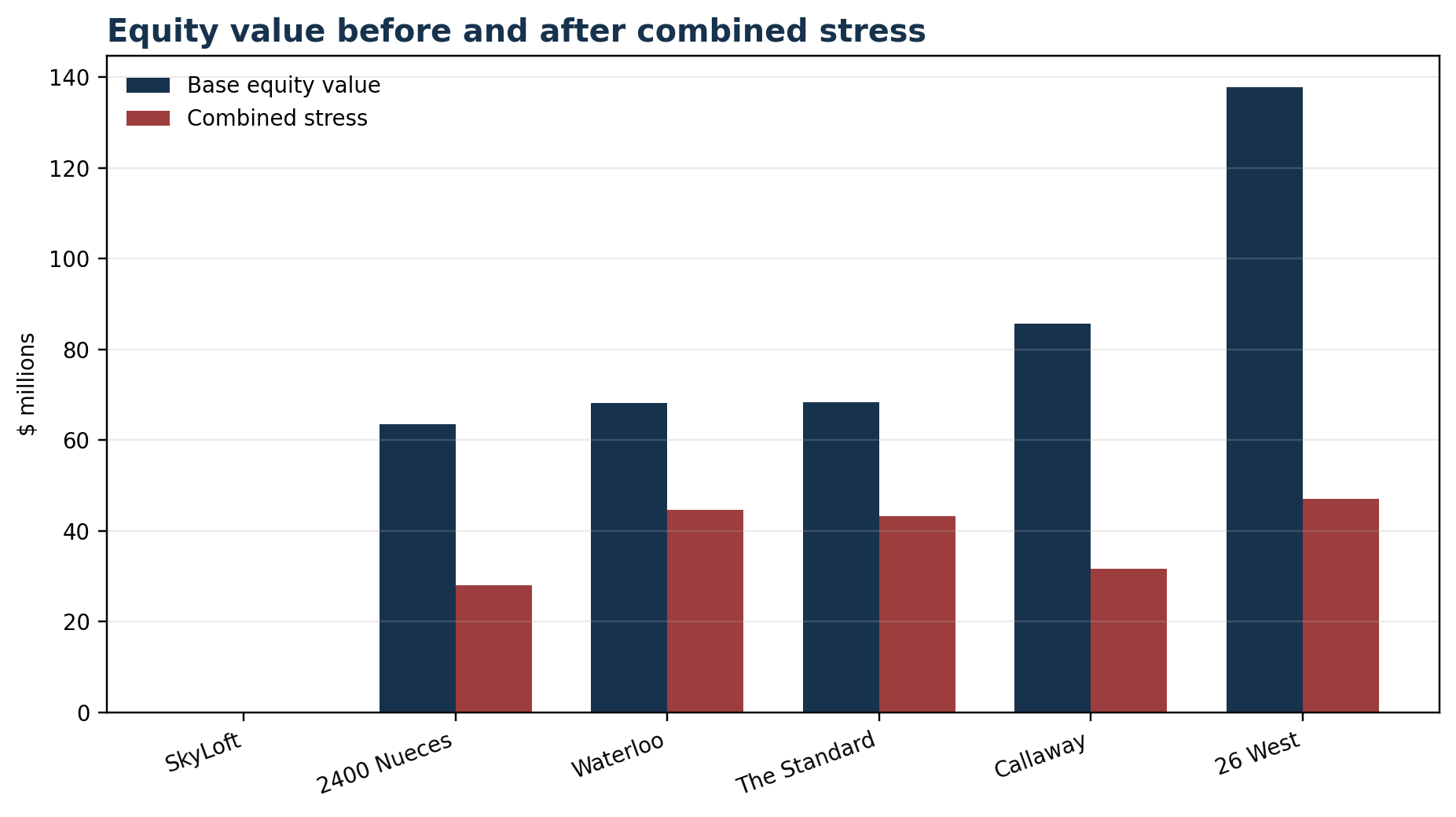
Only SkyLoft has a disclosed loan stack in the package. The other five bars pair illustrative debt with modeled residual equity; they do not report current financing balances.
Disclosed debt & preferred · derived common capital
SkyLoft2019 disclosed debt and preferred; common derived from total uses- Senior / modeled debt
- $36.0MDisclosed
- Subordinate mortgage
- $30.125MDisclosed
- Preferred equity
- $35.0MDisclosed
- Common / residual equity
- $23.24MDerived
Illustrative debt + modeled residual equity
2400 NuecesIllustrative RFS-bond allocation; actual project balance not public- Senior / modeled debt
- $42.0MIllustrative
- Common / residual equity
- $63.5MModeled
- WaterlooOwner established; current debt illustrative
- Senior / modeled debt
- $88.0MIllustrative
- Common / residual equity
- $68.3MModeled
- The Standard2018 construction loan established; current recap debt illustrative
- Senior / modeled debt
- $95.0MIllustrative
- Common / residual equity
- $68.3MModeled
- CallawayPlatform established; current debt illustrative
- Senior / modeled debt
- $62.5MIllustrative
- Common / residual equity
- $85.7MModeled
- 26 WestAcquisition established; current debt illustrative
- Senior / modeled debt
- $38.8MIllustrative
- Common / residual equity
- $137.8MModeled
University ownership and development entitlement change the model
2400 Nueces is a useful control precisely because it is not a clean private-market comparable. The UT System bought the leasehold estate and improvements for $74.759 million in 2018. University ownership changes taxes, governance, lease terms, and the required guarantor. The model assumes no property-tax expense and produces $5.54 million of NOI. Its 17.6% modeled levered IRR depends on an illustrative bond allocation, so the purchase price is established while the asset-level financing is not.
The university’s published nine- and 12-month options show why term matters. A higher nine-month installment can still cost less over the academic year. Proximity alone does not require a full-year private-tower commitment.
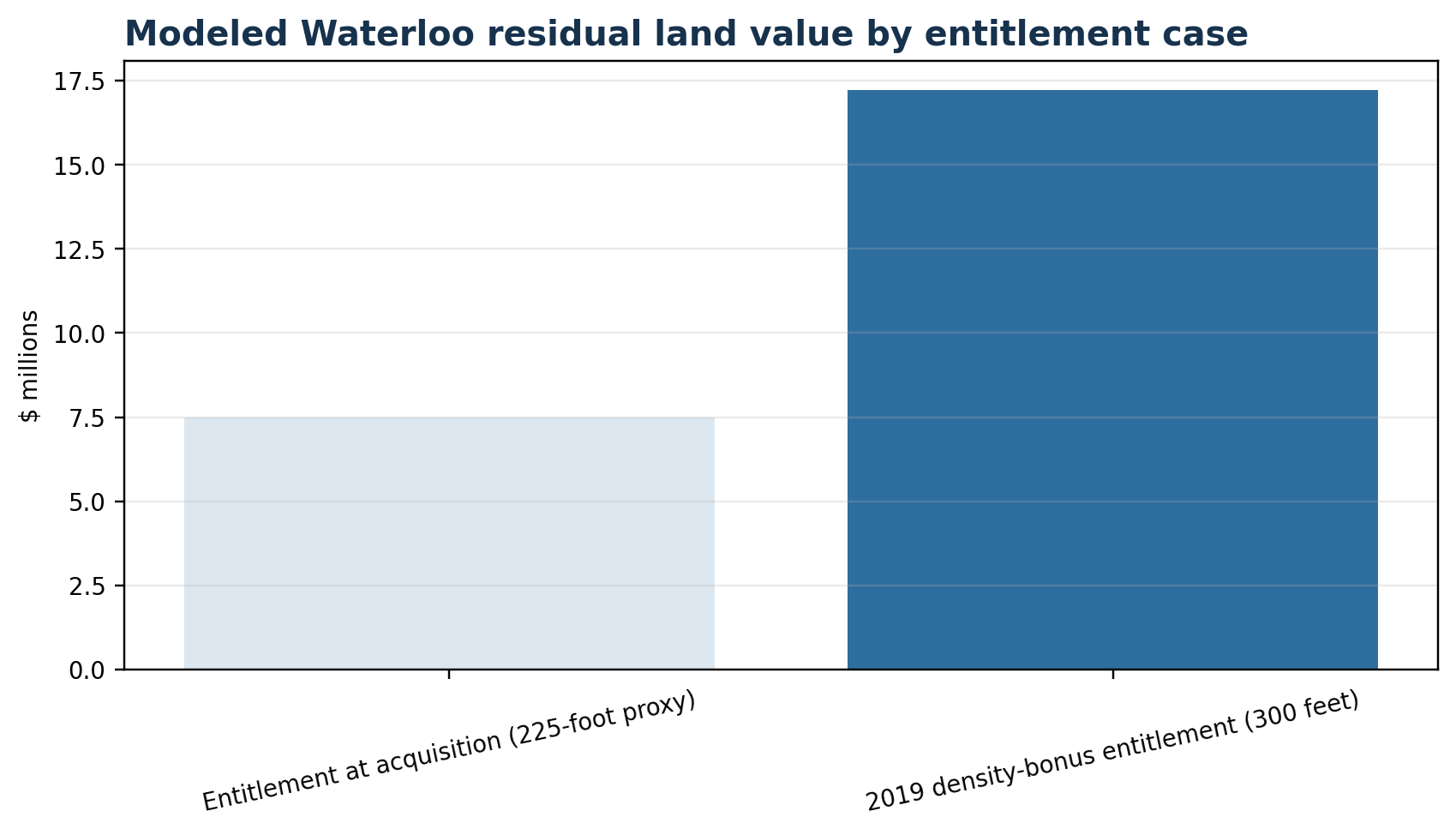
Waterloo turns land-use entitlement into a development calculation. LV Collective acquired a 0.45-acre site, used a November 2019 density-bonus amendment to support a 300-foot, 796-bed tower with an affordable set-aside, delivered it in 2022, and sold it to Global Student Accommodation. The sale price and full budget were not disclosed, so the workbook reconstructs a central $155 million development cost rather than presenting one invented transaction number.
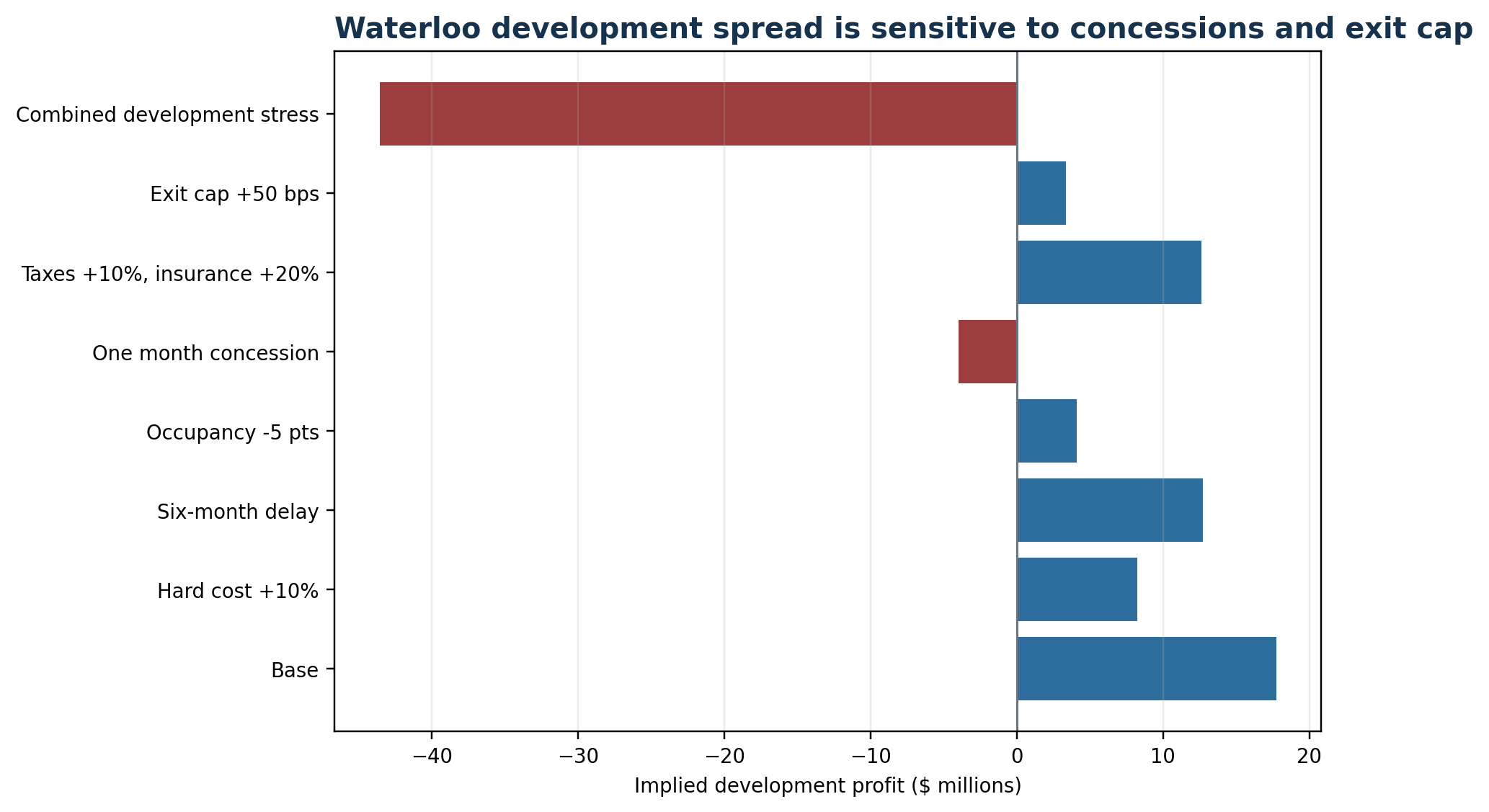
At $9.5 million of stabilized NOI, the central yield on cost is 6.13%. A 5.50% exit cap implies $172.7 million of value and $17.7 million of development profit. That 63-basis-point spread is thin: a 50-basis-point exit-cap increase cuts profit to $3.3 million, one month of effective concessions makes it slightly negative, and the combined cost, leasing, and exit shock produces a modeled $43.6 million loss.
Basis separates The Standard, Callaway, and 26 West
The Standard shows how a high-margin tower can sit close to a financing threshold. Landmark completed the 934-bed property after a reported $101.1 million construction loan and retained ownership in a 2023 recapitalization. The recap balance, rate, and maturity were not disclosed, so the workbook uses a $95 million illustrative balance at the study cutoff. Under the combined stress, the model requires the largest paydown in the sample: $46.3 million.
Callaway reaches similar NOI with a different statement. Its $17.74 million of effective gross income is the sample high, but $9.58 million of expense leaves $8.15 million of NOI. At an illustrative central basis and 50% leverage, the ten-year common IRR is 13.0%. A student can face an expensive, difficult-to-exit contract while the owner earns an ordinary modeled return for a service-heavy asset. Both can be true.
26 West is the low-basis case. American Campus Communities bought the 1,026-bed property for $86.2 million in 2011. The study’s normalized statement produces $10.60 million of NOI and a central value of $176.6 million. Its 25.5% modeled levered IRR is the sample high because the acquisition basis is far below the study’s replacement economics. It is not a realized sponsor return: debt at the study cutoff, major capital improvements, capital calls, and historical distributions remain unresolved.
- The Standard: strong operations can still face a large refinancing gap if recapitalization debt is high.
- Callaway: the highest student-facing bundle also carries the largest modeled operating cost per bed.
- 26 West: the oldest reported acquisition basis preserves the largest modeled equity cushion.
- Rent practices alone do not rank owner returns.
Preleasing reduces one risk; it does not prove scarcity
Premium West Campus beds cost more than imperfect substitutes. The model's central bridge starts with an $850 conventional split-housing control, then assigns value to walk-to-campus location, furnishings and internet, individual liability, new construction and amenities, and room or bathroom privacy. About $100 per month remains unexplained in the central case. The ranges are broad and are not a hedonic regression, so the residual cannot simply be labeled market power.
UT reported 55,000 students in fall 2025, with university beds covering only part of that population. Walking distance, roommate matching, individual liability, furnishings, privacy, and amenities have value. Early leasing, parental guarantees, fear of losing a layout, and expensive relets can also weaken bargaining power.
Rise, Rambler, and The Standard advertised concessions alongside urgency. Those pages reveal sales pressure, not remaining inventory. Executed leases, weekly availability, and property-level concession histories would be needed to measure the premium more precisely.
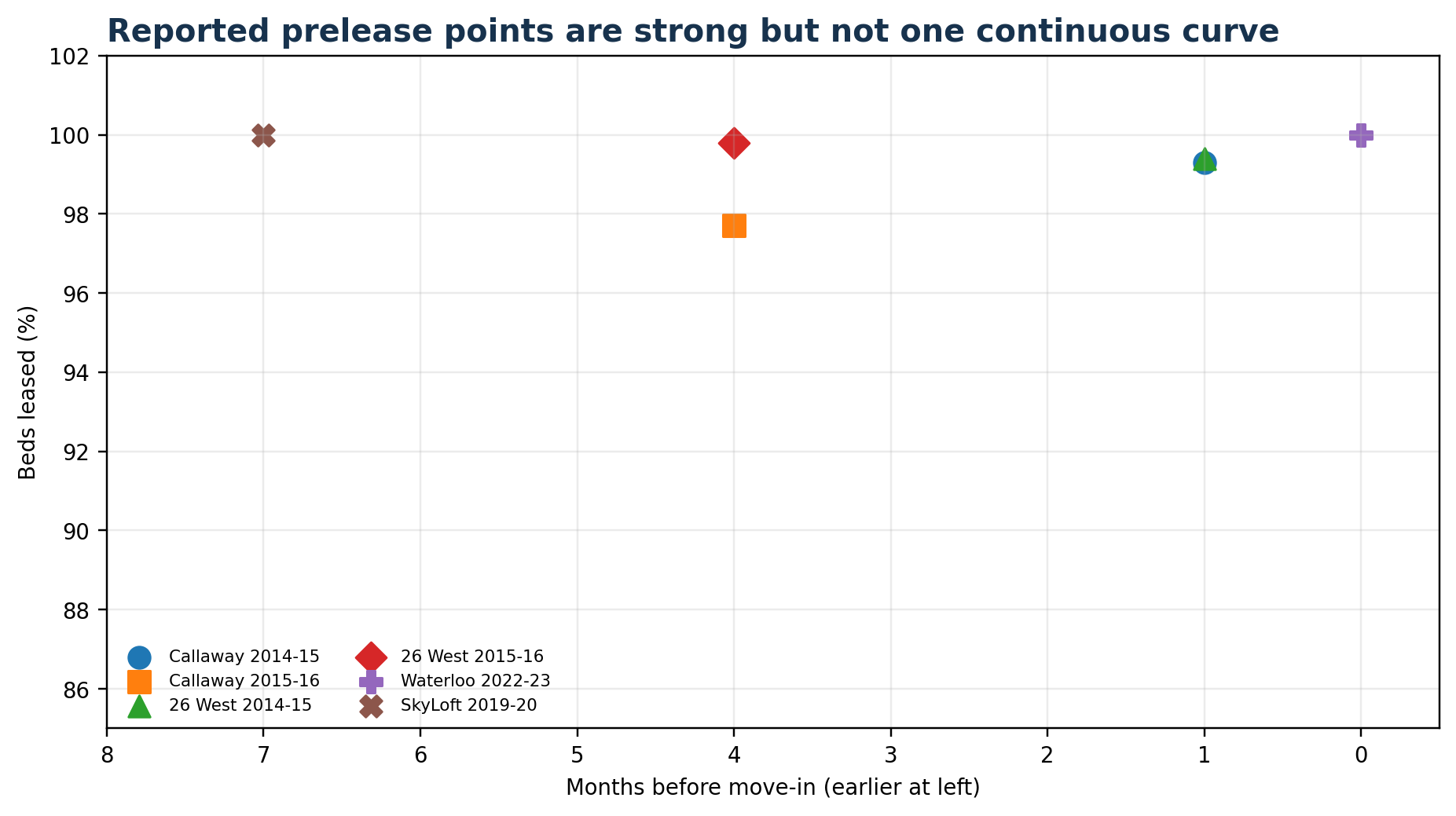
Preleasing is valuable because it converts future demand into signed paper, but points from different years do not form one market curve. SkyLoft was 100% leased in its January 2019 file and only 42% occupied in March 2025 surveillance. A strong early rent roll can reduce one year's lease-up uncertainty without immunizing the property from later demand, management, reputation, or capital problems.
Positive NOI can coexist with a refinancing shortfall
The combined model applies a 4% rent cut, seven points of occupancy loss, one additional month of concessions, 10% higher taxes, 20% higher insurance, 8% higher payroll and repairs, $500 per bed of replacement spending, a 75-basis-point cap-rate increase, and refinancing 200 basis points above the base rate. It is intentionally severe and internally linked, but it is not a forecast of West Campus.
SkyLoft begins with the least common-equity protection. NOI falls from $6.12 million to $3.94 million, cash flow to common turns negative, and implied value falls to $50.9 million—below the $66.125 million whole mortgage. Common and preferred capital are wiped in the model, and part of the subordinate note lacks value coverage.
The Standard, Waterloo, and Callaway retain positive property NOI under the stress while facing large modeled refinancing paydowns. Cash-positive operations do not ensure that the owner can replace the old loan balance. An equity injection, preferred capital, extension, sale, or control transfer may still be required.
| Property | Base NOI | Combined-stress value | Modeled refi paydown | Interpretation |
|---|---|---|---|---|
| SkyLoft | $6.12M | $50.9M | $38.1M | Value falls below disclosed whole mortgage |
| 2400 Nueces | $5.54M | $62.3M | $7.8M | Uses illustrative bond allocation; public support differs |
| Waterloo | $8.60M | $91.1M | $41.6M | Positive NOI does not preserve old illustrative balance |
| The Standard | $9.39M | $91.9M | $46.3M | Largest modeled paydown in sample |
| Callaway | $8.15M | $67.9M | $26.3M | Service-heavy expense base amplifies stress |
| 26 West | $10.60M | $104.7M | $0.0M | Lower modeled leverage preserves refinance room |
Vacancy reaches sponsor equity before senior property debt
A tenant or guarantor absorbs only a signed obligation. They do not cover vacant beds elsewhere in the building. Unleased inventory first reduces property cash flow through lost rent and added concessions. That operating shortfall then reaches common sponsor equity through lower distributions and lower value.
Preferred equity follows economically, although contractual control can move before the preferred principal is fully lost. Mezzanine and subordinate mortgage debt follow according to their documents. Senior mortgage debt is last at the property level. Reserves, enforcement costs, guarantees, and claim timing can alter recovery, but the order is set by contracts rather than the consumer brand.
At SkyLoft's central modeled value of $87.4 million, the whole mortgage remains covered while common equity is zero and the $35 million preferred principal is partly impaired. At the $50.9 million combined-stress value, common and preferred capital are gone and roughly $15.2 million of the subordinate mortgage lacks value coverage, while the $36 million senior balance remains covered.
- Signed tenant or guarantor: liable only for the executed lease, not speculative vacancy.
- Property operating cash flow: first place where vacancy, bad debt, and concessions appear.
- Common sponsor equity: first capital layer to lose residual value.
- Preferred equity: next economic loss layer, often with earlier intervention rights.
- Mezzanine or subordinate mortgage debt: impaired after junior capital according to contract priority.
- Senior mortgage: last property-level claim to absorb the remaining shortfall.
The Austin home-service ownership map traces a related local-control problem from the customer-facing brand through operating platforms and investors.
Missing debt and lease records limit the conclusions
Property-level debt, rates, maturities, guarantees and reserves at the study cutoff remain unresolved for five of the six properties. Waterloo's sale price and full development budget are undisclosed. Property-level executed leases, bad-debt histories, remaining inventory and realized concessions are unavailable.
Those gaps prevent a clean concentration ratio, a market-wide rent regression, a realized sponsor-return comparison, and a definitive ranking of refinancing risk. Filling them would require deed and UCC work, lender or sponsor disclosure, weekly lease-up files, executed-lease samples, property-level operating statements, and a complete bed and pipeline denominator.
The supported finding is the combination of scarce location, differentiated services, individual-bed pricing, early leasing, and hard-to-exit signed obligations. Property margins do not resolve owner returns. Basis and capital structure can turn a collectible rent dollar into an ordinary return, a large modeled return, or almost no common cash flow.
- Do not report a market concentration ratio from this six-property evidence sample.
- Do not present illustrative non-SkyLoft debt as current reported borrowing.
- Do not treat normalized or stress-case IRRs as realized sponsor returns.
- Do not assign the unexplained rent premium to market power without executed-lease and inventory evidence.
- Do not treat a guarantor as protection against beds that were never leased.
Compare the lease first, then the capital stack
A student’s exit options depend on the signed term, guaranty, cancellation rules, and relet process. The owner’s outcome depends on costs, basis, financing, concessions, and refinancing. The six-property model keeps those questions separate rather than inferring monopoly or realized returns from rent alone.
Sources
- West Campus investigative report
Verified Jul 22, 2026
- West Campus six-property financial model
Verified Jul 22, 2026
- West Campus dossiers, methodology, and claims matrix
Verified Jul 22, 2026
- SkyLoft UBS 2019-C16 collateral term sheet — SEC
- Fitch surveillance for UBS 2019-C16
- 2400 Nueces rates — UT University Housing and Dining
- UT System Board of Regents meeting minutes — July 11, 2018
- Waterloo development case study — LV Collective
- Waterloo acquisition report — REBusinessOnline
- The Standard recapitalization — TSB Capital Advisors
- American Campus Communities 2021 Form 10-K — SEC
- 26 West property and current pricing — American Campus Communities
- University Neighborhood Overlay Program — City of Austin
Supporting material
- Full investigative report
The complete 16-page article, exhibits, source notes, and assumption boundaries.
- Editable investigative report
The supplied editable report used as the primary source for this web edition.
- Executive analytical memo
A concise decision memo separating supported findings, model outputs, and unresolved evidence.
- Six-property financial model
The 17-sheet model covering sources, assumptions, property statements, scenarios, student cost, zoning, and loss allocation.
- Dossiers, methodology, and claims
Property dossiers, source ledger, claims matrix, counter-evidence, and methodology notes.