Financial systems
What is a Trump Account worth at 18?
In my base case, the $1,000 pilot deposit grows to $2,589 after tax at 18. For college, the 529 strategy leaves more to spend.

The short version
- I calculate that $1,000 in a Trump Account could be worth $2,589 after tax at 18 ($1,660 in 2026 dollars) at a 7% return, and $21,206 with $50 a month.
- Keeping the seed in the Trump Account and saving $50 a month in a 529 for college raises the after-tax age-18 total to $23,410 from $21,206, in the middle-tax example.
- Treasury’s $2,980–$13,800 range covers the seed alone; the familiar $173,375 figure needs 18 deposits of $5,000 at 7%.
- The first-home exception shields at most $10,000 of lifetime distributions from the additional 10% tax; ordinary income tax still applies.
I calculate that a $1,000 Trump Account deposit could be worth $2,589 after tax at age 18, or $1,660 in 2026 dollars. Saving $50 a month brings the estimate to $21,206 after tax. The November 12, 2026 model assumes a 7% annual return, 0.1% fund fee, 2.5% inflation, 22% ordinary income tax and a qualifying college withdrawal.1
Put the same monthly savings in a 529 education savings plan and keep the seed in the Trump Account, and the combined after-tax value rises to $23,410, or $15,010 in 2026 dollars. The 529 strategy adds $2,205 nominal, or $1,414 after inflation.2
Treasury’s historical figures put the seed alone at $2,980–$13,800 at 18 before taxes and inflation. That range comes from historical U.S. stock returns.24
Download the Excel model · Forward scenarios · Historical outcomes · Five-vehicle comparison. The tables show future dollars and purchasing power at the end-2026 price level, with 18 years of inflation applied to an age-18 result.1
Compare after-tax values by account
Tax assumptions
| Account | Before withdrawal | After federal tax |
|---|---|---|
| Trump Account | $23,510.59 | $20,714.26 |
| 529 plan | $20,190.99 | $20,190.99 |
| Custodial taxable | $20,190.99 | $18,782.34 |
| Parent’s Roth IRA | $20,190.99 | $18,124.97 |
| Taxable brokerage | $20,190.99 | $18,782.34 |
Example arithmetic for general information. The Trump Account receives a $1,000 pilot deposit. Private contributions stop by age 18. The model applies federal tax at withdrawal.
What is a Trump Account, and who gets the $1,000?
A Trump Account is a child’s traditional individual retirement account, or IRA, with special rules during childhood. The one-time $1,000 federal contribution is for eligible U.S.-citizen children born from January 1, 2025, through December 31, 2028, with the required Social Security number and election; eligibility for an account itself is broader.3
Contributions began July 4, 2026. Elections opened earlier. Temporary regulations took effect September 30, 2026, and Treasury completed automatic enrollment on October 1. A parent or guardian must claim an automatically created account to manage it and elect the pilot deposit if that election is still outstanding.4
During the childhood “growth period,” ordinary family, beneficiary, other-person and employer contributions share a $5,000 annual limit. Qualifying employer contributions can receive an income-tax exclusion of up to $2,500 per employee, across the employee’s covered accounts, and count toward the child’s $5,000. The seed, qualifying general contributions and qualifying rollovers are outside that cap. Both dollar limits begin inflation adjustments after 2027; future published limits are not yet known.5
Ordinary cash investments go into qualifying broad U.S. stock-index funds without leverage. The 0.1% annual ceiling applies to the funds’ fees and expenses. Trustees can charge other fees. The September temporary regulations also permit qualifying donated stock under specified holding rules.6
The model standardizes the clock: a child born January 1, 2027, receives the seed immediately and has 18 eligible contribution years, 2027–2044, so the age and calendar-year rules line up; the effective temporary rule expressly uses the birthday for section 530A.41 A child born in 2025 and first funded in July 2026 does not have 18 full years before turning 18. The model’s maximum saver contributes $111,100 in total: a projected indexed limit each year, starting at $5,000 and reaching $7,600 in 2044.7
How are Trump Account withdrawals taxed?
Family money already taxed becomes basis: the amount the child can eventually recover without being taxed again. The federal seed, excluded employer money and qualified general contributions create no basis; those dollars and investment earnings are generally taxable as ordinary income when distributed.8 Ordinary-income tax uses rates applied to income such as wages. In a taxable investment account, long-term capital gains—the profit on investments held for more than a year—can receive a lower rate.15
The IRS allocates each withdrawal proportionately to the account’s after-tax basis and taxable balance. The child can recover the share allocated to basis tax-free. Trump Accounts use their own basis calculation under the IRA aggregation rules.8
For the base $50-monthly example, the account reaches $24,140.81 before withdrawal tax at 18. Family deposits total $10,800, leaving $13,340.81 taxable on full liquidation. At the stated 22% rate, income tax is $2,934.98, leaving $21,205.83. A qualified college withdrawal avoids the additional early-distribution tax, but it does not erase ordinary income tax.9
The special childhood restrictions generally end on January 1 of the year the child turns 18. Before 59½, the taxable portion ordinarily also faces a 10% additional tax, unless an exception applies. Qualifying college expenses are one exception; a qualifying first home has a $10,000 lifetime limit. At 60, that early-distribution tax disappears, but ordinary income tax remains. Provider access procedures may use the eighteenth birthday; the January 1 newborn example avoids this operational mismatch.10
The kiddie tax can matter here too. It applies parental tax calculations to certain children’s unearned income, depending on age, student status and support. IRA income is not automatically sheltered from that rule. Our 12%, 22% and 37% ordinary rates are marginal-dollar scenarios, with relevant allowances assumed used by other income; they are not completed tax returns for every child with that family income.11
A seed-only unmarried dependent full-time student with no other income can owe less. Keeping the same return and inflation assumptions, projecting the published 2027 $1,400 allowance forward at an unrounded 2.5% annually, and applying a 10% child rate to the next band gives $3,206 after tax, or $2,056 real, at 18.40
How much will it be worth at 18, 25 and 60?
With the base assumptions, the seed alone is worth $2,589 after tax at 18, $3,599 at 25 and $42,565 at 60. Contributions and the use of the withdrawal change the outcome: the age-25 example includes the additional 10% tax, while the age-18 example assumes qualifying college expenses.12
Base projections prepared November 12, 2026. Each cell shows after-tax nominal dollars, followed by 2026 dollars in parentheses. Contributions stop at 18; each row assumes a full withdrawal.
| Age, calendar year and use | Seed only | Seed + $50 monthly | Seed + projected maximum |
|---|---|---|---|
| 18 · 2045 · college | $2,589 ($1,660) | $21,206 ($13,596) | $182,073 ($116,739) |
| 25 · 2052 · unrestricted | $3,599 ($1,942) | $29,632 ($15,983) | $254,682 ($137,373) |
| 27 · 2054 · first home | $4,718 ($2,422) | $34,120 ($17,517) | $286,630 ($147,156) |
| 60 · 2087 · retirement | $42,565 ($9,674) | $311,915 ($70,893) | $2,615,702 ($594,506) |
Source: forward_scenarios.csv, base rows; 7% gross annual total return, 0.1% annual fee, 2.5% inflation, 22% ordinary tax. First-home rows use the conservative interpretation explained below.12
The federal $1,000 alone is worth $1,660 in 2026 dollars at 18 and $9,674 at 60
After-tax value of the federal $1,000 seed alone at withdrawal, USD, by age and use
Show the numbers
| USD | Dollars received | 2026 purchasing power |
|---|---|---|
| Age 18, college | $2,589 | $1,660 |
| Age 25, other use | $3,599 | $1,942 |
| Age 60, retirement | $42,565 | $9,674 |
Adding $50 a month lifts the value at 18 to $13,596 in 2026 dollars, and at 60 to $70,893
After-tax value of the $1,000 seed plus $50 a month of family deposits to age 18, USD, by age and use
Numbers and method
| USD | Dollars received | 2026 purchasing power |
|---|---|---|
| Age 18, college | $21,206 | $13,596 |
| Age 25, other use | $29,632 | $15,983 |
| Age 60, retirement | $311,915 | $70,893 |
Figure 1. Estimates as of November 12, 2026. Source: forward_scenarios.csv; assumptions above. Future calendar years are 2045, 2052 and 2087 for ages 18, 25 and 60.
Three assumptions carry most of the result: how much is deposited and when; the investment return after fees and inflation; and the tax rate and withdrawal exception at the end. The base annual return after the modeled fee is 6.893%: 1.07 × 0.999 − 1. Returns include reinvested dividends. The model uses the same fee assumption across vehicles to isolate tax treatment.1
The low and high cases use 4% and 10% gross annual returns, respectively. At 18, their after-tax outcomes in 2026 dollars are:12
| Saver | Low: 4% | Base: 7% | High: 10% |
|---|---|---|---|
| Seed only | $995 | $1,660 | $2,731 |
| Seed + $50 monthly | $10,276 | $13,596 | $18,391 |
| Seed + projected maximum | $93,103 | $116,739 | $149,381 |
The low seed-only result is roughly its original purchasing power after tax. The maximum case mostly reflects a large family-saving commitment, not the government’s $1,000 alone.12
What have stocks returned over 18 years?
The complete Shiller sample produces 1,650 overlapping 18-year windows, with annualized real stock returns of 2.00%, 6.73% and 11.01% at the 10th, 50th and 90th percentiles before model fees. Each percentile ranks a return within that historical sample.13
The input contains 1,866 complete monthly observations, January 1871–June 2026; later rows lack complete dividend inputs and are excluded. Shiller’s average prices and interpolated dividends approximate an index investment.13
For each window, the model replays the entire monthly real-return sequence, then adds the forward 2.5% inflation assumption and modeled fee. It deposits $50 at each month-end or the projected maximum at each year-end. It does not plug an annualized percentile return into an annuity formula: the order of strong and weak months affects money deposited along the way. Each saver gets percentiles from its own distribution of terminal balances.14
Historical-path estimates at age 18, prepared November 12, 2026: after-tax 2026 dollars, 22% ordinary tax, qualifying college use.
| Saver | 10th percentile | Median | 90th percentile |
|---|---|---|---|
| Seed only | $1,094 | $2,473 | $5,020 |
| Seed + $50 monthly | $10,502 | $17,918 | $30,919 |
| Seed + projected maximum | $90,112 | $145,575 | $241,741 |
Historical stock paths turn the federal $1,000 into $1,094 to $5,020 at 18
After-tax value at 18 of the $1,000 seed alone, 10th, median and 90th percentile of 18-year US stock paths, 2026 dollars
Show the numbers
| USD, 2026 dollars | After-tax value at 18 |
|---|---|
| 10th percentile | $1,094 |
| Median | $2,473 |
| 90th percentile | $5,020 |
Adding $50 a month, history gives $10,502 to $30,919 at 18
After-tax value at 18 of the $1,000 seed plus $50 a month, 10th, median and 90th percentile of 18-year US stock paths, 2026 dollars
Show the numbers
| USD, 2026 dollars | After-tax value at 18 |
|---|---|
| 10th percentile | $10,502 |
| Median | $17,918 |
| 90th percentile | $30,919 |
With the projected maximum contributions, history gives $90,112 to $241,741 at 18
After-tax value at 18 of the $1,000 seed plus projected maximum contributions, 10th, median and 90th percentile of 18-year US stock paths, 2026 dollars
Numbers and method
| USD, 2026 dollars | After-tax value at 18 |
|---|---|
| 10th percentile | $90,112 |
| Median | $145,575 |
| 90th percentile | $241,741 |
Figure 2. Source: Shiller monthly data through June 2026; historical_18_year_cohorts.csv and historical_percentiles.csv. The displayed outcomes replay historical real returns under the stated future contribution, inflation, fee and tax assumptions.
The observations overlap heavily, and the sample contains one country’s stock-market history. The lower 4% nominal forward case deliberately tests a weaker return than the historical median. The historical median is useful evidence about the past; it does not settle today’s expected return.13, 14
Is a Trump Account better than a 529 or custodial account?
For qualified college spending, the modeled 529 has the highest after-tax value in all three tax scenarios, tying zero-tax taxable accounts in the lower-tax case. For a first home and retirement, the ranking changes because education benefits, capital-gains taxes, IRA rules and ownership differ.2
Every strategy below keeps the same federal seed in a Trump Account. Only $50 a month of family money for 18 years changes location. “Custodial” means a taxable account legally belonging to the child; “parent taxable” means an ordinary investment account owned by the parent. Both pay tax on modeled dividends along the way and on remaining gains when sold. Parent-owned rows assume survival, continued ownership and no inheritance-related basis change.2, 15
The lower, middle and higher tax scenarios apply 12%/22%/37% ordinary rates. Adult taxable investment rates are 0%/15%/23.8%; the last includes the 3.8% net investment income tax under the assumed income conditions. The higher custodial scenario uses a chosen 20% investment-tax rate through the model’s first 24 years and 23.8% afterward. Form 8615 also considers eligibility and uses its own January 1 birthday convention. All profiles assume other income has absorbed allowances; dividend yield is a fixed 2% modeling input.16
After-tax 2026 dollars, estimated November 12, 2026. Qualified college at 18; first home at 27; retirement at 60. Texas/federal-only baseline.
| Tax scenario | Family contribution vehicle | College, 18 | First home, 27 | Retirement, 60 |
|---|---|---|---|---|
| Lower tax | Trump Account | $14,452 | $19,221 | $79,667 |
| Lower tax | 529; eligible Roth rollover for retirement | $15,223 | $19,144 | $88,708 |
| Lower tax | Custodial taxable | $15,223 | $22,209 | $88,708 |
| Lower tax | Parent’s Roth, conditional | $14,452 | $22,209 | $88,708 |
| Lower tax | Parent taxable | $15,223 | $22,209 | $88,708 |
| Middle tax | Trump Account | $13,596 | $17,517 | $70,893 |
| Middle tax | 529; eligible Roth rollover for retirement | $15,010 | $17,440 | $87,468 |
| Middle tax | Custodial taxable | $13,930 | $19,377 | $69,106 |
| Middle tax | Parent’s Roth, conditional | $13,596 | $21,898 | $87,468 |
| Middle tax | Parent taxable | $13,930 | $19,377 | $69,106 |
| Higher tax | Trump Account | $12,313 | $14,961 | $57,732 |
| Higher tax | 529; eligible Roth rollover for retirement | $14,691 | $14,885 | $85,607 |
| Higher tax | Custodial taxable | $13,261 | $17,715 | $58,632 |
| Higher tax | Parent’s Roth, conditional | $12,313 | $21,432 | $85,607 |
| Higher tax | Parent taxable | $12,998 | $17,511 | $57,995 |
Source: five_vehicle_comparison.csv and monthly traces. Parent Roth values are conditional family-wealth benchmarks; first-home Trump values use the conservative cap allocation.2
For college at 18 the 529 and Roth path leaves $15,010, ahead of the Trump Account's $13,596
After-tax value of the same $50 monthly saving by vehicle, college use at 18, 2026 dollars
Show the numbers
| USD, 2026 dollars | After-tax value |
|---|---|
| Trump Account | $13,596 |
| 529 / Roth path | $15,010 |
| Custodial account | $13,930 |
| Parent's Roth | $13,596 |
| Parent taxable | $13,930 |
For a first home at 27 the parent's Roth leaves $21,898, against $17,517 in the Trump Account
After-tax value of the same $50 monthly saving by vehicle, first-home use at 27, 2026 dollars
Show the numbers
| USD, 2026 dollars | After-tax value |
|---|---|
| Trump Account | $17,517 |
| 529 / Roth path | $17,440 |
| Custodial account | $19,377 |
| Parent's Roth | $21,898 |
| Parent taxable | $19,377 |
For retirement at 60 the 529 and parent's Roth paths leave $87,468, ahead of the Trump Account's $70,893
After-tax value of the same $50 monthly saving by vehicle, retirement use at 60, 2026 dollars
Numbers and method
| USD, 2026 dollars | After-tax value |
|---|---|
| Trump Account | $70,893 |
| 529 / Roth path | $87,468 |
| Custodial account | $69,106 |
| Parent's Roth | $87,468 |
| Parent taxable | $69,106 |
Figure 3. Middle-tax scenario, 2026 purchasing power, estimated November 12, 2026. Source: five_vehicle_comparison.csv. The same federal seed is included in every strategy; parent Roth ownership and age conditions apply.
A 529 plan permits tax-free withdrawals for qualifying education. For this middle-tax household, the family-funded 529 reaches $20,821.20 tax-free at 18, alongside $2,589.29 after tax from the seed. That explains the $23,410.50 total. Education expenses must support the tax treatment, including coordination with education credits; the model assumes sufficient qualifying costs.17
A 529 is not permanently trapped in education. Eligible transfers to the beneficiary’s Roth IRA have a $35,000 lifetime ceiling, annual IRA limits, a 15-year account requirement and exclusion of contributions made during the preceding five years and earnings attributable to those contributions. The retirement scenario begins transfers at 23, assumes sufficient earned compensation and no competing IRA contributions, and freezes the verified 2026 $7,500 annual IRA limit as a modeling proxy. In this base case, $32,397.24 transfers by 27, exhausting the 529 before the lifetime ceiling. This conditional strategy explains its strong retirement result; it is not an unlimited conversion right.18
A parent’s Roth is different property. Here the parent starts at 35, so is 53, 62 and 95 at the child’s three withdrawal ages. The college calculation empties the account, taxing earnings while assuming the education exception removes the additional tax. By the home date, the age and Roth holding-period assumptions permit a qualified withdrawal. The retirement comparison assumes the parent is still alive and still owns the account at 95, with sufficient contribution eligibility and room along the way. Inherited-Roth rules can require earlier distribution; this is not a child’s Roth account.19
For the middle-tax retirement case, the Trump Account’s $70,893 real modestly exceeds the custodial account’s $69,106 because tax deferral eventually offsets part of its ordinary-income disadvantage. It does not exceed the qualifying 529-to-Roth strategy here. At the higher rates, the custodial result exceeds the Trump result. The ranking depends on tax rates, dividend yields and the holding period.2
Which assumptions change the answer most?
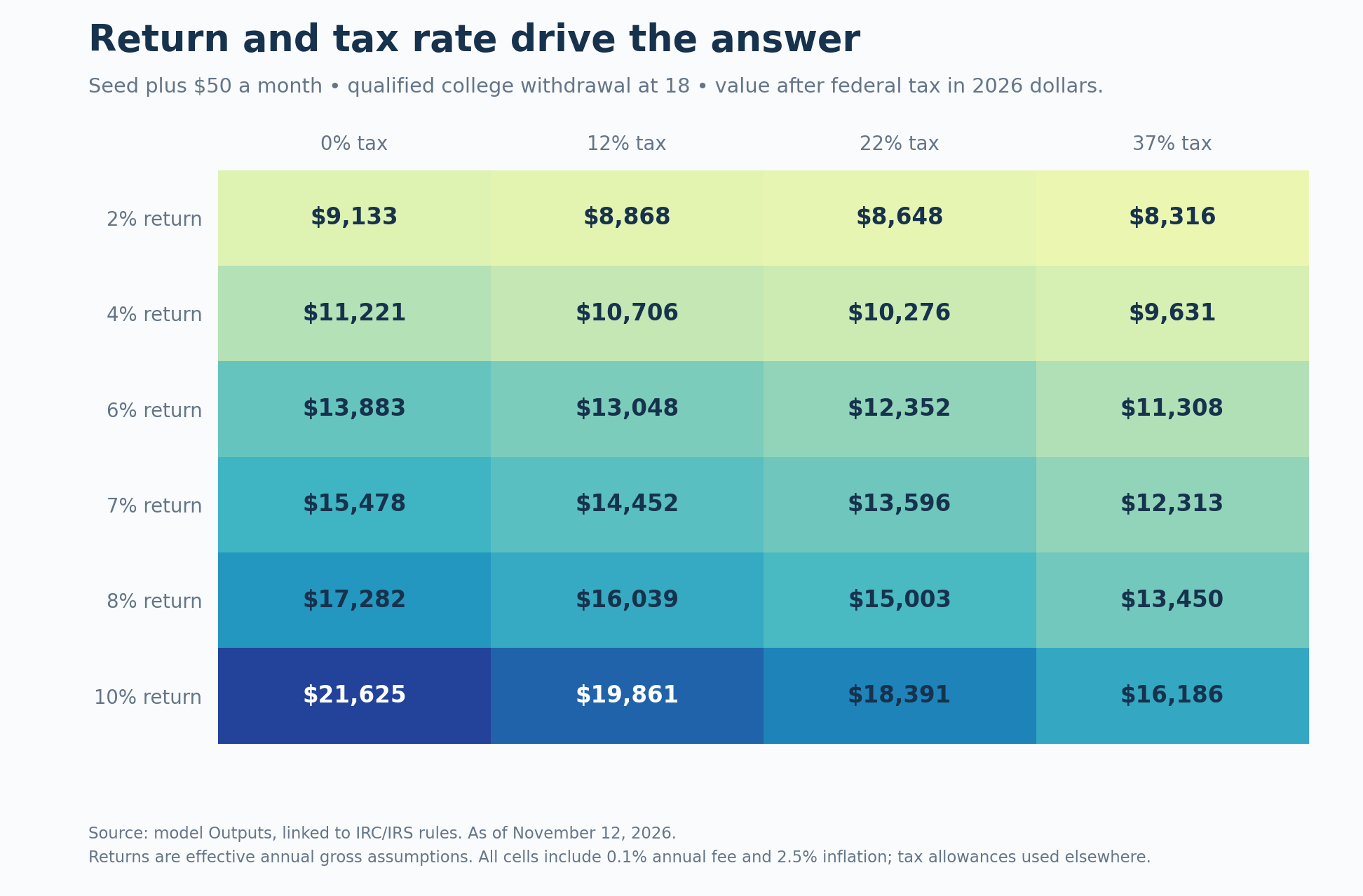
Return and withdrawal tax jointly move the age-18 answer substantially. For the $1,000 seed plus $50 monthly, the same model ranges from $8,316 real at 2% gross returns and 37% ordinary tax to $21,625 real at 10% gross returns and no ordinary tax.32
Age-18 after-tax 2026 dollars; qualifying college use; estimates prepared November 12, 2026.
| Gross annual return | 0% ordinary tax | 12% ordinary tax | 22% ordinary tax | 37% ordinary tax |
|---|---|---|---|---|
| 2% | $9,133 | $8,868 | $8,648 | $8,316 |
| 4% | $11,221 | $10,706 | $10,276 | $9,631 |
| 6% | $13,883 | $13,048 | $12,352 | $11,308 |
| 7% | $15,478 | $14,452 | $13,596 | $12,313 |
| 8% | $17,282 | $16,039 | $15,003 | $13,450 |
| 10% | $21,625 | $19,861 | $18,391 | $16,186 |
 (opens the full-size image)
The comparison also depends on the household’s withdrawal tax rate, account fees, intended use, state tax rules and employer or donor contributions. More complete dividend data could extend the historical sample. Inflation affects purchasing power and projected contribution limits.1, 21, 5
Does a state tax deduction change the 529 comparison?
It can add to the 529's advantage for education; the table above includes no state deduction. Texas has no state personal income tax, making the federal-only baseline useful for a Texas example.21
For a New York example, assume eligible married filers use the state’s plan, contribute $600 annually, and receive a deduction at an illustrative 6% marginal state rate. The contribution is below the state’s $10,000 joint annual deduction limit. The saving is $36 a year, or $648 over 18 years if held as cash without interest—$415.48 in modeled 2026 purchasing power at the college date.20
State treatment of Trump Accounts also matters. Pennsylvania’s guidance taxes investment income annually and distinguishes gifts from compensation-related employer contributions; Wisconsin’s July bulletin does not recognize the federal exclusion. Neither state can be represented by applying the federal deferral formula unchanged.21
Can you use a Trump Account to buy a house?
Yes, after the childhood restrictions end, but the first-home exception protects at most $10,000 of qualifying lifetime distributions from the additional 10% tax. It does not make the entire account tax-free or exempt all its earnings from ordinary income tax.22
The base $50-monthly account reaches $43,984.05 before withdrawal taxes at 27, with $10,800 basis. Ordinary tax at 22% is $7,300.49. Applying the $10,000 home cap to gross qualifying distributions, with basis allocated proportionately, produces $2,563.95 additional tax and $34,119.61 spendable, or $17,517.00 real.23
The workbook’s main case allocates the cap across the gross qualifying distribution and its basis. Applying it directly to taxable dollars gives $2,318.41 in additional tax and $34,365.16 spendable, or $17,643.06 real. The nominal outcomes differ by $245.54. The sensitivity data give both results; the on-page calculator shows the taxable-dollar case. The IRS guidance leaves this mixed-basis home example open.23
Where do the $13,800, $173,000 and million-dollar figures come from?
They describe different contributions, return periods and tax assumptions. Treasury’s $2,980–$13,800 range concerns the seed alone; the larger examples generally require repeated deposits or much stronger long-run returns.24, 25
Treasury’s March table uses Kenneth French data. Replaying 81 birth cohorts, 1926–2006, using the following 18 annual returns, reproduces the three percentiles to the nearest $10. The September temporary rule republishes the same historical table.24, 39
Treasury seed-only illustration, restated November 12, 2026: age 18, 22% ordinary tax, qualifying college use, 2.5% annual inflation.
| Historical percentile | Published nominal | Rebuilt nominal | 2026 dollars before tax | 2026 dollars after tax |
|---|---|---|---|---|
| 10th | $2,980 | $2,981.07 | $1,911 | $1,491 |
| 50th | $6,180 | $6,178.70 | $3,962 | $3,090 |
| 90th | $13,800 | $13,803.23 | $8,850 | $6,903 |
Treasury's published $2,980 to $13,800 range falls to $1,491 to $6,903 after 22% tax and 2.5% inflation
Treasury's published historical seed illustration, restated for a qualified withdrawal at 18, USD
Numbers and method
| USD | Published nominal balance | After 22% tax and 2.5% inflation (2026 dollars) |
|---|---|---|
| 10th percentile | $2,980 | $1,491 |
| Median | $6,180 | $3,090 |
| 90th percentile | $13,800 | $6,903 |
Figure 5. Source: Federal Register, March 9, 2026, Table 1; French annual returns; treasury_range_reproduction.csv. The after-tax figures apply the assumptions stated in this article.
The familiar $173,375 result follows from a $1,000 seed plus 18 end-year $5,000 deposits at 7%, with no fee or contribution indexing. Family basis is $90,000. Under the stated college tax treatment it becomes $155,033 nominal after tax, or $99,402 real. The arithmetic reproduces the figure. I found no primary Treasury attribution.25
The Council of Economic Advisers’ August 2025 charts are also reproducible: all 18 plotted values match to the published dollar. Their middle maximum-contribution outcomes are $303,757 at 18 and $1,091,899 at 28. The first uses 10.3% nominal annual returns and includes a $9,997.72 adult IRA deposit on the age-18 endpoint; the second uses 10.9% and continues adult contributions through 28. The report’s transition-year labels differ between its text and figure note, so I state the matching convention explicitly. Those adult IRA deposits require sufficient compensation and available contribution room.26, 19
Using all private contributions as after-tax basis, 22% ordinary tax and this report’s 2.5% inflation, the CEA age-18 middle maximum is $168,141 real after tax for qualifying college. The age-28 maximum is $408,236 real after ordinary tax and the additional 10% tax for unrestricted withdrawal. Deductible adult or excluded employer contributions would create less basis and a lower spendable value.27
A seed-only $1 million at 60 would require about 12.20% nominal compound annual growth, before fees. At the same 22% withdrawal tax and 2.5% inflation, that million would mean about $177,281 in 2026 purchasing power.25
How many Trump Accounts have been created and funded?
On October 29, 2026, the IRS reported nearly 70 million accounts, more than 27 million with contributions, and nearly $9 billion contributed. Treasury reported five million accounts as of April 14, before automatic enrollment.28
Treasury automatically enrolled more than 60 million accounts, and SSA says some unclaimed accounts received donor deposits. The totals count accounts and contributions. A current count of accounts claimed by families and a matching eligibility denominator remain unavailable.28
Nearly 70 million Trump Accounts exist, and over 27 million of them have received a contribution
Accounts created and accounts receiving contributions, millions, as reported October 29, 2026
Numbers and method
| million accounts | Accounts, millions |
|---|---|
| Accounts created | 70 million |
| Accounts receiving contributions | 27 million |
Source: IRS October 29, 2026 release. Created accounts include automatic enrollments. Funded accounts can include donor and government deposits (retrieved November 12, 2026).
The table shows reported deposits, employer benefits and announced commitments.29, 30
| Program, checked November 12, 2026 | Amount and status |
|---|---|
| Dell | $6.25 billion commitment; $250 per child; almost 25 million children reported funded |
| Dalio | $250 per child for approximately 300,000 Connecticut children; announced commitment, payments not verified |
| Micron | $250 million commitment; eligible employee match up to $1,000 per child and $250 community deposits |
| BNY | $1,000 match for eligible newborns of eligible U.S. employees; aggregate payments not disclosed |
| BlackRock | $1,000 match for eligible U.S. employees’ children; aggregate payments not disclosed |
| Bisignano | $250 per child ages 2–8 in Brooklyn ZIP 11234, reported deposited October 29 |
| Shotwell | One share per selected child; selection expanded to 2,050,000; expected delivery by end-2026, no fixed dollar valuation |
Source: donor and employer program announcements; donor_employer_programs.csv. Eligibility is program-specific.29, 28, 30
Dell lists a ZIP-code median-family-income threshold of about $117,300, with specified exceptions. Shotwell’s notices describe prospective deliveries. The IRS total counts contributions received.29, 30
The Joint Committee on Taxation estimated a $15.233 billion net budget cost in FY2025–34, including $14.599 billion of outlays. The displayed annual amounts sum to $15.234 billion because the figures are rounded.31
Can I rebuild these numbers or use my own assumptions?
The calculator below compares one standalone account at a time and shows nominal dollars. It puts the $1,000 pilot deposit in the Trump Account row, uses end-of-year deposits, and omits dividend taxes along the way, state deductions and 529-to-Roth rollovers. The workbook compares household strategies instead, keeping the pilot deposit in a Trump Account in every row and moving only the family savings. Its monthly-deposit tables include those additional assumptions.2, 33
For a first home, the on-page example applies the remaining lifetime exception to taxable Trump Account dollars. The workbook also allocates the exception across gross distributions and basis, showing how that choice changes the result.23
The next investment-rule check is December 17, 2026, after the scheduled December 16 hearing. The next annual check is January 15, 2027. Final regulations, revised limits and new participation figures can change these results sooner.34
Austin’s school tax and operating budget looks at how tax collections finance public education. Where Austin property tax goes traces the recurring tax on a home.
Appendix A — What are the Trump Account rules?
Rules checked November 12, 2026.
| Question | Current rule and source |
|---|---|
| Who owns it? | The child owns a designated traditional IRA; it is not a Roth. The account does not automatically lose its Trump designation after childhood. IRC 530A(a), (b), (h); Notice 2025-68 G-2.3, 8 |
| Who is eligible? | Account: valid SSN and under 18 at the election year’s end. Federal seed: additional U.S. citizenship, 2025–2028 birth and election conditions. IRC 530A(b)(2); 6434.3 |
| How does opening work? | Contributions were permitted from July 4, 2026. October automatic enrollment created accounts that must be claimed; the pilot requires its own election. Form 4547 instructions; TD 10056 §1.530A-1T; current IRS FAQs.4 |
| How much can be contributed? | $5,000 aggregate annually during growth, including eligible employer money; no earned-income requirement then. Seed, qualified general gifts and qualifying rollovers are outside the cap. Indexed after 2027. IRC 530A(c).5 |
| How is employer money treated? | Up to $2,500 per employee can qualify for income exclusion under a written program; it counts toward the child’s limit and creates no basis. The exclusion does not itself remove payroll-tax treatment. IRC 128; proposed REG-101355-26.35 |
| Which investments and fees? | Eligible broad U.S. index funds, without leverage, with fund fees/expenses at most 0.1%. Qualifying donated stock is an exception, generally held until the earlier of five years or growth-period end. Trustee fees are not all capped. IRC 530A(b)(3); TD 10056 §1.530A-7T.6 |
| Which dollars are taxed? | After-tax family contributions create basis. Federal, excluded employer and qualifying general gifts create no basis. Earnings and zero-basis dollars are taxable; distributions allocate basis proportionately. IRC 530A(d)(2), (h)(4); Notice G-1.8 |
| Can money leave during childhood? | Ordinary withdrawals prohibited. Exceptions include qualifying whole-account transfers, an ABLE transfer in the year the child turns 17, excess-contribution correction and death. Excess-contribution earnings face a special 100% tax. IRC 530A(d)–(e).36 |
| What changes at 18? | Growth restrictions end January 1 of the year the child turns 18; ordinary IRA contribution and distribution rules generally apply. Operational access may use the birthday.10 |
| What additional tax applies? | Generally 10% of taxable early distributions before 59½. College exceptions require eligible expenses; first-home exception has a $10,000 lifetime cap. Both still leave ordinary tax. IRC 72(t).10, 22 |
| What about financial aid? | General FAFSA rules exclude noneducation IRA balances; applying this to Trump Accounts is an inference, because no Trump-specific ruling was found. Taxable and untaxed distributions, excluding rollovers, can enter aid income. Custodial assets and parent 529 assets have different classifications.37 |
| What about SSI and other benefits? | SSA excludes the balance during growth, then counts it as a resource from January 1 of year 18. Routing wages or benefits into the account does not remove income counting. General SNAP IRA exclusion is an inference for Trump Accounts; MAGI Medicaid has no asset test. Eligibility varies by benefit program.38 |
| What about state taxes? | Federal rules do not settle state conformity. Texas has no personal income tax; Pennsylvania and Wisconsin apply their own rules. This report does not supply a 50-state determination.21 |
Appendix B — How does the calculator do the arithmetic?
For a full withdrawal, let V be the balance, B the remaining after-tax basis, t the ordinary tax rate and p the applicable additional tax. Taxable dollars are MAX(V − B, 0), and spendable dollars are V − t × MAX(V − B, 0) − p. Real value divides that result by (1 + inflation)^years.1, 8
For partial withdrawals, the basis share is proportional to total basis divided by account value. For the home scenario, the conservative additional tax is 10% × MAX(V − B, 0) × MAX(1 − MIN(V, H)/V, 0), where H is the unused lifetime home cap. The alternative is 10% × MAX(V − B − H, 0). Both appear in the specification because the mixed-basis allocation is unresolved in the located guidance.23
Taxable accounts add reinvested after-tax dividends to basis, preventing those dollars from being taxed twice on sale. A 529 tracks remaining basis when money moves to a Roth. Parent Roth calculations distinguish contribution basis from earnings and use the parent’s age. The workbook uses stated tax rates for its examples.2
The CEA reproduction includes contributions at year zero and at the age shown. In the forward model, family deposits end before age 18. The CEA data show all 18 points and contribution assumptions. Treasury’s 81 cohort balances use the historical-return sample.26
Questions about Trump Accounts
What could a $1,000 Trump Account deposit grow to?
In the base model, a $1,000 deposit grows to $2,589 after tax at 18, or $1,660 in 2026 dollars. That assumes a 7% annual return, a 0.1% fee, 2.5% inflation, 22% ordinary income tax and a qualifying college withdrawal.1
Who qualifies for the $1,000 Trump Account contribution?
The federal pilot covers eligible U.S.-citizen children born from January 1, 2025, through December 31, 2028, with the required Social Security number and election. Other eligible children can have an account without the federal deposit.3
Are Trump Account withdrawals tax-free at 18?
The share of the withdrawal allocated to after-tax contributions comes out tax-free. Earnings and contributions that created no basis generally face ordinary income tax. Qualifying college expenses can remove the additional early-withdrawal tax.8, 10
What does the college example show for a 529?
Saving $50 monthly in a qualifying 529 and keeping the seed in a Trump Account produces $23,410 after tax at 18 in the middle-tax example. Saving both in the Trump Account produces $21,206 under the same return and fee assumptions.2
Can a Trump Account pay for a first home?
After childhood restrictions end, a qualifying first-home withdrawal can avoid the additional 10% tax up to a $10,000 lifetime cap. Ordinary income tax still applies to taxable dollars. The workbook shows both ways of allocating that cap when a withdrawal includes after-tax basis.22, 23
Sources and calculation references
All sources below were accessed November 12, 2026. The numeric claim ledger maps each modeled figure to a workbook cell. The source table records primary documents, page or section, URL, date and evidence status, and the chart data maps the figures to their live formula cells.
- Excel model, inputs and forward outputs. Forward scenarios, Base case, Seed only and $50 per month rows at age 18. Estimates dated November 12, 2026. ↩
- five_vehicle_comparison.csv, named profile/vehicle/age rows; underlying middle-tax monthly trace. All strategies keep the same seed. model assumptions dated November 12, 2026. ↩
- 26 USC 530A, subsections (a), (b)(1)–(2), (h); 26 USC 6434, subsections (a)–(e). ↩
- Form 4547 instructions, contributions and pilot timing; TD 10056, effective September 30, 2026, §1.530A-1T(d)–(f); current IRS FAQs, eligibility and claiming questions 3–5; Treasury October 1 announcement. ↩
- 26 USC 530A(c); 26 USC 128, (a)–(c); 26 USC 1(f), inflation indexing. Future limits use model assumptions. ↩
- 26 USC 530A(b)(3); investment proposal CC-00349938-26, proposed §1.530A-3(e)–(f), preamble I.E and IV, August 21, 2026; TD 10056, temporary §1.530A-7T(b)(8), (d)(2)–(7). ↩
- contribution_schedule.csv, 2027–2044 rows; statutory calendar in 26 USC 530A, (b) and (c). Index forecast assumes 2.5% annual chained-CPI growth and statutory rounding down to $100. ↩
- IRS Notice 2025-68, section II, page 4, and G-1/G-2, pages 36–38; 26 USC 530A(d)(2), (h)(4). Direct quotation from G-1. ↩
- forward_scenarios.csv, Base/$50 per month/age 18; IRS Publication 970, chapter 8, education exception for early IRA distributions. ↩
- 26 USC 72(t), (1), (2)(A)(i), (2)(E)–(F), (7)–(8); Publication 590-B, Early Distributions; operator overview, transition and withdrawals at 18. ↩
- Form 8615 instructions, Unearned Income and Who Must File; Revenue Procedure 2026-35, §3.02, page 7, published 2027 amount. Main comparison uses conditional marginal rates with allowances used elsewhere; it is not a complete return. ↩
- forward_scenarios.csv, case/saver/age fields; contribution_schedule.csv. Returns, inflation, fees and future indexed caps are declared assumptions dated November 12, 2026. ↩
- Robert Shiller data page and original Excel data, Data sheet, Price/Dividend/CPI/Real Total Return Price fields and source notes; shiller_monthly_raw.csv preserves source rows. Complete sample January 1871–June 2026. ↩
- historical_18_year_cohorts.csv and historical_percentiles.csv; 216-month windows, monthly source-factor replay, linear percentile interpolation equivalent to
PERCENTILE.INC. The modeled inflation and taxes convert historical real returns into standardized future-dollar scenarios. ↩ - IRS Publication 550, investment income, dividends and basis; Form 8615 instructions. The model assumes qualified dividends, no discretionary realized gains before the endpoint, reinvestment after tax and long-term treatment for terminal gains. Recent dividend reinvestments can in practice create a small short-term component; this approximation is disclosed in the tool specification. ↩
- model_parameters.json, profiles and dividend_yield; IRS net investment income tax guidance, 3.8% rate, thresholds and IRA exclusion. Scenario assumptions are not assertions that all taxpayers in an income group face identical tax. ↩
- Publication 970, chapter 7, qualified tuition programs and coordination; five_vehicle_comparison.csv, Middle tax/age 18 rows. ↩
- 26 USC 529(c)(3)(E); IRS IRA contribution limits, verified 2026 limit; comparison_trace_middle_tax.csv, ages 23–27. No 2027 IRA limit was verified in the retrieved primary pages. ↩
- Publication 590-B, Roth ordering rules, qualified distributions and Distributions After Owner’s Death; Publication 590-A, Roth eligibility and contribution limits. Parent ages and survival use model assumptions. ↩
- New York 529 program, State Income Tax Deduction; New York 2024 tax-law changes, qualifying 529-to-Roth treatment; arithmetic: $600 × 6% × 18 = $648, then $648 ÷ 1.025^18 = $415.475509. The 6% rate and cash retention are illustrative inputs. ↩
- Texas College Savings Plan FAQs, state income tax; Pennsylvania Revenue answer 4264, updated August 7, 2026; Wisconsin Tax Bulletin 234, July 2026, page 2; TD 10056 footnote 3 does not determine state treatment. ↩
- 26 USC 72(t)(8); Publication 590-B, First Home, lifetime limit and qualifying costs. Additional eligibility and timing requirements apply. ↩
- forward_scenarios.csv, Base/$50 per month/age 27; independent review and calculator specification. Alternative formula changes only the allocation of the remaining $10,000 exception: $43,984.051788 − 22% × $33,184.051788 − $2,318.405179 = $34,365.155216. No located primary worked example resolves this precise mixed-basis home case. ↩
- March 9, 2026 Federal Register proposal, 91 FR 11199–11200, Table 1 and footnote 7. September 30 temporary rules, Table 1. French factor data, September 2026 annual market and risk-free series. Treasury range calculations use years b+1 through b+18 for birth year b. ↩
- public_claims_restated.csv; Mathulate calculator, default $173,375.09 illustration, competition evidence only. This report independently calculates the values and implied returns; no primary Treasury attribution for $173,000 was located. ↩
- CEA, August 2025, Trump Accounts Give the Next Generation a Jump Start on Saving, printed pages 1–4; cea_reproduction.csv, all 18 points. Exact timing matching the chart includes a contribution at the endpoint; see Appendix B. ↩
- cea_reproduction.csv, Middle/maximum rows at ages 18 and 28, aftertax_real_2_5pct. Family basis assumptions are $115,058.078531 and $226,719.809751, respectively. The after-tax figures are calculated from the CEA balances. ↩
- IRS, October 29, 2026, program totals; Treasury, April 15, 2026, figures as of April 14; Treasury, October 1, automatic enrollment; SSA, October 20, donor funding of unclaimed accounts. See takeup_chronology.csv. ↩
- Dell program, eligibility footnote October 9, 2026; Dalio donor release, December 17, 2025; Micron community investment; BNY April 6 release; BlackRock match announcement. donor_employer_programs.csv separates announcements from reported payments. ↩
- Shotwell gift program, Quick Answers, eligibility and notification sections; October 30 notification milestone, year-end delivery expectation. The source contains no fixed dollar valuation. See publication_gaps_demand.csv for excluded unverified pledge. ↩
- JCX-35-25, July 1, 2025, page 2, Chapter 2 item 4; page 8 footnote 1. jct_budget_estimate.csv includes annual figures, the displayed total and rounding difference. ↩
- sensitivity.csv, all return/tax combinations; age 18, end-month family contributions, college exception. All values are November 12, 2026 model estimates. ↩
- Excel model and source register, with document locators, calculation references and access dates. ↩
- Federal Register, November 4, 2026 hearing notice, 91 FR 69522, Dates. Hearing scheduled December 16 and subject to the notice’s cancellation conditions. Refresh dates are editorial targets. ↩
- 26 USC 128; REG-101355-26, August 11, 2026 proposal, §1.128-2(d)(5), (d)(7), preamble III.A.6; reliance conditions distinguish proposed clarifications from final regulations. ↩
- 26 USC 530A(d)–(e), permitted childhood distributions, ABLE rollover and excess contributions. ↩
- 2026–27 Federal Student Aid Handbook, Excluded Assets; 2027–28 SAI guide, pages 6, 8–9 and 14. Trump-specific asset classification not located; application of the general IRA rule is an inference. Institutional aid formulas can differ. ↩
- SSA POMS SI 01120.250, July 9, 2026, B.1–B.2; 7 USC 2014(g)(7), SNAP retirement-resource exclusions; 42 CFR 435.603(g), MAGI Medicaid no-asset-test rule. Separate non-MAGI and state rules are not modeled. ↩
- IRS Bulletin 2026-44, CC-00226466-26, “Withdrawal of Proposed Amendments to the Regulations,” withdraws the March 9, 2026 notice REG-117270-25 and reproposes related rules. ↩
- Workbook
Outputs!B63:C63andInputs!B76:B78; Revenue Procedure 2026-35, §3.02 (page 7) and dependent standard deduction §3.15(2) (page 13). The future modeled first allowance is $1,400 × 1.025^18; the next equal band uses an assumed 10% child rate; parent-rate excess uses 22%. Actual future brackets, eligibility and other income can change the result. ↩ - TD 10056, §1.530A-1T(c)(5), “Application of the birthday rule,” specifically illustrates a January 1 birthday. Form 8615 uses its own year-end age convention. ↩
Supporting material
- Excel model (XLSX file) Sourced inputs, live calculations and reported outputs.
- Source and model data (CSV collection) (ZIP file) Data tables, source references and calculation exports.
- Source table (CSV file) Download as CSV.
- Forward scenarios (CSV file) Download as CSV.
- Five vehicle comparison (CSV file) Download as CSV.
- First home allocation sensitivity (CSV file) Download as CSV.
- Historical 18 year cohorts (CSV file) Download as CSV.