Financial systems
Where did the tariff refunds go?
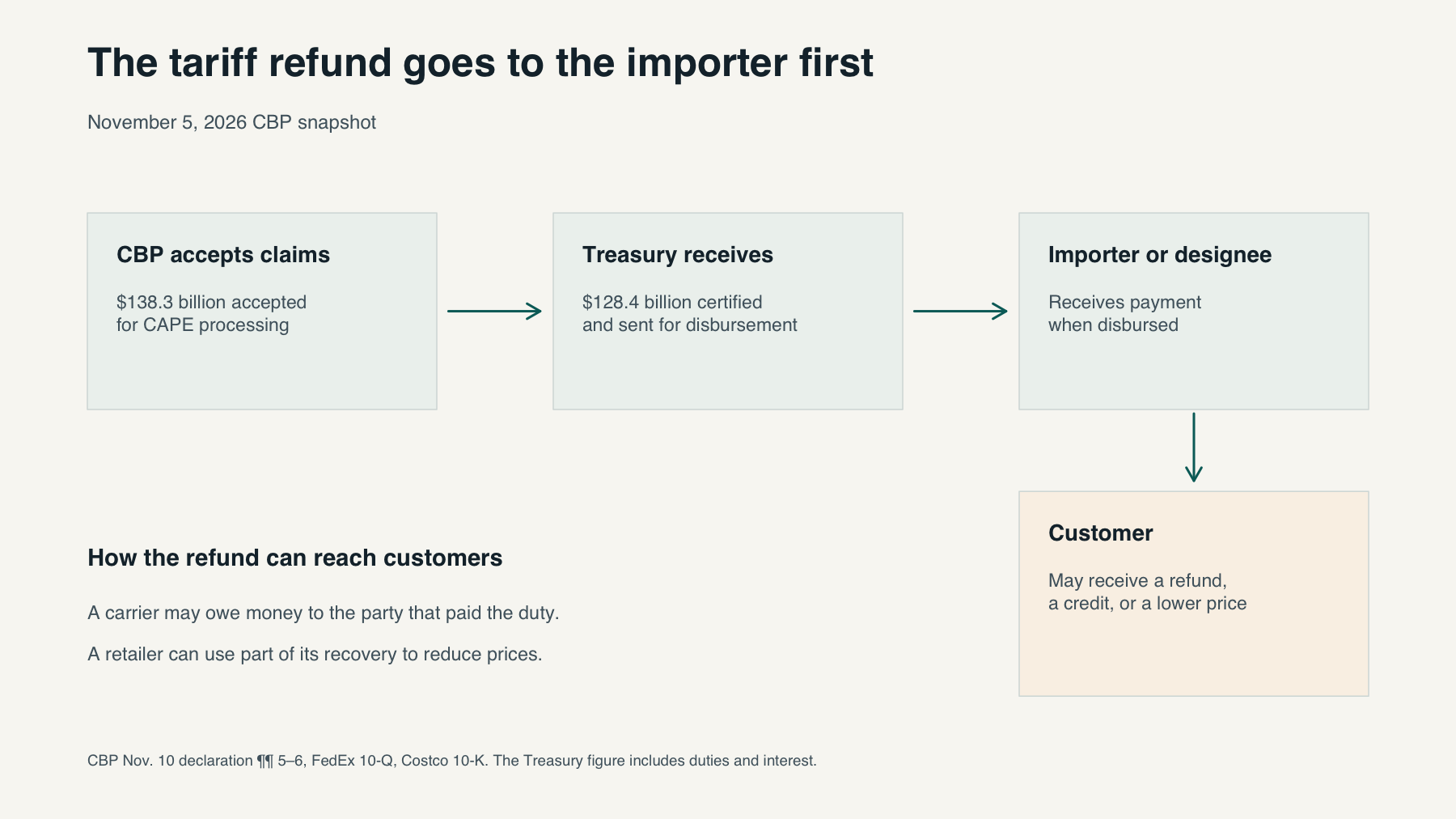
CBP sent $128.4 billion to Treasury for disbursement by November 5. Company filings show how some of that money reached customers.
The short version
- CBP had certified and sent $128.4 billion in refunds and interest to Treasury by November 5, 2026, out of $138.3 billion accepted.
- FedEx, UPS, Medline, Costco and TJX each disclosed receipts above $300 million; FedEx received $3.3 billion and accrued $2.7 billion for estimated customer refunds.
- Shoppers who paid a higher shelf price have no general CBP claim; refunds go to importers of record, and a customer billed a tariff by a carrier may be eligible for a refund tied to that shipment.
- From February to October 2026, unadjusted national CPI fell 1.58% for furniture and bedding and 0.55% for major appliances, while apparel rose 1.69% and toys 9.42%.
U.S. Customs and Border Protection had certified and sent $128.4 billion in tariff refunds and interest to Treasury for disbursement by November 5, 2026. It had accepted $138.3 billion for processing. The refund program, called Consolidated Administration and Processing of Entries, or CAPE, goes through importers, so the path to a business or household that paid higher prices depends on who imported the goods and what happened after the refund arrived.1, 4
Eight companies in the filing sample below reported about $5.117 billion in cash receipts across different dates. FedEx accounted for $3.3 billion and recorded $2.7 billion in estimated customer obligations. Costco reported $339 million across two periods and said it used some of the recovery to lower member prices. Vishay disclosed $30.008 million in customer pass-through.20, 24, 28
 (opens the full-size image)
Search company tariff refunds
| Company | Disclosure cutoff | Cash refunds ($M) | Accounting treatment | Customer evidence |
|---|---|---|---|---|
| Costco (COST) | Oct. 7, 2026 filing | 339 | $174M lower merchandise costs and $10M interest in FY2026. Another $155M received after year-end. | Member price reductions reported. Dollar amount undisclosed. |
| DHL Express | Nov. 12, 2026 check | — | Process guidance only | Eligibility depends on who imported the goods and whether DHL is authorized. |
| FedEx (FDX) | Sep. 30, 2026 | 3300 | $2.7B estimated customer liability | Shipment refund portal. Cumulative customer payments undisclosed. |
| LCI Industries (LCII) | Sep. 30, 2026 | 114.6 | Duty refunds recorded as loss recoveries. Interest reported separately. | Customer repayment amount undisclosed. |
| Medline (MDLN) | Sep. 26, 2026 | 399 | $402M reduction in goods cost and $18M interest income | $78M estimated customer liability and reduction to net sales. |
| Rockwell Automation (ROK) | Sep. 30, 2026 | 103 | Reduced cost of sales. Interest reported separately. | $85M accrued for estimated customer refunds. |
| TJX Companies (TJX) | Aug. 1, 2026 | 331 | Reduced cost of sales, including buying and occupancy costs | Customer repayment amount undisclosed. |
| UPS (UPS) | Sep. 30, 2026 | 500 | $270M in other current liabilities | About $230M passed through, inferred from the receipts and remaining amount. |
| Vishay Intertechnology (VSH) | Oct. 3, 2026 | 30.008 | Reduced product costs. Pass-through reduced net revenue. | $30.008M passed through to customers. |
Selected disclosures. Cutoff dates and interest treatment vary. A blank cash amount means the source gave no figure.
How much did the government send?
CBP’s November 10 declaration puts $9.9 billion between amounts accepted and amounts certified and sent to Treasury. The accepted category includes potential and certified refunds. The transmitted total combines duties and interest. The declaration gives no nationwide figure for the cash that had reached recipients’ bank accounts.1
| CBP snapshot | Accepted for processing | Certified and sent to Treasury | Difference |
|---|---|---|---|
| October 2, 2026 | $136.6B | $126.0B | $10.6B 2 |
| October 23, 2026 | $137.9B | $127.7B | $10.2B 3 |
| November 5, 2026 | $138.3B | $128.4B | $9.9B 1 |
CBP also reported 18,072 electronic-payment holds totaling about $737 million; those refunds had not gone to Treasury. The October 8 Court of International Trade opinion cites an estimated $166 billion in duties originally collected under IEEPA. That figure is duty principal, while the $128.4 billion includes interest. Treasury’s aggregate customs receipts cover duties under multiple authorities and cannot reconcile the two.1, 6, 8, 9
Which tariffs did the Supreme Court strike down?
The Supreme Court ruled 6–3 on February 20 that the International Emergency Economic Powers Act did not authorize the challenged tariffs. The Court affirmed the judgment in V.O.S. Selections and vacated the judgment in Learning Resources for lack of jurisdiction. The ruling addressed tariff authority. The Court of International Trade and CBP handled the refund process that followed.5, 7
| Date | What happened |
|---|---|
| February 24 | A temporary 10% Section 122 import surcharge began, with exceptions. 10 |
| March 5 | The trade court amended an order directing CBP to liquidate or reliquidate entries without IEEPA duties. Immediate compliance was later suspended as CBP built its automated process. 7 |
| April 20 | CBP launched CAPE for eligible entries with duties awaiting final accounting or finalized within the last 80 days. 4 |
| May 7 and June 11 | The trade court invalidated the Section 122 proclamation and granted relief to three importers. The Federal Circuit stayed the relief pending appeal. 11, 12 |
| July 24 | The Section 122 surcharge expired. A new Section 301 action imposed 10% or 12.5% duties on covered imports from 60 economies, subject to exclusions. 10, 13 |
| October 6 and 8 | CBP began rolling access for qualifying plaintiffs with court orders to recalculate finalized duties. The trade court certified an importer class under Rule 23(b)(2). 1, 6 |
Section 232 metals duties, Section 338 duties on covered Canadian goods and Section 301 China technology-transfer duties continued under their own authorities. USTR extended 178 exclusions under the China action through January 10, 2027. The trade court heard a challenge to the July Section 301 action on September 30.15, 16, 18, 14, 17
Which companies received refunds?
FedEx, UPS, Medline, Costco and TJX each disclosed receipts above $300 million. Filings differ on whether the reported cash includes interest. A liability records an expected obligation, a receipt records incoming cash, and a reported remittance or price reduction records what reached customers. Adding those three kinds of amounts would count the same dollars at multiple steps.20, 22, 25, 24, 26
FedEx and UPS. FedEx reported $4.6 billion in claims filed, $3.3 billion received and $2.7 billion accrued for estimated customer refunds by September 30. The filing also describes recoveries against prior credit losses, so subtracting the liability from the receipts cannot show how much FedEx paid. UPS reported about $500 million in receipts with about $270 million still to pass through, implying about $230 million already passed through from those rounded figures.20, 22
Costco and TJX. Costco received $184 million in fiscal 2026, including $10 million of interest, and a further $155 million after year-end. It reported that the duty recovery increased gross margin by three basis points after accounting for investments in member prices. It gave no dollar total for the price reductions. TJX reported $331 million of refunds including immaterial interest and recognized the amount in cost of sales. Its filing gave no dollar amount of customer repayment.24, 26
Medline, LCI Industries, Vishay and Rockwell Automation. Medline reported $399 million in cash and a $3 million receivable. It also recorded an estimated $78 million customer liability. LCI reported $114.6 million in duty refunds and $4.4 million in interest. Vishay recorded $30.008 million of actual pass-through in fiscal Q3. Rockwell disclosed $103 million in refunds paid by the government and $85 million in accrued customer credits that reduced revenue. Its $5 million of interest income is outside the sample cash subtotal.25, 27, 28, 29
Companies also raised cash against refund claims
Universal Electronics received $7.6 million under a financing agreement with a potential clawback. Its filing later showed $9 million in CBP receipts, including interest, as of September 30. Accuray raised $6.6 million against $9.3 million of asserted claims, a roughly 29% difference from face value before timing and contract terms. Accuray had remitted $2.7 million to the investor by June 30, with a further $2.8 million of receipts awaiting remittance. Both companies accounted for their agreements as financing. The investor remittances and advances sit outside the company cash subtotal.30, 31
Can shoppers or shipment customers get money back?
If a carrier itemized a tariff on your bill, a customer may be eligible for a carrier refund tied to that shipment. FedEx directs eligible customers to its refund portal and says it generally sends payment within 30 days of receiving complete and accurate payment and tax information, provided it has received the associated refund. UPS publishes instructions by shipment type. DHL’s procedure depends on who acted as importer of record and whether DHL has authorization. CBP’s published 60–90 day target applies to accepted, eligible customs filings outside compliance review.21, 23, 32, 4
Shoppers who paid a higher shelf price have no general CBP claim for the difference. The October 8 Freestyle World class covers importers of record that paid covered IEEPA duties, with exclusions for importers already litigating. H.R. 10494 proposed a $2,000 single or $4,000 joint federal rebate, subject to eligibility limits. It remained a bill in the November 12 review.6, 19
Consumers have sued retailers and carriers. The Costco complaint alleges unjust enrichment and consumer-protection violations and seeks restitution and other relief. The federal multidistrict litigation panel listed Costco, Nike, Walmart and Amazon cases for a December 3 hearing on proposed centralization, which concerns case management. FedEx reported 13 related suits consolidated in Tennessee and one pending in the trade court. The cited records show allegations and procedural steps, not any final customer recovery.33, 35, 34, 20
Did retail prices fall after the ruling?
Some did. From February to October 2026, the unadjusted CPI fell 1.58% for furniture and bedding and 0.55% for major appliances. Apparel rose 1.69%, televisions rose 5.06% and toys rose 9.42%. These are national category averages. Product mix, seasonal prices, demand, inventory and continuing tariffs can all move them.36, 38
After the February 2026 ruling, toys, apparel and televisions rose while furniture and appliances eased
U.S. CPI-U price indexes, unadjusted, January 2025 = 100, January 2025 to October 2026; ruling on February 20, 2026
Show the numbers
| Index, Jan 2025 = 100 | Apparel | Furniture and bedding | Major appliances | Toys | Televisions |
|---|---|---|---|---|---|
| Jan 2025 | 100.0 | 100.0 | 100.0 | 100.0 | 100.0 |
| Feb 2025 | 103.4 | 99.9 | 101.8 | 100.7 | 98.6 |
| Mar 2025 | 104.4 | 100.5 | 101.9 | 99.3 | 96.4 |
| Apr 2025 | 103.2 | 101.9 | 102.5 | 99.4 | 94.4 |
| May 2025 | 102.1 | 101.1 | 105.5 | 100.8 | 94.8 |
| Jun 2025 | 101.9 | 101.6 | 108.1 | 102.2 | 95.7 |
| Jul 2025 | 100.6 | 102.5 | 105.5 | 101.9 | 96.7 |
| Aug 2025 | 102.7 | 102.8 | 104.3 | 101.5 | 98.0 |
| Sep 2025 | 105.4 | 103.7 | 104.5 | 102.0 | 98.0 |
| Oct 2025 | — | — | — | — | — |
| Nov 2025 | 101.0 | 103.7 | 102.9 | 99.6 | 94.6 |
| Dec 2025 | 99.7 | 103.3 | 100.8 | 98.7 | 93.2 |
| Jan 2026 | 101.7 | 104.0 | 102.0 | 100.5 | 95.2 |
| Feb 2026 | 106.0 | 104.0 | 103.1 | 100.3 | 94.6 |
| Mar 2026 | 107.9 | 103.6 | 102.5 | 101.6 | 92.6 |
| Apr 2026 | 107.5 | 103.2 | 101.7 | 102.6 | 93.3 |
| May 2026 | 107.0 | 102.5 | 103.8 | 102.8 | 92.4 |
| Jun 2026 | 105.8 | 103.0 | 103.4 | 105.8 | 93.6 |
| Jul 2026 | 104.5 | 103.0 | 101.2 | 106.0 | 95.9 |
| Aug 2026 | 106.5 | 102.0 | 102.3 | 103.8 | 97.0 |
| Sep 2026 | 109.0 | 101.2 | 102.2 | 108.7 | 96.2 |
| Oct 2026 | 107.8 | 102.4 | 102.5 | 109.8 | 99.4 |
| Unadjusted U.S. price index | Jan. 2025 to Feb. 2026 | Feb. 2026 to latest | Latest |
|---|---|---|---|
| Apparel | +5.97% | +1.69% | Oct. 2026 |
| Furniture and bedding | +4.05% | −1.58% | Oct. 2026 |
| Major appliances | +3.05% | −0.55% | Oct. 2026 |
| Toys | +0.33% | +9.42% | Oct. 2026 |
| Televisions | −5.41% | +5.06% | Oct. 2026 |
| Consumer-goods imports excluding vehicles | +0.09% | +2.45% | Sept. 2026 |
February is the month of the ruling and includes days under different policies. BLS did not publish October 2025 CPI observations for these series during the funding lapse. The import price index excludes customs duties and covers a different basket from the retail series.36, 37, 38
Federal Reserve research measures the original price burden with more granular methods. One study estimated a 0.15 retail price response per percentage point of realized tariff rate in its sample. Another analysis estimated that the 2025 tariff increases raised core goods PCE prices by 3.1% through February 2026. Both measure price effects of the original tariffs. Neither observes what share of the later refunds reached households.40, 41
Frequently asked questions
How much has CBP sent to Treasury for tariff refunds?
CBP had certified and sent $128.4 billion in duties and interest to Treasury for disbursement as of November 5, 2026. It had accepted $138.3 billion for processing.1
Who gets an IEEPA tariff refund first?
CBP processes eligible refunds for the importer of record. An authorized broker may submit the filing for the importer. Eligibility depends on the entry and whether customs has finalized the duties on it.4, 1
Can I get a refund on a package I paid tariffs on?
It depends on who imported the shipment and who billed you. FedEx, UPS and DHL publish procedures for eligible customers. An eligible carrier claim depends on the shipment and any associated customs refund.21, 23, 32
Is there a federal tariff refund check for consumers?
There was no general federal consumer check program in the November 12 review. H.R. 10494 proposed a consumer rebate and remained a bill.19
Did the ruling end all U.S. tariffs?
The ruling addressed tariffs imposed under IEEPA. Section 301 and Section 232 tariffs remained in place under their own authorities.5, 13, 15
Data and next updates
The company sample covers only the identified filings and process guidance. It excludes a full importer census, nonpublic recipients, a nationwide cash disbursement total, entry-level refund payments and any national estimate of the amount returned to customers. CBP reports national progress as processing totals, and issuers report on different dates and accounting bases.
The next import-price release is scheduled for November 17 and the next CPI release for December 10. The December 3 hearing and the next CBP court declaration are the next checks on case management and refund progress.39, 36, 35
The Texas electricity delivery charge investigation follows another cost from the customer’s bill to the companies and investors that receive it.
- CBP declaration filed November 10, 2026, 26-01088, ECF 69, paragraphs 3–8. ↩
- CBP declaration with October 2 data, 26-01088, ECF 58, paragraph 5. ↩
- CBP declaration with October 23 data, 26-01088, ECF 65, paragraphs 5–6. ↩
- CBP CAPE deployment, CSMS 68340863, entry scope, submission and timing. ↩
- Supreme Court opinion in Learning Resources and V.O.S. Selections, February 20, 2026. ↩
- Court of International Trade class certification opinion, October 8, 2026, pp. 7–8, 30–31. ↩
- Federal Register CAPE information collection notice, October 5, 2026. ↩
- 19 U.S.C. §1505, subsections (b) and (c). ↩
- Treasury Monthly Treasury Statement, aggregate receipts and outlays. ↩
- CBP temporary Section 122 surcharge guidance, effective and expiration times. ↩
- Oregon v. United States, May 7, 2026, conclusion. ↩
- Federal Circuit stay, 26-1804 and 26-1805, ECF 61, June 11, 2026. ↩
- CBP Section 301 forced-labor duty guidance, July 24 implementation. ↩
- Court of International Trade oral argument record, 26-03555, September 30, 2026. ↩
- CBP Section 232 metals guidance, CSMS 68855869. ↩
- CBP Section 338 Canada guidance, October 30 tariff schedule changes. ↩
- U.S. International Trade Commission Harmonized Tariff Schedule, current product codes and rates. ↩
- USTR China Section 301 exclusion extension, notice and expiration date. ↩
- H.R. 10494 as introduced, proposed IRC §6428C. ↩
- FedEx September 2026 Form 10-Q, IEEPA Tariff Refund Program. ↩
- FedEx IEEPA refund portal FAQs, eligibility and disbursement. ↩
- UPS September 2026 Form 10-Q, note 10 and management discussion. ↩
- UPS tariff refund request process, shipment and brokerage guidance. ↩
- Costco fiscal 2026 Form 10-K, Tariff Impacts and Gross Margin. ↩
- Medline September 2026 Form 10-Q, note 9, pp. 23–24. ↩
- TJX August 2026 Form 10-Q, Tariffs and Gross Margin. ↩
- LCI Industries September 2026 Form 10-Q, note 2 and management discussion. ↩
- Vishay October 2026 Form 10-Q, tariff discussion and segment reconciliation. ↩
- Rockwell Automation fiscal 2026 Form 10-K, note 1. ↩
- Universal Electronics September 2026 Form 10-Q, note 8. ↩
- Accuray fiscal 2026 annual report, note 1, Tariff Refund Participation Agreement. ↩
- DHL Express tariff guidance, IEEPA Refunds tab. ↩
- Stockov v. Costco complaint, N.D. Ill., 1:26-cv-02734. ↩
- Crespo Rosado v. FedEx transfer order, S.D.N.Y., 1:26-cv-01861, ECF 19. ↩
- Federal multidistrict litigation panel hearing order, MDL 3202, attached schedule pp. 2–3. ↩
- BLS October 2026 CPI release, November 10. The linked CSV identifies the five underlying series. ↩
- BLS September 2026 import-price release, table 1, end-use code 4. ↩
- BLS import price measurement FAQ, treatment of duties. ↩
- BLS import-price release calendar, October 2026 observation month. ↩
- Federal Reserve, Paying More and Buying Less, revised August 2026. ↩
- Federal Reserve, Detecting Tariff Effects, Part II, April 2026, baseline results. ↩
Supporting material
- Excel model (XLSX file) Sourced inputs, live calculations and reported outputs.
- Source and model data (CSV collection) (ZIP file) Data tables, source references and calculation exports.
- Company refunds (CSV file) Download as CSV.
- Cape progress (CSV file) Download as CSV.
- Legal timeline (CSV file) Download as CSV.
- Price indices (CSV file) Download as CSV.
- Source register (CSV file) Download as CSV.
- Selected dockets (CSV file) Download as CSV.
- Claim financing (CSV file) Download as CSV.