Anduril is building a prime. The price assumes a platform.
A cash-flow valuation of the factories, software economics, and financing required to turn defense demand into shareholder returns.
What operating outcome would justify Anduril’s $61 billion financing valuation?
The base cash-flow model values consolidated operations at about $28 billion despite assuming $51 billion of annual revenue and a 22% operating margin in 2036. At the same operating economics, supporting the $61 billion gross equity reference requires roughly $100 billion of 2036 sales. That comparison assumes $3 billion of net cash and precedes minority interests and senior claims. Contract ceilings are not revenue, and factory investment must be paid for before growth creates distributable cash. These are author scenarios, not audited private-company accounts.
Evidence: Completed May financing reference · Arsenal-2 investment and Navy contract announcement · Reproducible cash-flow model
Read this alongside Who owns the cash flow?.
On July 27, the first Ohio-built Fury aircraft rolled off Anduril’s Arsenal-1 production line. A completed aircraft is evidence. A factory’s advertised annual capacity is still a promise. The distinction matters when the company behind both commands a $61 billion financing valuation. S8 S1
My view is that Anduril can become a major defense supplier without being a good investment at that price. Its most durable advantage may be making hardware faster and with less capital, rather than collecting software rents on a captive customer. The factories and software can reinforce each other. They do not necessarily earn the same margins.
I estimate approximately $28 billion of consolidated enterprise value in the base case. Adding hypothetical net cash of $3 billion gives about $31 billion before minority interests and security-specific claims. That already requires roughly $51 billion of annual revenue and a 22% operating margin in 2036. The valuation dispute is not whether Anduril grows. It is how much profitable growth the entry price leaves for its next shareholders.
Scope and assumptions
Evidence cutoff: October 14, 2026. Company announcements, media-reported projections, and author assumptions are distinguished. No audited Anduril accounts, current cash balance, share-class terms, or completed Arsenal-2 minority-interest agreement were available in the reviewed record. All values are USD; model figures are billions. The DCF values consolidated operations. Equity bridges precede unknown outside claims; cash-flow deficits are economic measures, not treasury forecasts.
Start with the price that actually closed
The completed May financing raised $5 billion at a $61 billion valuation; Anduril reported $2.2 billion of 2025 revenue. Reuters subsequently reported discussions about financing near $100 billion, potentially with performance conditions. I use $61 billion as the completed transaction reference and $100 billion as an additional expectations test, not a closed round. S1 S2
March press reporting put projected 2026 sales at $4.3 billion and operating losses at $1.2 billion. Those are planning figures, not actual results. The sales anchor is seven months old; new awards do not automatically raise recognized revenue. The secondary revenue report repeats The Information rather than independently confirming it. S3 S4
I do not know product-level margins, funded backlog, customer advances, warranty provisions or share-class rights. This is therefore an expectations model, not a per-share appraisal. Its useful question is what operating outcome would make the headline price sensible.
| Public reference | What it establishes | What it does not establish |
|---|---|---|
| $61bn May valuation S1 | Completed financing reference | Enterprise value or common-share fair value |
| $4.3bn 2026 sales projection S4 | Reported March planning anchor | Actual October revenue |
| $20bn Army ceiling S5 | Five-year base plus five-year option | Funded backlog or $2bn annual revenue |
| $1.8bn NGC2 ceiling S11 | Announced fielding expansion | Separately additive software revenue |
| $3.7bn Arsenal-2 investment S6 | Private investment announcement | Cash already spent |
| $2.9bn Navy contract limit S6 | Outcome-linked purchases | Unconditional capex reimbursement |
Different dates and economic meanings. These rows must not be summed.
The valuable part is the system, but the bill includes the hardware
The strongest Anduril thesis is that shared software coordinates equipment while a shared production system reduces manufacturing cost and time. Each new product can reuse engineering, procurement, integration and tooling. That is a plausible source of operating leverage. It is not zero marginal cost.
There is evidence for software sold beyond an Anduril airframe: an $86 million, three-year mission-autonomy integration award from Special Operations Command in 2025, and a Lattice selection for NATO’s air-command data platform in July 2026. Neither announcement discloses a recurring software segment with known renewal rates or margins. S13 S14
Three economic roles must remain separate. Software sold independently earns revenue. Software bundled with a platform can improve its price or contribution. Internal manufacturing software can reduce work in process or investment per unit. The last two benefits belong in the relevant operating assumptions; adding a separate software valuation afterward would count them twice.
Faster inspection, for example, could increase output per machine and free cash trapped in unfinished products. That matters without an external software sale. But an internally valuable tool does not become a separately monetized platform merely because it has a product name. A credible valuation follows the customer’s payment and the supplier’s costs.
The customer wants interoperability, not a new dependency
The Army’s Right to Integrate favors open interfaces and modular systems, while describing Lattice as an integration tool. This creates room for a capable integrator and limits the strongest lock-in thesis. S10
The Air Force has made the distinction commercially explicit. Its June CCA awards separated aircraft from mission-autonomy software. Anduril won air-vehicle work and a competitive software option, alongside software awards to RTX Collins Aerospace and Shield AI. The service described a further competition for a primary provider by summer 2027. Winning the aircraft does not settle the software contest. S17
The same release links full licensing payment to performance and permits purchases from other vendors in its pool. Portability could let Anduril sell autonomy on competitors’ aircraft. It could also let competitors run software on Anduril hardware. The addressable market expands while customer captivity shrinks. S17
October’s NGC2 fielding expansion is important evidence of adoption, but its up-to-$1.8-billion value covers an integrated program, not software annual recurring revenue. Integration knowledge and field reliability can still create switching costs. The company has to keep earning them through development and support. S11
International growth can share the economics as well. The proposed EDGE-Anduril joint venture offers local production and sustainment, but a jointly owned operation is not wholly attributable parent revenue. More access to customers need not mean ownership of every dollar of profit. S15
More units do not guarantee the same growth in dollars
A May framework described a minimum of 3,000 surface-launched Barracuda-500M systems over three years. The announcement supplies neither unit prices nor program-level profits. Accepted deliveries and contribution after support costs will determine the economic result. S16
The Army’s $20 billion enterprise framework consolidates more than 120 procurement actions, reduces pass-through charges and establishes volume discounts. It can lower selling and contracting friction, but some underlying business already existed. The buyer explicitly retains competition for future programs. S5
I expect demand to favor replenishable systems, easier upgrades and mixed-fleet operation. That creates a price-volume tension. For an illustrative hardware product with unchanged mix, 20% more units at a 7% lower price means only 11.6% revenue growth. Treating greater affordability as a competitive advantage while holding both unit revenue and dollar growth unchanged would make the forecast internally inconsistent.
Steelfin’s common-component strategy could improve this equation. Flight testing is planned for 2027, however, so the announcement is development evidence rather than proof of accepted high-rate output. S9 Replenishment also differs from subscription revenue: initial inventory buildouts can give way to slower replacement cycles. Software upgrades may soften that pattern without eliminating it.
The durable advantage would be qualified output per dollar invested. Capacity is valuable when it accepts real orders without another large investment; it is expensive when equipment, labor and inventory wait for demand. A larger defense budget alone cannot decide which condition applies.
The base case needs a very large software business
A 22% consolidated operating margin is already demanding. Lockheed Martin’s Missiles and Fire Control segment reported 14.1% for the first half of 2026. Segment profit and consolidated EBIT are not equivalent, and business mix differs. The comparison establishes a burden of explanation, not a multiple to copy. S12
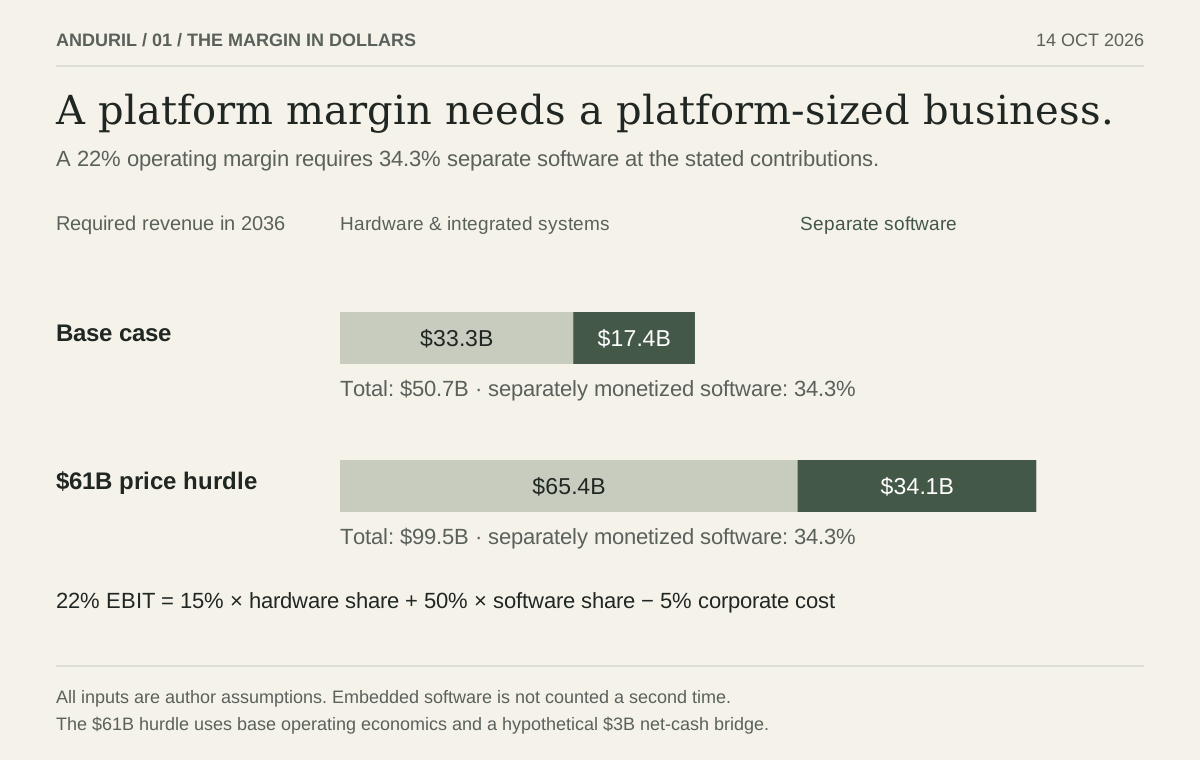
Suppose hardware contributes 15% of revenue after product costs and development, separately paid software contributes 50%, and corporate expense consumes 5% of total sales. The relationship is EBIT margin = hardware contribution × hardware share + software contribution × software share − corporate cost. A 22% EBIT margin requires 34.3% software sales; 28% requires 51.4%. These are author assumptions, not disclosed segments.
Translate the percentage into a business. At base-case 2036 sales of $50.7 billion, that requires $17.4 billion of separately monetized software and $33.3 billion of hardware and related activity. At the $61 billion price’s reverse-DCF revenue hurdle, required software sales rise to $34.1 billion. This is a necessary-condition test, not a bottom-up forecast or software revenue already hidden inside hardware.
Better manufacturing offers another route. A 20% hardware contribution reduces the software needed for the base margin to 23.3% of sales, or $11.8 billion. Either route is ambitious. The question is whether independently paid software and genuinely superior hardware contribution can coexist at the modeled scale, after allocating development expense once.
| Revenue case | Total sales | Software at 15% hardware contribution | Software at 20% hardware contribution |
|---|---|---|---|
| Base operating case | 50.7 | 17.4 | 11.8 |
| Revenue supporting $61bn bridge | 99.5 | 34.1 | 23.2 |
| Revenue supporting $100bn bridge | 162.9 | 55.8 | 38.0 |
50% software contribution and 5% corporate cost in both columns. No separately valued software asset is added to the DCF.
Economic value and treasury liquidity are different questions
Arsenal-2 combines $3.7 billion of announced private investment with a Navy contract of up to $2.9 billion tied to production outcomes. Initial operations are expected in 2030. Payment for delivered output is not automatically a reimbursement of factory investment; netting the two headlines would invent a financing benefit. S6
There is also an ownership claim. At the announcement, President Trump said taxpayers would receive 40% of the shipyard. The reviewed record does not establish completed cash-flow rights, priority or consideration. This is a project-level announcement, not 40% ownership of Anduril’s parent. S7
The consolidated DCF therefore precedes an unknown minority-interest deduction. A completed outside claim must be valued and subtracted, or the project modeled on an attributable basis. Neither deducting 40% of the whole company nor silently assigning the project claim zero value is acceptable.
I phase the private investment over 2027–2031 at $0.60 billion, $0.85 billion, $0.90 billion, $0.85 billion and $0.50 billion. That is an author schedule, additional to ordinary investment in other capacity. The Navy ceiling does not reduce it.
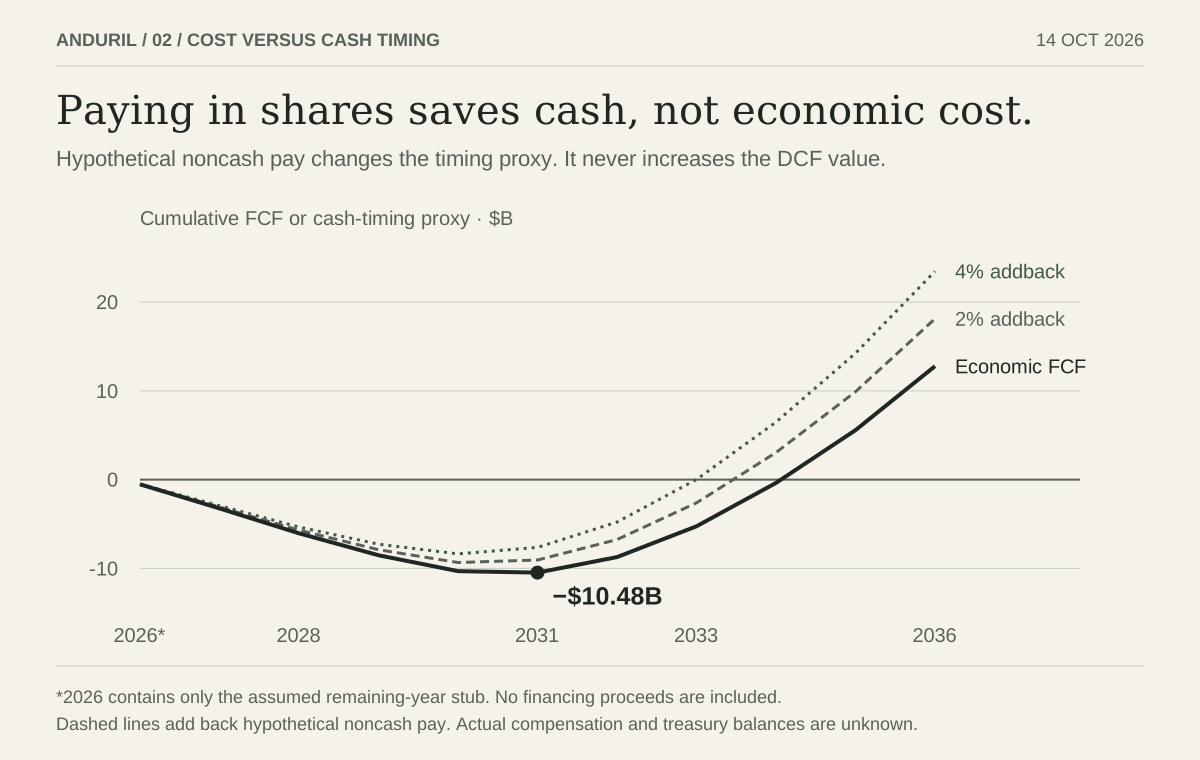
The base case reaches a $10.5 billion cumulative economic FCF deficit. Against hypothetical available liquidity of $3 billion, the difference is $7.5 billion. But this is not an actual financing requirement: the valuation leaves stock compensation in operating costs rather than adding it back as free money. That is appropriate for economic value and insufficient for a treasury forecast.
An explicit illustration separates the two. Adding back assumed noncash compensation equal to 2% of sales reduces the cash-timing gap to $6.3 billion; at 4%, it falls to $5.4 billion. Enterprise value does not change. Actual stock compensation, withholding, repurchases, customer advances, restricted cash, debt service and liquidity reserves remain unknown. Neither percentage estimates Anduril’s actual pay mix.
What the operating model actually assumes
Revenue rises to $6.9 billion in 2027, $22.2 billion in 2031 and $50.7 billion in 2036, approximately 28% annual growth over a decade. The margin-mix test gives that scale economic meaning; it does not turn an expectations model into inside knowledge of classified programs.
EBIT margins rise from a 20% loss in 2027 to 9% in 2031 and 22% in 2036. Ordinary capital spending declines from 6% to 3.5% of sales, before Arsenal-2. Operating working capital falls from 18% to 14% of sales, a favorable assumption about inventory, collections, supplier terms or customer funding.
There is a second optimistic assumption inside the cash conversion. In 2036, net investment in plant and working capital is only $1.27 billion against $8.48 billion of operating profit after tax, while sales still grow 12%. That requires earlier capacity and continuing expensed development to support considerable new output without proportional fresh investment. It deserves as much scrutiny as the margin target.
The five-year maturity transition then adds an explicit reinvestment adjustment as the model converges to sustainable returns. The downloadable forecast displays that adjustment separately. It is a valuation normalization, not an identified construction project. Likewise, the cash ratios do not establish accounting return on capital: expensed research, asset vintages and the opening balance sheet are not reconstructed here.
Free cash flow is operating profit after cash tax, plus depreciation, less capital expenditure and the change in working capital. The model taxes positive EBIT at 24% and gives no immediate refund for losses. Undisclosed loss carryforwards could defer taxes, so no extra tax asset is added. Development and economic employee compensation stay inside EBIT.
The remaining-2026 stub is 78/365 of an annualized cash-flow proxy, approximately negative $0.53 billion. Its annual inputs are the reported $1.2 billion operating-loss projection, 2% depreciation, an assumed $1 billion ordinary capex budget and 18% working capital on the change in sales. This is pro-rata timing, not observed fourth-quarter cash burn. Earlier spending is not charged again.
| 2027 | 2031 | 2036 | |
|---|---|---|---|
| Revenue | 6.88 | 22.24 | 50.70 |
| EBIT margin | (20%) | 9% | 22% |
| EBIT | (1.38) | 2.00 | 11.15 |
| Cash tax | — | 0.48 | 2.68 |
| Depreciation | 0.14 | 0.56 | 1.27 |
| Ordinary capex | 0.41 | 1.11 | 1.77 |
| Arsenal-2 investment | 0.60 | 0.50 | — |
| Increase in working capital | 0.46 | 0.63 | 0.76 |
| Economic unlevered FCF | (2.72) | (0.16) | 7.21 |
Full-precision calculations and all 15 annual rows per scenario are in the model. Rounded components may not sum exactly.
The result is about $28 billion of operating value
The discount rate is 12%: an underwriting hurdle, not a statistically estimated private-company cost of capital. After 2036, growth fades over five years to 3%. Reinvestment converges to what sustains a 15% return on new invested capital in the base case.
Terminal cash flow equals next-year after-tax operating profit multiplied by one minus growth divided by return on new capital. At 3% growth and 15% returns, 20% of operating profit after tax must be reinvested. Higher growth is not free. About 66% of base enterprise value still comes from the terminal period after 2041.
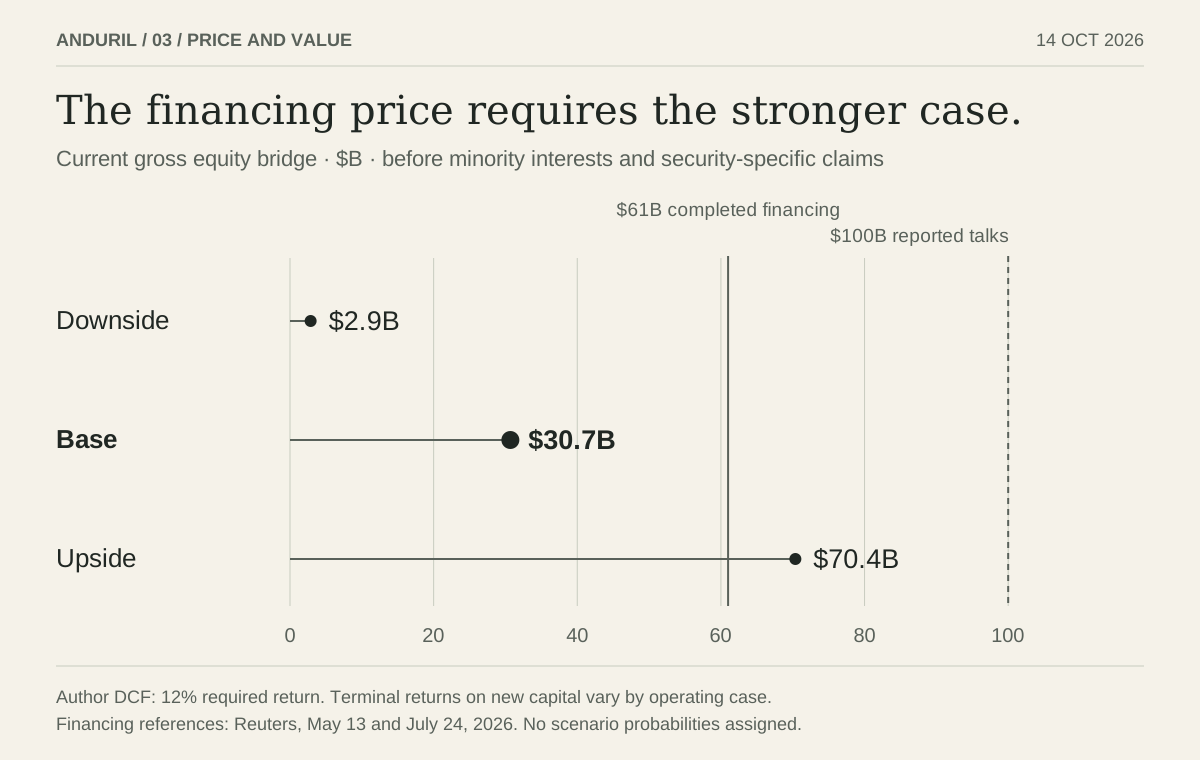
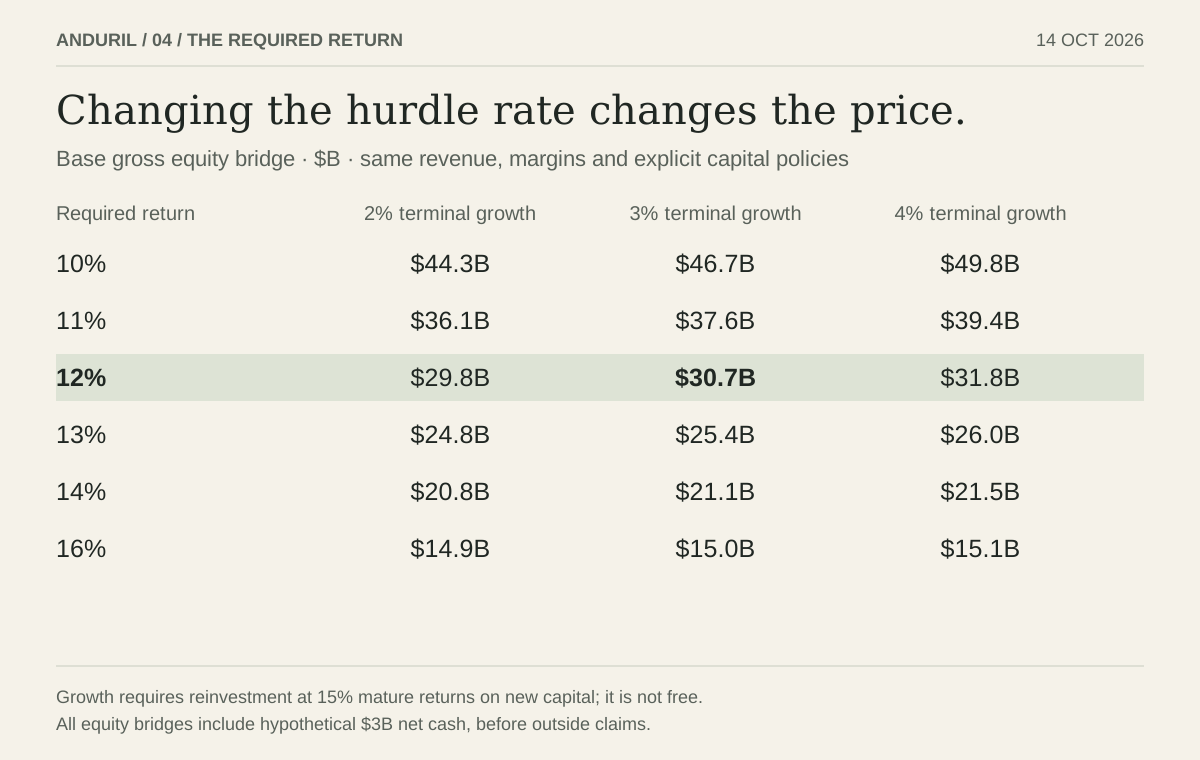
The base result is $27.7 billion of enterprise value and $30.7 billion after hypothetical $3 billion net cash, before outside claims. A 10% discount rate raises that bridge to $46.7 billion; 14% lowers it to $21.1 billion. Those are assumptions, not statistical bounds. Cash and fair-valued outside claims change the bridge dollar for dollar.
The upside reaches $74.9 billion of 2036 sales, 28% margins and 20% mature returns on new capital: $67.4 billion of enterprise value and a $70.4 billion gross bridge. That combines faster growth, better margins and less capital intensity. It is not an independent probability estimate of three favorable events.
The downside grows to $17.1 billion of sales and 15% margins, yet continuation value is approximately zero after investment and losses. Its $2.9 billion gross bridge is not a cash-recovery floor. Project cancellation could improve outcomes; unavailable financing and senior claims could worsen them. Negative continuation value calls for changing the capital plan rather than assigning a negative price to limited-liability shares.
The larger risk is earning the margin too late
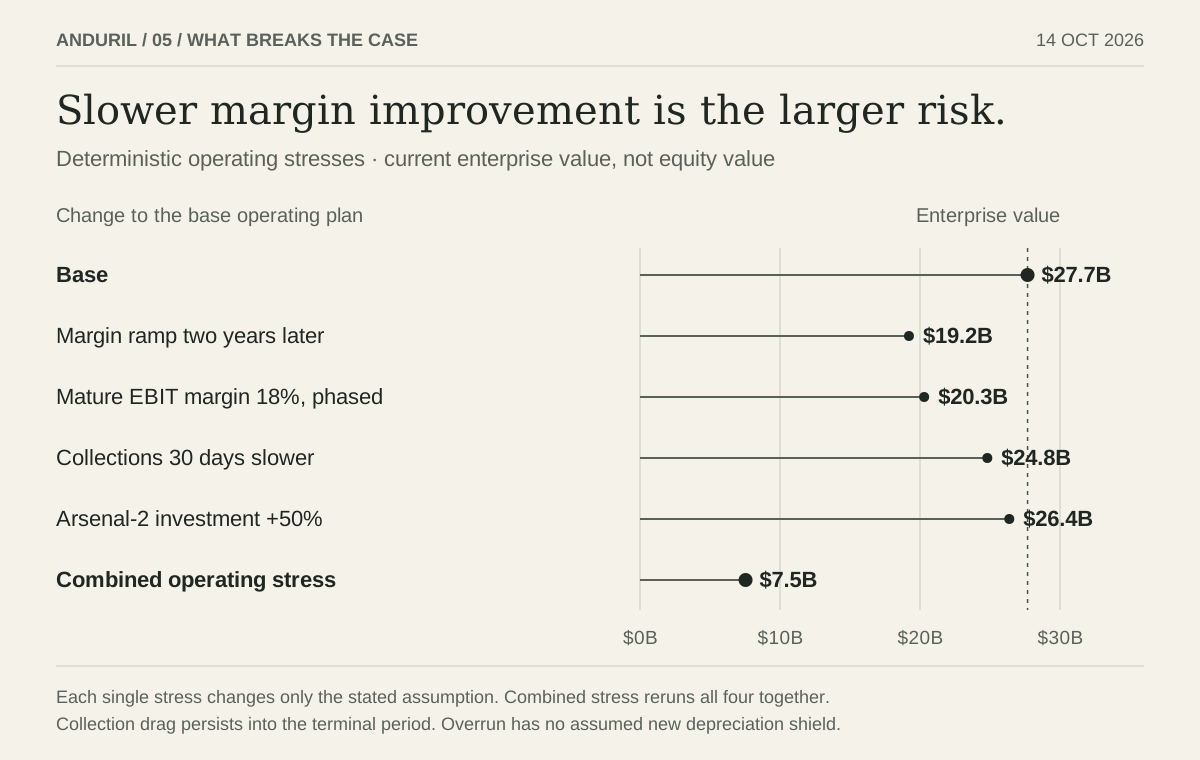
A discount-rate grid is not an operating explanation. I stress the business itself, holding the 12% hurdle fixed. Delaying the margin ramp by two years while keeping sales and investment on schedule lowers enterprise value from $27.7 billion to $19.2 billion. A separate case phasing the mature margin down to 18% produces $20.3 billion.
Thirty additional collection days reduce value to $24.8 billion. That scenario builds extra receivables equal to sales × 30/365 beginning in 2027 and funds their growth permanently, including in the terminal period. It changes cash timing, not reported operating profit. At 2031 base revenue alone, the extra balance is about $1.8 billion.
A 50% Arsenal-2 spending overrun lowers value to $26.4 billion. This conservative cost stress gives no extra depreciation or tax shield for the overrun. Its $1.3 billion present-value effect is much smaller than the $8.5 billion lost to a delayed margin ramp: a one-off construction problem and a slower earnings engine have different durations.
The combined operating stress yields $7.5 billion of enterprise value, not the sum of independently calculated losses. This is a deliberately adverse combination, not a probability-weighted forecast. The conclusion is practical: accepted output, realized contribution and collections deserve more diligence than whether a single factory meets its announced budget.
| Author stress | Enterprise value | Change versus base |
|---|---|---|
| Base | 27.7 | — |
| Margin ramp delayed two years | 19.2 | (8.5) |
| Mature margin 18%, phased | 20.3 | (7.4) |
| Collections 30 days slower | 24.8 | (2.9) |
| Arsenal-2 spending +50% | 26.4 | (1.3) |
| All four stresses together | 7.5 | (20.1) |
No hypothetical cash or minority-interest bridge is included here. Full overlay rules are in stress.py; these are not confidence intervals.
What would make $61 billion reasonable?
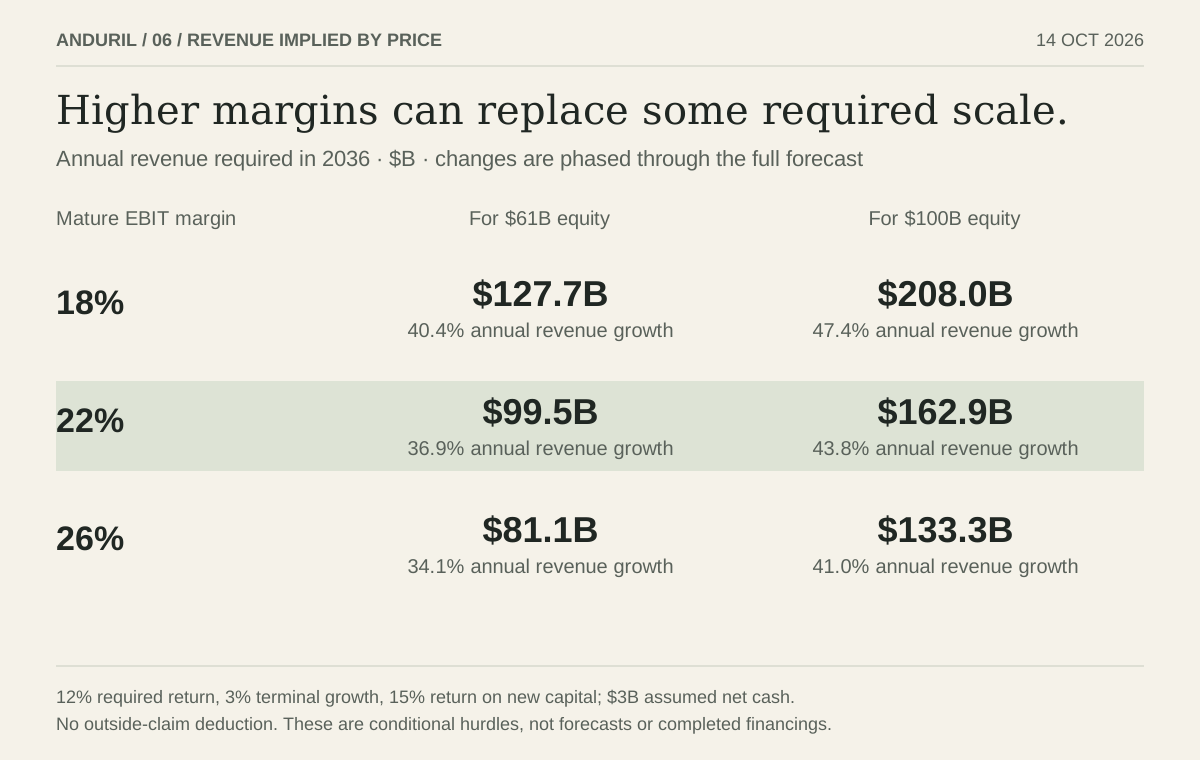
At base margins, capital productivity and discounting, the $61 billion gross equity reference requires $99.5 billion of 2036 sales: about 37% annual growth from the planning anchor. The $100 billion reference requires $162.9 billion, or 44% growth. Each annual growth factor changes, so earlier losses and investment scale with the larger business rather than only inflating the terminal year.
Both tests assume $3 billion net cash and no minority deduction. Final outside claims would raise the required operating outcome. The companion stress solver can price those claims explicitly instead of assuming that a gross company valuation belongs entirely to common holders.
The strongest bullish rebuttal is a different combination of margins and capital efficiency, not another contract ceiling. Independent software wins could make the mix substantially better, and reusable production could reduce the cash needed for growth. The upside case shows a combination that supports $61 billion. The base case’s 22% margin already gives considerable credit for those advantages; assigning another platform premium would count them again.
Intrinsic value also differs from a venture return target. With no interim distributions, a 15% annual return over ten years and 20% cumulative ownership dilution require an exit equity value of about $308 billion from a $61 billion entry, or $506 billion from $100 billion. The equation is entry value × 1.15¹⁰ ÷ 0.80. These are illustrative exit-equity hurdles, not terminal enterprise values.
Future investment is already charged through negative FCF. A blanket dilution haircut on top is not the right adjustment. New financing creates cash and a claim simultaneously; price, preferences and participation terms determine its effect on existing owners. The separate return illustration does not feed back into the DCF.
The stronger bull case changes the economics, not the label
The right challenge to this valuation is that software and production could be more complementary than the base forecast allows. A design that uses common components across products might require less new tooling. Faster updates might keep an installed system useful for longer. Independent autonomy wins might earn licensing revenue without another aircraft sale. Those mechanisms would change identifiable lines of the forecast rather than justify a premium outside it.
The reverse model shows how much that matters. Phasing the mature EBIT margin to 26%, rather than 22%, lowers the 2036 revenue needed for the $61 billion bridge from $99.5 billion to $81.1 billion. The software and hardware contributions still need to support that margin; it is not an assumption that every added dollar has negligible cost. This is a more coherent bullish argument than applying a software multiple to consolidated sales.
There is also a financing-market argument. Applying a 10% discount rate to the entire upside operating case gives a gross equity bridge of $103.2 billion. That scenario combines $74.9 billion of 2036 sales, 28% margins, better capital efficiency and a lower required return. It demonstrates that $100 billion is arithmetically possible. It does not demonstrate that the combination is likely or that the smaller discount rate compensates for the execution risk.
I would change the price before demanding that the final 2036 numbers arrive, but only as intermediate evidence makes those mechanisms credible. Renewed third-party software licenses would be more informative than another bundled system award. Repeat production with fewer hours of rework would be more informative than another facility announcement. Contract terms that return capital earlier would matter more than a larger unfunded ceiling.
The difference is between a future that could occur and one supported strongly enough to pay for today. The model is useful only while that distinction remains visible. A public listing, a strategic investor or another high-priced private round can change liquidity and market price without, by itself, proving better underlying cash generation.
The evidence that would change my price
First, paid software adoption independent of Anduril hardware. Repeat licensing, third-party deployments and contribution after development would support a higher margin case. Another integrated contract with an AI label would not settle the question.
Second, accepted output and cash conversion. I would seek repeat shipments, first-pass yield, rework and warranty costs, inventory days, and capital required for additional qualified output. A growing order book is less persuasive when unfinished inventory grows faster and acceptance is delayed.
Third, attributable economics. Arsenal-2’s final ownership, funding conditions and payment terms must reconcile to the parent’s cash flows. Customer finance may reduce the burden; outside rights may reduce the upside. The current public record does not resolve the balance.
My forecast is that Anduril becomes more industrial as it becomes more important. Shared software can improve the economics of a much larger production system without making all its revenue software revenue. A customer that wants both more output and continued competition can reward the best supplier while refusing to surrender the architecture.
The base case is about $28 billion of enterprise value, not an attractive common-share offer without further diligence. At $61 billion, I would require operating evidence closer to the upside case. Anduril may earn the higher price. Its next investors should distinguish the value of helping build a new prime from the price of assuming it has already become a platform.
Assumptions
- FY2025 revenue is company-reported; FY2026 revenue and operating loss are March investor projections reported by the press, not observed results or newly confirmed October guidance.
- The model uses a remaining-2026 stub, annual forecasts through 2036, a five-year maturity transition, and a reinvestment-funded terminal value. R&D and economic employee compensation remain in EBIT.
- Net cash and available liquidity are separate $3 billion assumptions. Zero minority-interest value means an unadjusted bridge, not evidence that outside claims are worthless.
Sources
- Reuters: completed Series H financing and company-reported 2025 sales
Reuters · 2026-05-13
Verified Oct 14, 2026
Reported completed transaction; company financial disclosure, not audited accounts.
- Reuters: reported financing discussions near $100 billion
Reuters · 2026-07-24
Verified Oct 14, 2026
Discussions and potential conditions; not evidence of a completed round.
- The Information: investor financial projections
The Information · 2026-03-05
Verified Oct 14, 2026
Public preview of reported projections; underlying investor materials were not inspected.
- Reported 2026 revenue planning anchor
Investing.com · 2026-03-05
Verified Oct 14, 2026
Secondary report of The Information; not independent confirmation or an October update.
- U.S. Army: enterprise contract for commercial solutions
U.S. Army · 2026-03-13
Verified Oct 14, 2026
Maximum ordering value, consolidation and discounts; not revenue or funded backlog.
- Anduril: Arsenal-2 investment and Navy outcome-linked contract
Anduril · 2026-10-06
Verified Oct 14, 2026
Announced investment and timetable; no audited cash schedule or final financing agreement.
- Reported presidential announcement of a taxpayer shipyard stake
Anadolu Agency · 2026-10-07
Verified Oct 14, 2026
Announcement of a 40% project stake; final rights, priority, consideration and fair value unresolved.
- First Ohio-built Fury rolls off Arsenal-1 production line
One Columbus · 2026-07-27
Verified Oct 14, 2026
Regional development organization and project participant; first output is not sustained full-rate production.
- Anduril: Steelfin family announcement
Anduril · 2026-10-12
Verified Oct 14, 2026
Company development claims; flight testing planned for 2027.
- Open software architectures and the Right to Integrate
U.S. Army · 2026-09-10
Verified Oct 14, 2026
Army analysis of interoperability, not proof of future vendor economics.
- Anduril: NGC2 fielding expansion
Anduril · 2026-10-05
Verified Oct 14, 2026
Up-to value for an integrated program, not separately identified recurring software sales.
- Lockheed Martin second-quarter 2026 results
Lockheed Martin · 2026-07-23
Verified Oct 14, 2026
First-half Missiles and Fire Control segment margin; not equivalent to consolidated Anduril EBIT.
- SOCOM mission-autonomy integration award
Anduril · 2025-03-26
Verified Oct 14, 2026
Scope and amount do not disclose recurring software mix or profit.
- NATO eAirC2 data-platform selection
Anduril · 2026-07-07
Verified Oct 14, 2026
Company account of selection; no independent software revenue estimate inferred.
- EDGE-Anduril proposed production alliance
Anduril · 2025-11-13
Verified Oct 14, 2026
Proposed jointly owned venture; local production is not necessarily wholly attributable parent revenue.
- Surface-launched Barracuda-500M framework
Anduril · 2026-05-13
Verified Oct 14, 2026
Announced units and period; no unit price or program profit inferred.
- Air Force separates CCA aircraft and mission-autonomy procurement
U.S. Air Force · 2026-06-17
Verified Oct 14, 2026
Official mirrored release; full text inspected in a rendered capture. Distinct software competition, performance-linked payment and portable architecture; no final 2027 selection inferred.
Supporting material
- Interactive valuation and operating stresses
Change growth, margins, collection days, factory spending and outside claims. Cash-timing assumptions do not increase economic value.
- Reproduce the valuation
Original dependency-free Python model; annual cash flows, sensitivities and reverse DCF.
- Reproduce the operating stresses
Auditable overlays, margin-to-software scale test and separate cash-timing proxies. Uses model.py.
- Annual forecast data
Three author scenarios, 2027–2041, in USD billions. The remaining-2026 stub is in the model output.
- Operating stress data
Current enterprise values and economic FCF deficits under the stated operating stresses.
- Valuation outputs and assumptions
Original scenarios, assumptions, sensitivity cells and reverse DCF.
- Stress outputs and assumptions
Stress results, software revenue hurdles, cash-timing illustrations and claims sensitivities.