Financial systems
The AI commitments ledger
OpenAI and Anthropic account for $1.63 trillion of selected multiyear exposure once overlapping disclosures are removed.
Research report 10 · Prepared for sulayman-bowles.dev · Evidence cutoff: 12 November 2026
The disclosed AI infrastructure buildout is larger than the revenue currently reported by its leading model developers. It also has more financing behind it than a simple comparison of those developers’ revenue and their contract announcements suggests. Both statements survive a careful reading of the documents.
Three numbers frame the result:
- $1.631 trillion of selected multiyear exposure: $730.4 billion of selected original OpenAI contract and announced partnership values plus Anthropic’s $900.9 billion aggregate of remaining and subsequently entered commitments. A careless sum of that aggregate and its named contracts produces $2.277 trillion. Removing the named Anthropic rows reduces the selected inventory by $646.1 billion.
- $368.5 billion of confirmed US-dollar bond issuance since January 2025 by nine issuers. The total covers Microsoft, Oracle, Amazon, Alphabet and Meta, as well as CoreWeave, Nvidia, AMD and Broadcom. It measures gross principal before repayments and fees and excludes foreign-currency offerings.
- About $205 billion of annual OpenAI revenue in the base sensitivity would support the selected contracts’ $122.9 billion annual service equivalent if infrastructure absorbed 60% of revenue. That is about 4.1 times the approximately $50 billion annualized revenue run rate OpenAI’s CFO reported on November 10. The calculation annualizes the commitments at full delivery. Payment timing may differ.oai, cfo, bond
The defensible conclusion is that the expansion depends on a combination of growing customer receipts, large incumbent businesses, external capital, advance customer payments and contractual protection. Public evidence leaves industry-wide unconditional AI debt unquantified and leaves open whether current independent customer demand can fund every announced deployment.
A cloud contract can become a provider’s backlog, support a loan against equipment, produce a chip order, and sit inside a campus budget. Those are different claims on the same economic activity. Counting all four as new demand creates a large but misleading total.
1. What is being counted
The companion workbook tracks named customer commitments, broad corporate purchase and lease schedules, supplier backlog, financing and contingent support. Every commitment row records the payer, counterparty, amount or unknown, timing, capacity where disclosed, legal status, source date and page or section. Aggregate controls and superseded announcements remain visible but carry exclusion flags.
“Commitment” is deliberately broader than a recognized liability. The relevant documents include enforceable minimum purchases, conditional delivery contracts, lease commitments, residual-capacity purchases, equipment financing letters and nonbinding intentions. The model records the legal terms for each. An announced gigawatt is not converted into dollars using an assumed price.
The selected two-lab inventory is the part for which an intelligible overlap reconciliation is possible. It is not an exhaustive market total. Its OpenAI side uses original agreement values; its Anthropic side uses a more recent aggregate. Some original OpenAI spending may already have occurred. Some capacity has not arrived. Some values are caps and others are “more than” amounts represented by the disclosed anchor. Consequently, $1.631 trillion is neither a remaining-payments balance nor a minimum unconditional obligation.
The quantified customer ledger
All dollar amounts in the tables are US$ billions. “Unknown” means no sufficiently specific public dollar amount was found. The downloadable ledger also lists aggregate controls, superseded disclosures, supplier obligations and financing support.
| Payer → counterparty | Amount | Term or delivery | Capacity | Documented status / treatment |
|---|---|---|---|---|
| OpenAI → Microsoft Azure | 250 | Additional purchase disclosed October 2025; term unknown | Not priced in GW | Contract purchase; detailed schedule unavailable |
| OpenAI → Oracle | >300; model uses 300 | Five years | Up to 4.5 GW | Signed capacity-development agreement; announced partnership value; payment obligations undisclosed |
| OpenAI → AWS, original | 38 | Seven years, November 2025 | Large GPU cluster; no single priced GW figure | Signed agreement |
| OpenAI → AWS, expansion | 100 | Eight years, February 2026 | About 2 GW Trainium | Commitment added to the $38bn agreement |
| OpenAI → CoreWeave, March | Up to 11.9 | Through October 2030 | Undisclosed | Delivery and service conditions |
| OpenAI → CoreWeave, May | Up to 4.0 | Through April 2029 | Undisclosed | Additional capacity, delivery conditions |
| OpenAI → CoreWeave, September | Up to 6.5 | Through May 2031 | Undisclosed | Additional order; termination for cause |
| OpenAI → Cerebras | >20; model uses 20 | Delivery 2026–28; tranches 3/4 years, extendable | 750 MW committed | Capacity agreement; optional 1.25 GW excluded |
| Anthropic → Microsoft | 47.2–49.2 | November 2026–June 2033 | Undisclosed | Minimum purchases; specified exceptions |
| Anthropic → Google | 121.3 | April 2026–July 2033 | Undisclosed | Usage-independent minimum and true-up |
| Anthropic → AWS | 110 | May 2026–April 2036 | Up to 5 GW announced | Minimum purchase; replaces older announcement |
| Anthropic → SpaceXAI | Up to 120.5 | Through 2029 | Reserved AI capacity | Cancellable after initial protected periods |
| Anthropic → Nscale | Up to 44.6 | Through 2033 | Undisclosed in dollar schedule | Financing and delivery conditions |
| Anthropic → Lambda | 41.3 | Through 2034 | Undisclosed | $34.9bn tranche already terminable at filing |
| Anthropic → Broadcom / financing entities | 161.2, excluding interest | Five-year leases; 2026/27 delivery | Custom AI racks | Assignments do not increase aggregate rent |
Sources: Microsoft’s October 2025 subsequent-events note; OpenAI’s Oracle and AWS announcements; CoreWeave’s May 2025 10-Q and September 2025 8-K; Cerebras’ registration statement; Anthropic’s November 10 S-1/A, pp.178–181.oai, core, cerebras, anthropic
These fifteen named rows are not fifteen freely additive observations. OpenAI’s eight selected contract and announced partnership values sum to $730.4 billion. Anthropic’s seven named rows, using Microsoft’s $47.2 billion minimum, sum to $646.1 billion. The model discards that named subtotal in favor of Anthropic’s wider $900.9 billion aggregate.
The $646.1 billion adjustment removes overlapping disclosures. The remaining payment schedules are undisclosed. Named original contract values and remaining aggregate obligations need not be measured on the same basis. Nor does subtracting $646.1 billion identify a meaningful residual of “unnamed contracts.”
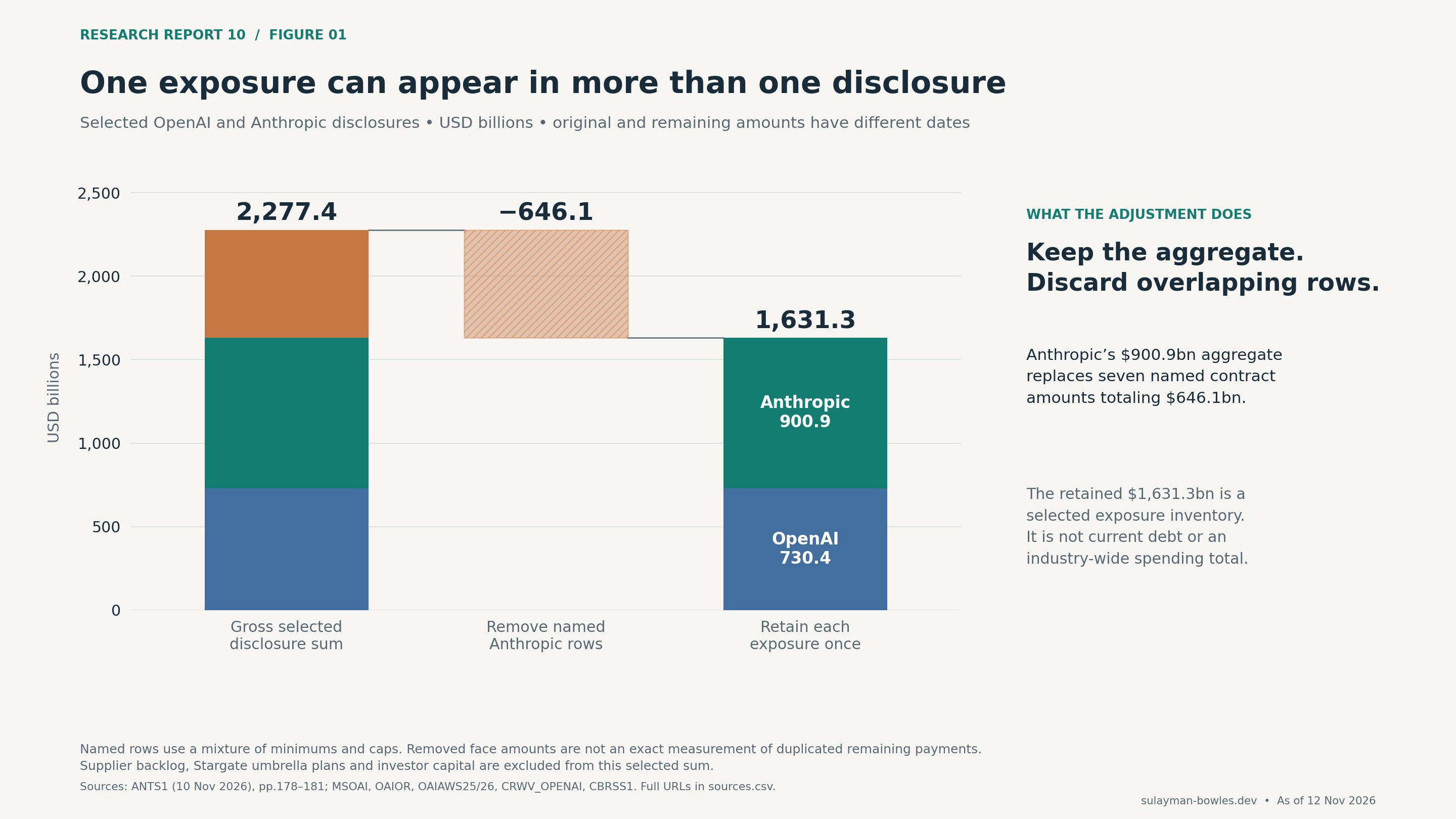
Figure 1. Gross selected disclosures, $2,277.4bn; named Anthropic rows removed, $646.1bn; selected inventory, $1,631.3bn. Source: contract rows and inclusion flags in the accompanying model. No supplier backlog or financing principal is added.
Large commitments that cannot be priced reliably
The unknown-dollar rows are economically important. OpenAI’s Nvidia announcement described a 10 GW deployment intention and an investment intention of up to $100 billion. The investment number was not OpenAI’s compute purchase price. Its AMD agreement identifies an initial 1 GW binding purchase within a larger 6 GW relationship. Its Broadcom collaboration targets 10 GW of custom accelerator racks, but does not disclose a purchase price. The related AMD warrants are contingent equity consideration.capacity
OpenAI’s PORTS-Pike agreement is a 20-year lease for a project approaching 8 GW, with an initial 800 MW expected in 2028. Nvidia’s subsequent $105 billion guarantee supports lease and power obligations associated with the initial 4.25 GW. The ledger records the $105 billion as support for the initial capacity obligations. Georgia’s Project Camellia adds a disclosed 3.2 GW power relationship with no usable price. Site power can overlap the economics of a wider compute or lease contract.ports
Stargate’s original $500 billion investment intention is an umbrella. It is not an extra order to put on top of Oracle, CoreWeave and the named sites. The same rule excludes the later progress milestone from the net ledger.
Other named links in the chain
| Payer → counterparty | Disclosed amount | Timing / capacity | Counting decision |
|---|---|---|---|
| Microsoft → Nebius | 17.3929 | Five-year service tranches; through 2031 | Includes $6.9581bn of prepayments |
| Microsoft → Nscale | 43.8 | Through 2033; original roughly 200,000-GPU plan expanded | Intermediary procurement; no addition to lab total |
| Microsoft → IREN | 9.7 | Average five years; 200 MW; delivery 2026–27 | 20% prepayment credited against later fees |
| Meta → CoreWeave, original | 14.2 | Multi-year; 2025 agreement | Precedes the incremental agreement |
| Meta → CoreWeave, expansion | 21.0 | March 2026 agreement | Includes exercise of earlier option; do not add option again |
| Meta → Nebius, original | 2.8807 | Five years; 2025 order | Fixed consideration; excludes variable services |
| Meta → Nebius, dedicated capacity | 12.0 | Five years; delivery from 2027 | Firm capacity, subject to delivery |
| Meta → Nebius, unused capacity | Up to 15.0 | Five years | Residual backstop; other buyers displace Meta |
| Nvidia → CoreWeave | Up to 6.3 | Through April 2032 | Unsold-capacity purchase backstop |
| SpaceX → Apollo-managed lessor | Approximately 40 | Equipment delivery first half 2027; 5–5.25 years | Binding financing letter, subject to closing conditions |
| Meta → AMD / system vendors | Unknown | Up to 6 GW; initial 2026 delivery | Preserve capacity; do not invent price |
| Meta → AWS | Unknown | Tens of millions of Graviton CPU cores | Preserve unpriced agreement |
Sources: counterparties’ filings and announcements, with transaction-level locators in contracts.csv; SpaceX’s October 26 8-K, Item 8.01.intermediaries, metacloud, spacex
The SpaceX transaction is both a financing arrangement and a future equipment-payment burden. Adding its $40 billion financing principal and the same $40 billion financed cost as two purchases would count it twice. SpaceX also supplies Anthropic. Without an allocation between its own models and cloud customers, its entire build cannot be added as independent final demand.
2. The strongest disclosure is still not a uniform take-or-pay number
Anthropic’s $900.9 billion aggregate can be reconstructed from $319.993 billion in its long-term contractual-obligations table, $17.4 billion of short-term contracts, $451.2 billion of uncommenced leases, and subsequent commitments of $105.7 billion long-term and $6.6 billion short-term. The component sum is $900.893 billion, reconciling to the rounded aggregate within $7 million.anthropic
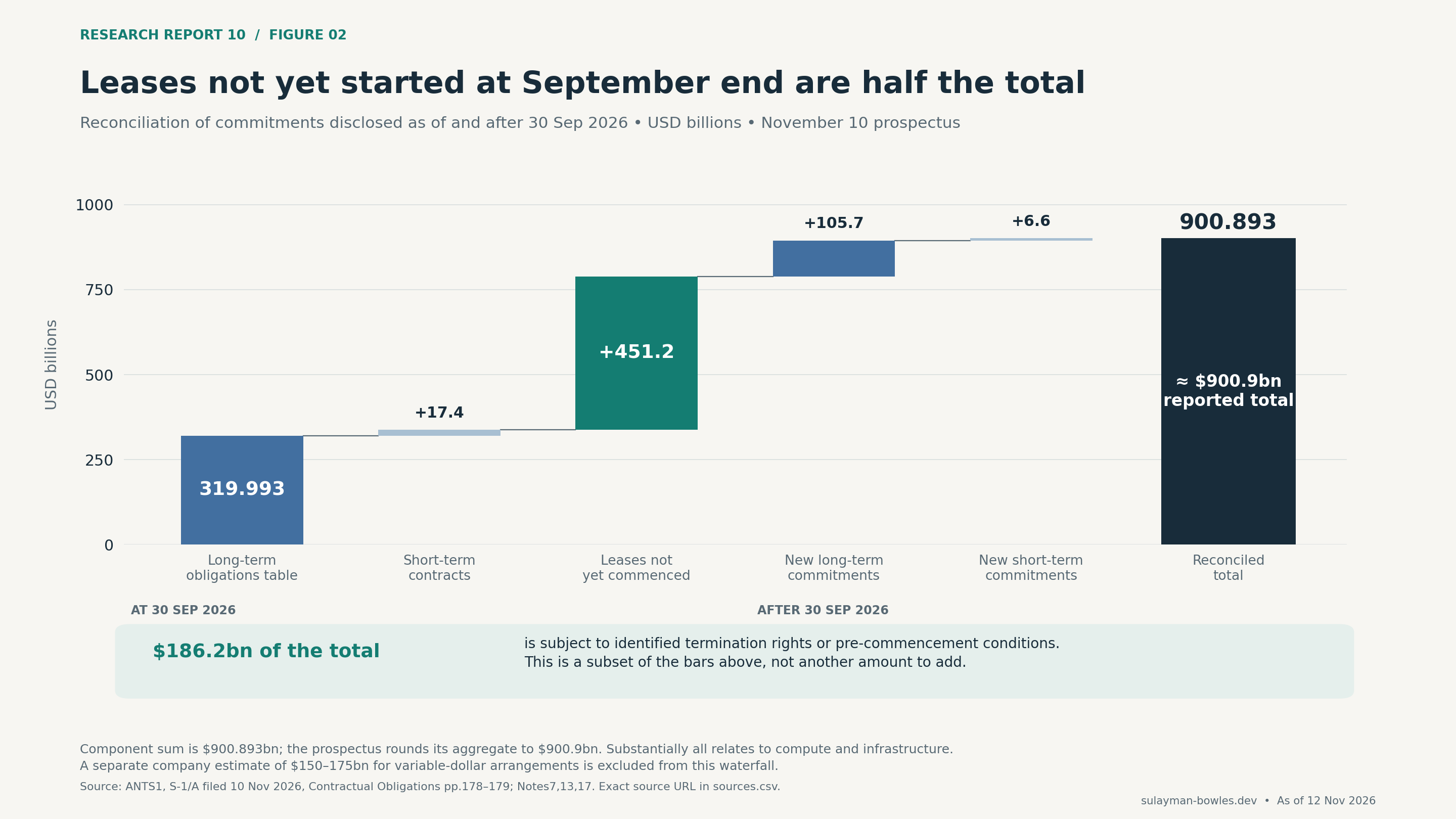
Figure 2. Components of Anthropic’s disclosed aggregate. The $186.2bn contingent or terminable subset is already within the total. Source: November 10 S-1/A, pp.178–179; workbook obligation schedule.
Subtracting the identified $186.2 billion contingent or terminable portion leaves $714.7 billion. Some of the remaining commitments may still carry conditions. The filing also estimates $150–175 billion of payments under arrangements without fixed dollar commitments, outside the $900.9 billion. Including that company estimate would lift selected two-lab exposure to $1.781–1.806 trillion across the included commitment and partnership categories.anthropic
The legal distinctions change the analysis. SpaceXAI’s long headline amount is not a protected minimum over the entire term: cancellation becomes possible on 90 days’ notice after initial periods. Lambda’s large August tranche had reached a contractual termination trigger when the prospectus was filed, although neither party had terminated. Nscale’s agreements depend on financing and delivery. A contract can be signed, significant and financeable while still containing material conditions.
Conversely, a requirement to pay regardless of utilization creates a different risk from ordinary metered cloud spending. Once the provider delivers qualifying capacity, falling utilization may not reduce the bill. The relevant evidence is the minimum-payment clause, the acceptance conditions and the cure or cancellation rights—not the presence of the word “partnership.”
Why backlog cannot be added
| Provider | Latest disclosed measure, $bn | Observation date | Main comparability issue |
|---|---|---|---|
| Microsoft | 683.0 total RPO; 677.0 commercial | September 30 | Includes substantial non-AI products |
| Alphabet | 567.7 total; 560.8 Google Cloud | September 30 | Definition expanded to include short original terms in 2026 |
| Amazon | Approximately 578.0 | September 30 | Primarily AWS; longer original contract terms |
| Oracle | 664.0 RPO | August 31 | Same customer purchases appear downstream |
| CoreWeave | 132.5 revenue backlog | September 30 | Broader than accounting RPO |
| Broadcom | 179.2 RPO | August 2 | Semiconductor and software; exclusions differ |
| Nvidia | 3.2 qualifying long-duration RPO | July 26 | Does not represent its whole GPU order book |
| AMD | 0.246 qualifying RPO | September 26 | Short-duration orders excluded |
Sources: each issuer’s revenue-recognition note; CoreWeave’s November 10 earnings exhibit and backlog footnote.msft, goog, amzn, oracle, crwv, nvda, amd, avgo
Meta’s reviewed filing does not provide a comparable AI RPO total. Its purchase and lease obligations appear in the payer schedules below.financial
RPO—remaining performance obligations—is a seller-side measure of future revenue under qualifying contracts. A buyer’s committed purchase and its seller’s RPO are usually two views of the same sale. The seller may then buy equipment from another company whose order book reflects a third view. None is automatically incremental demand.
Definitions matter even before removing overlap. CoreWeave’s September backlog cannot be subtracted from its June RPO to calculate a contemporaneous “non-RPO” amount. Alphabet’s inclusion of short contracts creates a definition break. Nvidia’s relatively small RPO does not imply a small forward equipment business. A total of these rows would conceal more than it revealed.
3. Where the financing comes from
The cash sources are substantial, but their labels are not interchangeable. Operating cash flow is a flow over a period. Cash on the balance sheet is a stock already accumulated. Bond principal is historical gross issuance. An undrawn facility is conditional future access. A guarantee can help another borrower finance equipment without transferring cash today.
For that reason, the funding ledger does not add all of these into a single “cash available” figure. It labels each item as funded, committed, contingent, forecast, proposed or noncash. It also preserves parent round totals and investor components with overlap warnings.
Bond markets: $368.5375 billion in dollars, plus other currencies
| Issuer | 2025 USD issuance | 2026 through cutoff | Total USD principal |
|---|---|---|---|
| Microsoft | — | 25.0000 | 25.0000 |
| Alphabet | 22.5000 | 45.0000 | 67.5000 |
| Amazon | 15.0000 | 62.0000 | 77.0000 |
| Meta | 30.0000 | 40.0000 | 70.0000 |
| Oracle | 25.7500 | 35.0000 | 60.7500 |
| CoreWeave | 6.3375 | 12.2000 | 18.5375 |
| Nvidia | — | 25.0000 | 25.0000 |
| AMD | 1.5000 | 4.7500 | 6.2500 |
| Broadcom | 14.0000 | 4.5000 | 18.5000 |
| Total | 115.0875 | 253.4500 | 368.5375 |
The registered offerings are traced to final prospectus supplements, then checked against debt notes and closing reports. CoreWeave’s private Rule 144A/Regulation S issues use publicly filed 8-Ks, indentures and closing announcements; there is no registered final prospectus supplement to invent. The workbook lists offering dates, maturities, coupons and currencies.bond
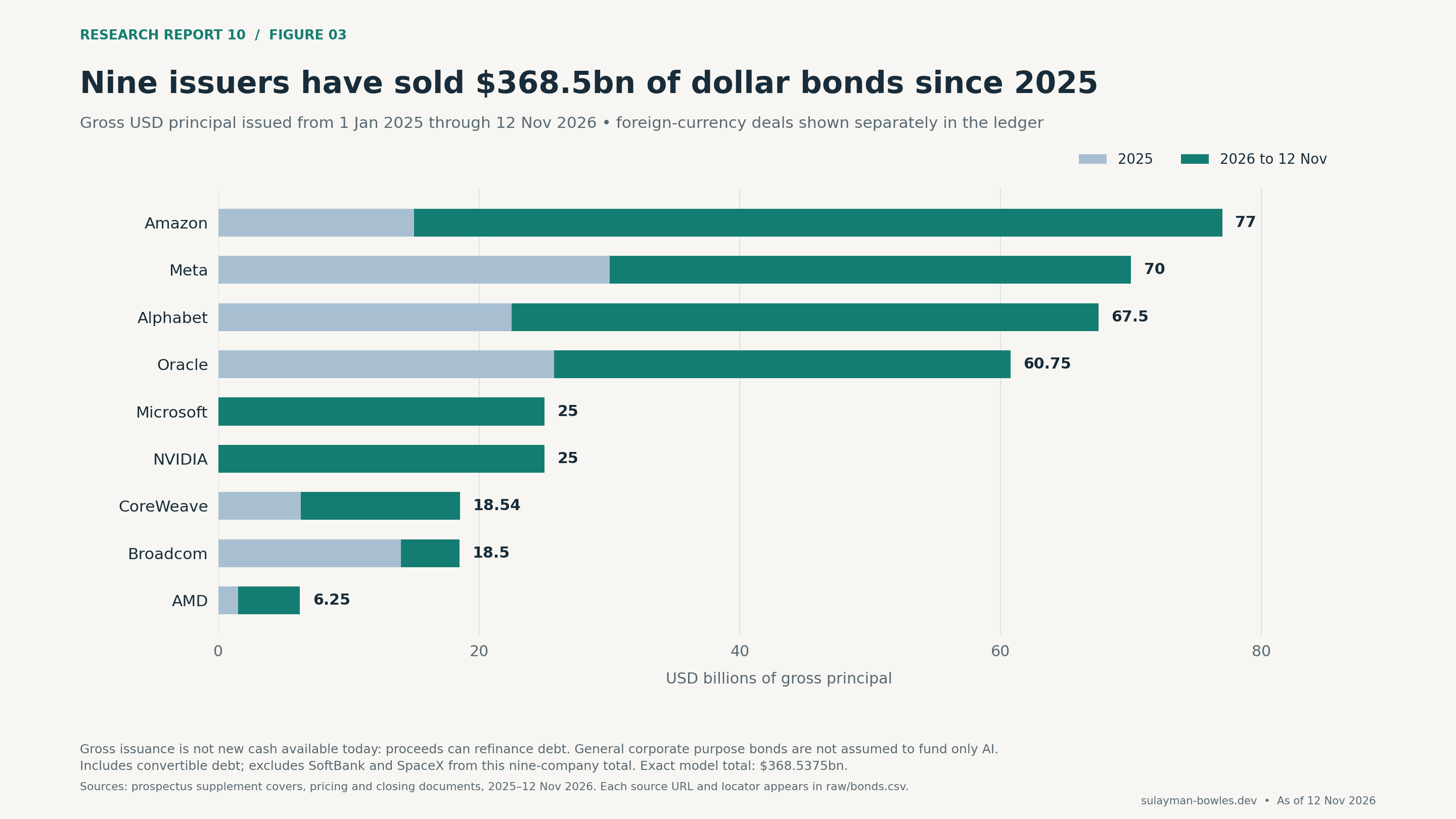
Figure 3. Confirmed gross USD bond principal since January 1, 2025. Source: offering inventory; independent issuer/year reconciliation. Proceeds are not all earmarked for AI.
Foreign-currency principal is preserved without applying an arbitrary current exchange rate. Alphabet’s additional issued amounts include €28.25bn, £5.5bn, CHF3.055bn, C$8.5bn, ¥576.5bn and A$5.5bn; Amazon’s include €14.5bn, CHF2.82bn, C$14bn and £4.25bn; CoreWeave issued €2bn. Meta’s €9bn offering was scheduled to settle on November 12, but an inspected closing confirmation was unavailable at the cutoff, so the ledger records the offering as priced and scheduled.bond
Oracle demonstrates why current filings matter. Its November 4 closing added $10 billion of notes and $10 billion of common stock after its August balance-sheet date. The debt inventory also includes the $7.75 billion February 2025 issue; a fiscal-2026-only search would miss it. Gross principal is not net proceeds: Oracle’s November debt prospectus gives $9.9573 billion before expenses for $10 billion face value.orclnov
Equity, private credit and project finance
| Recipient / structure | Documented funding | Status and overlap control |
|---|---|---|
| OpenAI, 2026 round | $122bn committed capital | Company-announced closed round; not evidence all cash arrived on announcement day |
| Amazon component | $50bn | Fully invested by September 30: 15 + 13.7 + 21.3 |
| SoftBank component | $30bn | Fully funded by October 1; inside 122 |
| Nvidia component | $30bn | Company-announced commitment; issuer filing leaves payment unverified |
| OpenAI, 2025 round | $41bn final investor-confirmed size | $30bn SoftBank plus $11bn others; historical funding |
| Anthropic | $110.432bn net preferred-stock cash proceeds in nine months of 2026 | Filed cash-flow figure; includes components of announced rounds |
| Anthropic future note facilities | $77bn at September 30: Amazon 15, Google 20, Broadcom 42 | Undrawn, conditional; Google’s planned $10bn IPO placement replaces half its note capacity |
| Broadcom equipment SPVs | $35bn June plus $63bn October | Committed financing for customer equipment; staged deployment |
| Oracle equity / preferred | $20bn completed ATM, $5bn mandatory preferred, $10bn November common issue | Completed transactions; gross and net proceeds shown |
| Meta preferred | $14.375bn gross | Closed October/November, including option |
| Meta common-stock forwards | $28.75bn public sale value | No initial issuer proceeds; future settlement differs |
| CoreWeave | $2bn Nvidia equity; multiple delayed-draw facilities; vendor financing | Equity paid; facility capacity is not the same as draws |
| SpaceX | $85.675bn net IPO proceeds; $25bn June notes; October $40bn equipment financing commitment | Notes refinanced $20bn bridge; avoid counting both |
Sources: funding rows with investor, issuer and filing receipts; Anthropic financial statements and convertible-note sections; Amazon Note 2; Meta closing 8-Ks; Oracle closing reports; SpaceX filings.round, softbank, anthropic, amzn, metafinance, orclnov, spacex
There are several important exclusions. Meta’s planned $60 billion ATM is not cash raised. Its stock forwards produced no initial issuer proceeds. CoreWeave’s forecast of $9 billion of customer prepayments over the next three months is a forecast of customer receipts. Nvidia’s historical up-to-$100 billion OpenAI investment intention is not added to its current round commitment. Nor are future customer warrants treated as cash financing.metafinance, crwv, capacity
CoreWeave’s delayed-draw debt illustrates the difference between a headline facility and available cash. Its $8.5 billion DDTL4 facility had $2.9 billion drawn at June 30. Other facilities have their own collateral, conditions and overlapping refinancing histories. Vendor financing of $5.147 billion represented outstanding equipment and software financing. A facility amendment that creates a $3 billion tranche while increasing remaining capacity by only $0.4 billion cannot be logged as $3 billion of incremental liquidity.crwv
Meta also raises financing at the campus level. Hyperion’s financing includes approximately $27.3 billion of notes issued by Beignet Investor; El Paso’s Sopaipilla vehicle issued about $12.6 billion. Project budgets, sponsor capital, Meta contributions, tenant leases and residual guarantees describe linked uses and sources. Their sum is not the amount of new computing demand. The workbook tracks the SPV notes and the downstream company contribution so each dollar of financing enters the total once.metaspv
How suppliers finance their customers
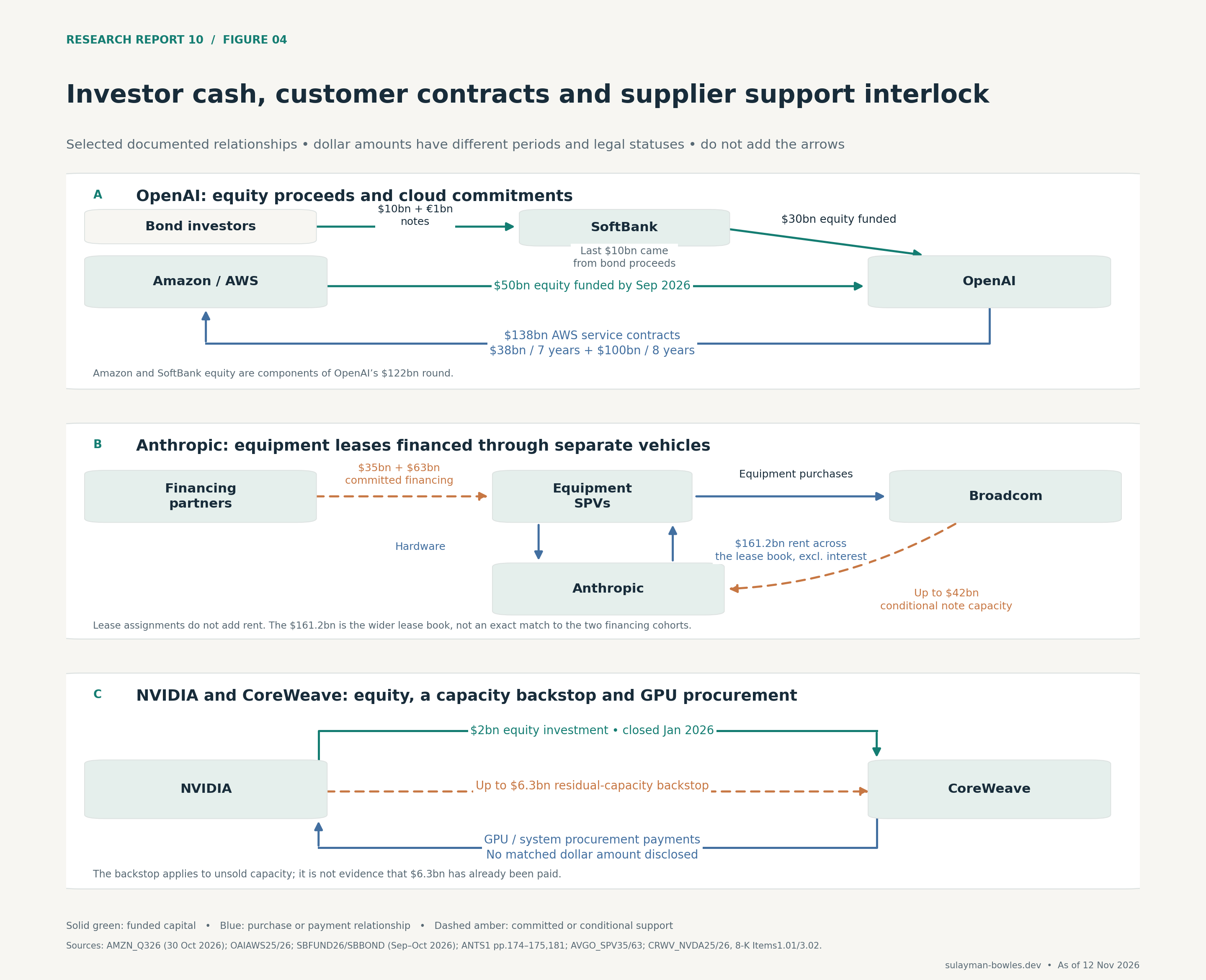
Figure 4. Documented investment, procurement, financing and support links. Solid funded flows, contractual future purchases and contingent support have different meanings. Arrows are not a claim that particular dollars were segregated or earmarked. Sources: Amazon Note 2; OpenAI/AWS announcements; SoftBank October 1 statement; Broadcom/Apollo financing announcements; CoreWeave 8-Ks.
The clearest loop is Amazon–OpenAI. Amazon invested $50 billion; OpenAI signed $38 billion plus $100 billion of AWS contracts. The investment is included in OpenAI’s fundraising, while the service purchases become AWS revenue as delivered. Neither netting the $50 billion off the contracts nor adding the investment to customer demand describes the underlying obligation correctly.amzn, oai
SoftBank supplies a traceable outside financing link. Its final $10 billion tranche of the 2026 OpenAI investment was funded from September bond proceeds. Its USD10 billion and EUR1 billion issue belongs in the wider funding inventory, outside the nine-issuer headline. The earlier bridge had been repaid and its remaining capacity cancelled; leaving it listed as additional available liquidity would overstate the financing.softbank
The Broadcom–Anthropic relationship uses both equipment finance and corporate equity. The June and October structures represent $98 billion of financing commitments for equipment underlying customer leases. Anthropic reports $161.2 billion of related equipment rent excluding interest; assignment to financiers does not create additional rent. Broadcom also has a $42 billion conditional note-purchase facility for Anthropic and contingent residual-value support. The October 8-K describes an approximately $43 billion maximum undiscounted exposure upon deployment, in addition to the earlier $29 billion cohort.avgo, spv
That structure shifts who advances money and who bears asset-value risk. It does not make financing principal, lease principal and a guarantee three independent pools of final spending. The $63 billion transaction’s connection to the previously announced capacity agreement is explicit; mapping every unnamed assignment in the customer filing to every lender entity would go beyond the disclosed evidence.
Nvidia’s $2 billion cash equity investment in CoreWeave and its up-to-$6.3 billion unused-capacity purchase agreement show another connection. The latter is a backstop: customers buying the capacity can displace Nvidia’s purchase. It should not be represented as ordinary third-party demand in addition to the sales that replace it.crwv
The economic question raised by these links is concentration. A supplier, investor and capacity backstop can be exposed to the same customer adoption outcome through several instruments. The documents show the correlated exposures. Each company’s response to a change in demand or delivery remains uncertain.
4. Who can carry the annual burden?
Incumbent cash generation is large, but capital spending absorbs most of it
The following table reconstructs trailing twelve-month flows as latest annual year + current interim period − prior comparable interim period. It uses whole-company revenue and operating cash flow. Each row uses the company’s own fiscal endpoint.
| Company | TTM ending 2026 | Revenue | Operating cash | Gross cash capital purchases | Difference | Adjusted cash / securities |
|---|---|---|---|---|---|---|
| Microsoft | Sep. 30 | 346.445 | 195.878 | 135.921 | 59.957 | 60.509 |
| Alphabet | Sep. 30 | 471.098 | 179.551 | 159.804 | 19.747 | 174.714 |
| Amazon | Sep. 30 | 797.455 | 168.300 | 215.192 | −46.892 | 110.130 |
| Meta | Sep. 30 | 241.605 | 133.087 | 104.438 | 28.649 | 79.324 |
| Oracle | Aug. 31 | 71.776 | 46.940 | 75.660 | −28.720 | 36.369 |
| CoreWeave | Sep. 30 | 9.886 | 7.197 | 27.618 | −20.421 | 4.184 |
| Nvidia | Jul. 26 | 302.970 | 134.360 | 7.354 | 127.006 | 56.586 |
| AMD | Sep. 26 | 45.436 | 8.827 | 2.067 | 6.760 | 15.776 |
| Broadcom | Aug. 2 | 89.104 | 40.653 | 1.250 | 39.403 | 23.975 |
Sources: annual and interim statements, reconstructed in TTM Inputs and Calculations. AMD uses continuing operations; CoreWeave’s capital line includes internal-use software and Nvidia’s includes intangibles. Securities exclude quoted equity and identified restrictions. Oracle uses cash only because its $0.708bn securities balance omits a breakdown for equity.financial
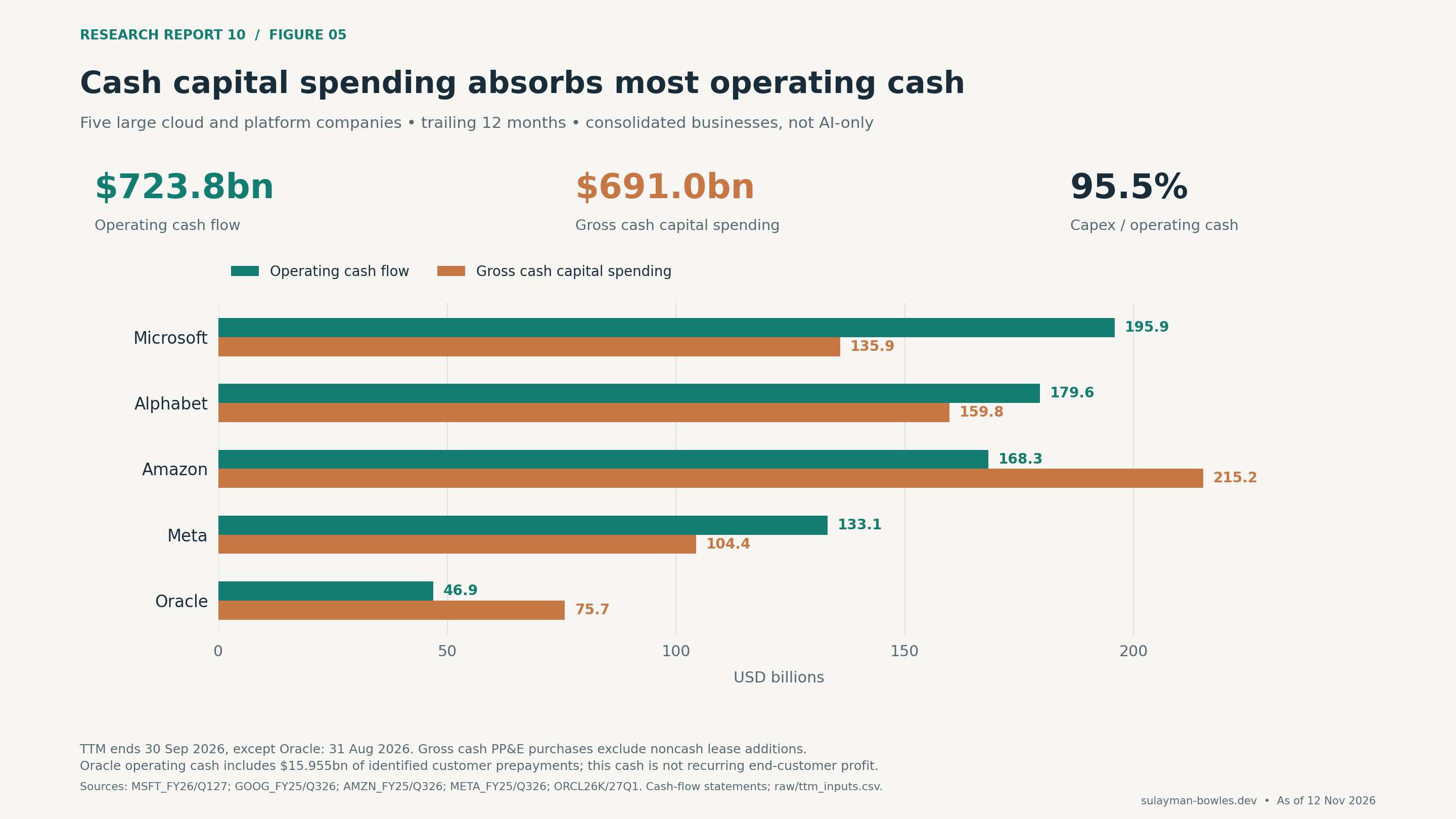
Figure 5. The first five companies generated $723.756bn of operating cash and spent $691.015bn on gross cash capital purchases, leaving $32.741bn on this definition. Periods end in September except Oracle, August. Source: statement-level historical inputs and formula reconstruction.
That difference is not discretionary cash. It precedes finance-lease principal, dividends, buybacks, acquisitions and equity investments. It also includes customer advances. Oracle’s operating cash flow contains $15.955 billion of increases in prepayments carrying a significant financing component. Removing only that identified contribution lowers the five-company difference to $16.786 billion. The sensitivity adds the modeled noncash financing adjustment to the reported comparison.oracle
Amazon’s reported free cash flow uses net capital expenditure. The model uses $215.192 billion gross cash purchases; Amazon subtracts $4.535 billion of proceeds and incentives to obtain $210.657 billion net purchases and −$42.357 billion reported free cash flow. Using that definition gives a modeled difference of −$46.892 billion.amzn
Liquidity needs similar care. Alphabet’s $265.098 billion reported cash and marketable securities includes $90.384 billion of quoted equity; $75.2 billion of that equity is temporarily restricted SpaceX stock. Excluding the equity gives $174.714 billion—without subtracting the restriction a second time. Microsoft’s $64.509 billion reported cash and short-term investments includes $4 billion restricted under a supplier agreement, leaving $60.509 billion. These adjustments prevent investment marks or restricted balances being described as ordinary spending cash.goog, msft
What the payment schedules show
| Payer; selected obligation scope | Payment window | Amount | / TTM revenue | / TTM OCF | / adjusted liquidity |
|---|---|---|---|---|---|
| Microsoft: purchases, construction, lease payments | FY to June 2027; June disclosure | 231.267 | 66.8% | 118.1% | 382.2% |
| Alphabet: material purchases | Oct. 2026–Sep. 2027 | 213.400 | 45.3% | 118.9% | 122.1% |
| Amazon: PPE and other purchases | Calendar 2027 | 74.052 | 9.3% | 44.0% | 67.2% |
| Meta: noncancelable contracts | Calendar 2027 | 121.410 | 50.3% | 91.2% | 153.1% |
| Oracle: purchases and commenced lease payments | FY to May 2028 | 11.163 | 15.6% | 23.8% | 30.7% |
| CoreWeave: commenced leases only | Calendar 2027; June schedule | 2.339 | 23.7% | 32.5% | 55.9% |
| Nvidia: own purchase, cloud, lease, equity and capex schedule | FY to January 2028 | 100.000 | 33.0% | 74.4% | 176.7% |
| AMD: unconditional purchases | FY2027 | 22.206 | 48.9% | 251.6% | 140.8% |
| Broadcom: inventory purchases | FY2027 | 52.674 | 59.1% | 129.6% | 219.7% |
| Anthropic: aggregate infrastructure payments | Oct. 2026–Sep. 2027 | 70.700 | 200.4% | 1,187.0% | 53.6% |
Sources: issuer commitment and lease notes; Anthropic p.178. Ratios are model calculations. The scopes differ and should not be summed. Oracle’s first disclosed full forward fiscal year is shown; its remaining FY2027 period contains only nine months. CoreWeave’s aggregate equipment-purchase obligation is unknown, so its lease-only row is especially incomplete.financial, anthropic
The ratios compare commitments with reported cash flow. Operating cash flow already deducts operating purchases, while capital purchase commitments can overlap capital expenditure. Subtracting the table again from OCF less capex would double count costs. The forward numerator also spans a different period from trailing revenue and cash flow. The ratio indicates the scale of the forward commitments.
The broad corporate envelopes are much larger than these dated slices: Alphabet’s material purchases total $924.4 billion, Meta’s noncancelable commitments $454.52 billion, Nvidia’s own commitments $366 billion, and Broadcom’s inventory purchases $126.821 billion. They include non-AI spending and commitments already counted elsewhere. Uncommenced leases are particularly important and often absent from balance-sheet lease liabilities until commencement: the latest disclosures include Microsoft $364.6 billion, Oracle $288 billion, Amazon $164.922 billion, Alphabet $130.5 billion and Meta $355.73 billion.financial
Private-lab transparency is uneven
OpenAI’s approximately $50 billion annualized run rate comes from the CFO’s statement about annualized revenue. Its public OCF, current cash balance and full annual payment schedule remain unknown in this ledger. The $122 billion fundraising announcement cannot substitute for those missing statements.
Anthropic remains private pending its proposed IPO, but its registration statement supplies financial statements. The model reconstructs $35.282 billion TTM revenue and $5.956 billion TTM operating cash flow, versus $131.845 billion of cash and short-term investments at September 30. Its company-reported October 31 revenue run rate is $81 billion. Proposed IPO proceeds are excluded until closing. Net loss should not be used as cash burn without reconciling large noncash financing remeasurements.anthropic
xAI requires another boundary change: after the February combination, relevant current public statements are SpaceX consolidated statements. Nine-month revenue of $27.083 billion, OCF of $13.097 billion and cash capital purchases of $48.069 billion are group figures. The Superintelligence segment includes cloud resale to labs and X advertising. Neither the whole group nor the whole segment is clean independent AI end-customer revenue.spacex
5. How much end-customer revenue is required?
The model asks a narrow question: how much annual revenue would let a lab devote a stated fraction of its receipts to these infrastructure payments? It does not value the company, project a market share or assert a gross margin.
The equation is:
Required revenue = annual infrastructure cash requirement ÷ infrastructure share of revenue.
The denominator is a cash-budget allocation covering inference, training and other included infrastructure. The remainder must support staffing, other operating costs, taxes, financing and any cash cushion. A 60% infrastructure share does not mean a 40% accounting gross margin; training and lease accounting can run through different financial-statement lines.
For OpenAI, the model annualizes the eight original values. Oracle contributes 300/5; AWS contributes 38/7 and 100/8; CoreWeave uses approximate inclusive 68-, 48- and 69-month spans; Cerebras uses four years. Together these non-Azure items contribute $87.159 billion a year. Azure’s undisclosed term is the main timing sensitivity: ten, seven or five years for the $250 billion purchase.
For Anthropic, there is no need to invent a maturity profile: the filing gives $70.7 billion for October 2026–September 2027, including $4.2 billion conditional or terminable. Its denominator is varied on the same cash-budget basis. Because the timing bases differ, the two companies’ thresholds are not added into a single annual industry forecast.
| Scenario | Azure normalization | Infrastructure / revenue | OpenAI annual service equivalent | OpenAI required revenue | / ~$50bn run rate | Anthropic required NTM revenue | / $81bn run rate |
|---|---|---|---|---|---|---|---|
| Low requirement | 10 years | 70% | 112.2 | 160.2 | 3.20× | 101.0 | 1.25× |
| Base | 7 years | 60% | 122.9 | 204.8 | 4.10× | 117.8 | 1.45× |
| High requirement | 5 years | 50% | 137.2 | 274.3 | 5.49× | 141.4 | 1.75× |
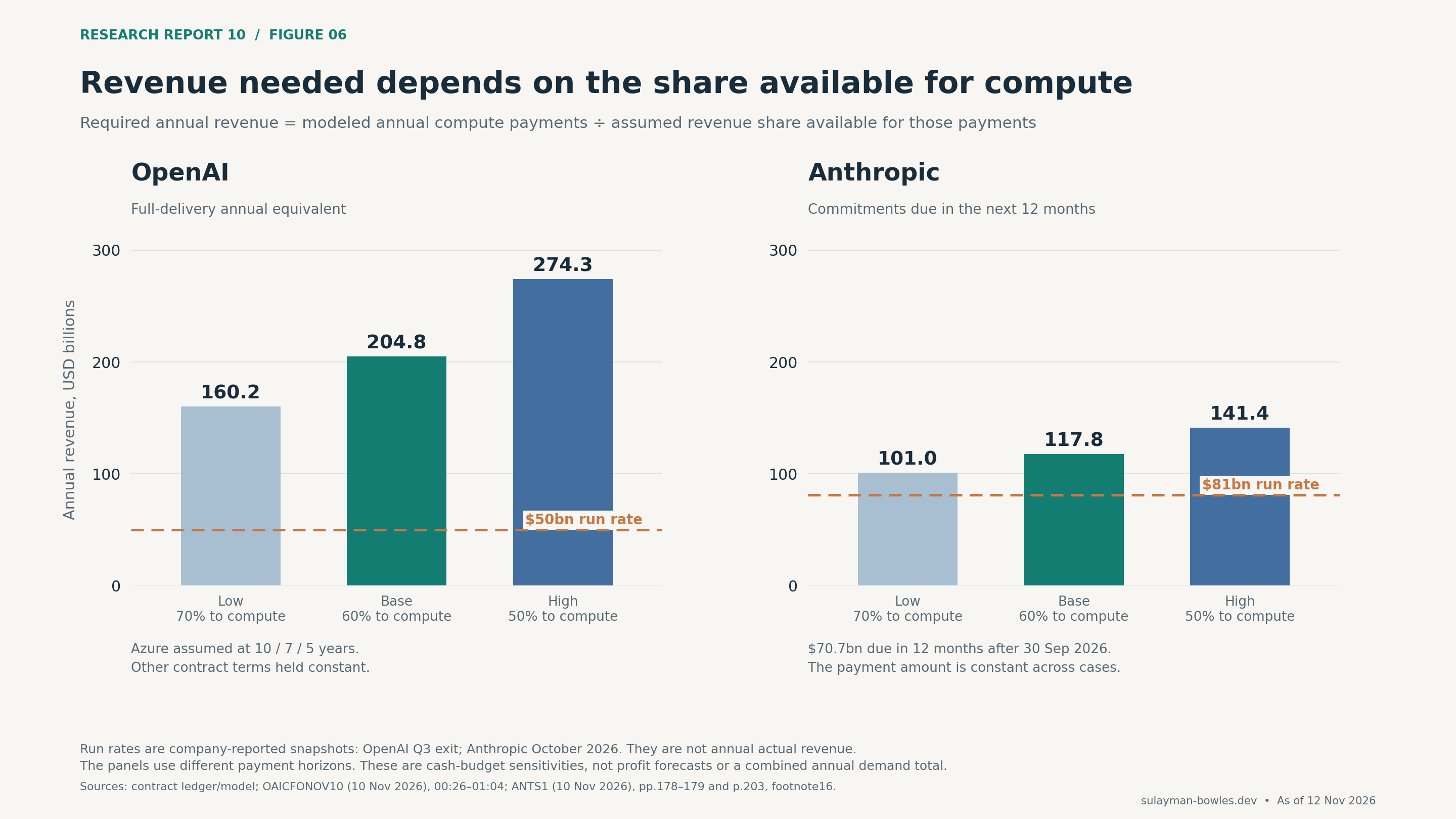
Figure 6. Calculated sensitivities versus company-reported run rates. OpenAI’s full-delivery normalization and Anthropic’s next-twelve-month schedule have different timing. Source inputs: contract ledger, Anthropic p.178/p.203, OpenAI CFO interview November 10, 00:26–01:04.
These hurdle rates cover the commitments the model can price. The OpenAI model omits unknown-priced capacity and cannot subtract amounts already consumed without a remaining-obligations schedule. Delivery ramps could push cash bills later; shorter concentrated payment periods could make particular years higher than the averages. Cerebras options are excluded, as are unpriced OpenAI hardware and power commitments.
There is also a measurement issue at the revenue end. Cloud resale, distribution arrangements and revenue-sharing can cause two companies to recognize revenue connected to the same final purchase. Microsoft’s OpenAI-related revenue, AWS sales to labs and Broadcom’s AI semiconductor sales cannot all be added to lab subscription and API revenue to measure independent end demand. Broadcom’s $16.7 billion quarterly AI semiconductor revenue measures supplier sales.msft, avgo
Public cloud segment revenue is broader than AI. Advertising cash can fund a data center even when the company reports no corresponding AI revenue. The clean comparison therefore remains imperfect: disclosed lab revenue and a sensitivity for cash needs, with reseller and accounting-basis differences left visible. An exact industry-wide end-customer revenue denominator is unknown from these public documents.
What moves the answer most?
At the base seven-year Azure allocation, varying only the infrastructure share from 70% to 60% to 50% changes OpenAI’s threshold from $175.5 billion to $204.8 billion to $245.7 billion. The assumption about how much revenue can be devoted to infrastructure matters more than a small adjustment to a contract’s month count.
At a fixed 60% share, changing Azure from ten years to seven to five moves the threshold from $186.9 billion to $204.8 billion to $228.6 billion. Every additional $10 billion of annual infrastructure requirements raises required revenue by $16.7 billion at that share. Conversely, removing $10 billion of future bills lowers the requirement by the same amount; it does not imply a $10 billion reduction in total contract value.
For Anthropic, excluding the identified $4.2 billion conditional portion reduces the near-term cash input to $66.5 billion and the 60% revenue threshold to $110.8 billion. That remains above its $81 billion exit run rate, but far below a calculation that divides the entire multiyear $900.9 billion by one year. The payment schedule shows when the commitments turn into bills.
Efficiency improvements can improve utilization and the revenue earned per unit of infrastructure. They do not automatically cancel a minimum-purchase clause. To translate better model efficiency into lower contractual cash requirements, evidence is needed of cancellation rights, transferable capacity, reduced prices, delayed delivery or replacement demand from other customers.
6. Evidence that would change the conclusion
The case for financing dependence would weaken if customer collections grew enough to cover dated infrastructure cash bills and the rest of the business. Several specific disclosures would make that test possible.
An OpenAI remaining-obligations schedule would replace original contract values with future payments, identify amounts already consumed, distinguish year-by-year ramps and expose overlap among cloud purchases, equipment leases and power agreements. A public cash-flow statement would distinguish outside financing from recurring customer collections. Those documents could materially raise or lower this report’s normalization.
Verified delivery and utilization would show whether reserved capacity is earning revenue. A delayed acceptance date can defer payments without reducing a nominal contract. A contract termination can reduce the exposure stock. Delivery delays change when cash is due. Terminations can change how much is owed.
Financing draw and repayment reports would identify how much of committed facilities reaches equipment vendors, what remains conditional, and how much gross issuance merely refinances existing debt. An increase in cash from new equity is different from a mark-up in the value of an investment. Facility availability tied to a customer’s delivery milestones is different from unrestricted cash.
Comparable end-demand reporting would isolate receipts from independent customers by excluding cloud resale and distribution pass-through. This is the evidence required to turn the two-lab revenue sensitivities into an industry funding test. More aggregate backlog, without customer concentration and recognition detail, would not solve that problem.
Revised asset recoveries and guarantee terms would alter the exposure borne by vendors and lenders. In residual-value structures, a lower outstanding lease balance and higher equipment recovery reduce support calls; a guarantee’s maximum is not its expected loss. Neither a maximum guarantee nor an equipment valuation should be represented as cash already spent.
The present evidence supports a conditional conclusion: current financing can bridge a large difference between construction spending and the customer revenue ultimately needed to sustain it. That bridge includes real operating businesses and completed capital raises. Its durability depends on cash collections, delivery timing, contract enforceability and access to additional funding—not on the sum of announcement headlines.
Model controls and reproducibility
The workbook labels sourced inputs, assumptions, formula calculations and outputs. It preserves unknowns and original currencies. The active scenario selector drives one calculation, with a two-variable sensitivity table for Azure duration and infrastructure budget share. The raw CSVs record transaction sources and inclusion flags; static PNG/SVG charts use the same numerical inputs.
Three headline numbers were independently checked. The $1,631.3 billion selected inventory was recalculated from the eight OpenAI rows and Anthropic aggregate, with the latter reconciled to its five disclosed components. The $368.5375 billion bond total was independently summed by issuer and calendar year and checked against filing aggregates and closing documents. The $204.7888 billion base OpenAI threshold was independently recomputed directly from the contract normalization. The $723.756 billion operating-cash total and $691.015 billion capital-purchase total were also reconstructed independently from annual and interim statements.
All quoted model figures are rounded from those calculations. The workbook gives the filing and balance-sheet dates for each source. Currency-specific offerings have not been converted without a documented issuance-date rate. Financing totals are not subtracted from procurement obligations, and no total is formed by adding customer commitments, provider RPO, chip orders and project budgets together.
Primary-source notes
The numbered notes below identify the main documents. The workbook and raw CSVs carry the fuller transaction-level source register, including prospectus coupons, maturity dates, closing receipts and page or note locators.
- Microsoft subsequent-events note (2025-10-29; Subsequent Event; October28 agreement); OpenAI: five new Stargate sites (2025-09-23; Oracle partnership paragraph; updated October22); OpenAI–AWS original agreement (2025-11-03; Opening and deployment paragraphs); OpenAI–Amazon expansion (2026-02-27; OpenAI to use Trainium compute; investment opening). ↩
- OpenAI CFO, Yahoo Finance interview (2026-11-10; Video transcript 00:26–01:04; CFO states Q3-exit annualized revenue approximately 50bn). ↩
- CRWV25Q1 (2025-05-15; Note 16 Subsequent Events, p 33; OpenAI additional $4bn through April 2029); CRWV8K (2025-09-25; Item 1.01; 6.5bn throughMay31 2031); CRWVOAI (2025-09-25; Opening total22.4bn reconciliation). ↩
- Cerebras registration statement (2026-04-17; Selected by Leaders; OpenAI Relationship pp 170–171); Cerebras June 2026 10-Q (2026-08-12; Note 3 OpenAI collaboration/RPO; Note 10 loan; Note 12 warrants). ↩
- Anthropic S-1/A (2026-11-10; pp.173–176 convertible notes; pp.178–181 obligations/arrangements; p.203 footnote 16 run rate; F-5–F-13 financial statements). ↩
- OAINVDA (2025-09-22; LOI paragraph; up to100bn investment); OAIAMD (2025-10-06; Definitive agreement and warrants); OAIBRCM (2025-10-13; Term sheet and deployment timing); OAISTAR (2025-01-21; Opening intention500bn overfouryears; initial100bn). ↩
- OAIPORTS (2026-08-17; 20-year lease paragraph; first800MW2028); OAICAM (2026-07-22; Opening3.2GW2028–2032); NVDA27Q2 (2026-08-26; 10-Q; Notes 7–10, 14; pp 3, 5, 8, 17–19, 31–34). ↩
- Nebius FY2025 20-F (2026-04-30; Note revenue recognition F-17; subsequent events); Nscale S-1 (2026-09-18; Risk factors customer concentration; Microsoft agreement; pp 3, 11); IREN FY2026 10-K (2026-08-27; AI Cloud Services Contracts / Microsoft Agreement). ↩
- CRWV META25 (2025-09-30; 8-K Item 1.01; transaction Sept25); CRWV META26 (2026-04-09; 8-K Item 8.01; transaction March31); NBISMETA26 (2026-03-16; Five-year contract and residual-capacity purchase paragraphs); METAAMD26 (2026-02-24; Takeaways and initial deployments); METAAWS26 (2026-04-24; Opening agreement and tens of millions of cores). ↩
- SPCXQ3 (2026-10-22; Statements; Notes 1, 3, 9, 16, 17, 18; pp 9–33); SPCXGPU40 (2026-10-26; Item 8.01; signed October 24, 2026; approximately 40bn principal plus interest and expenses); SPCXBOND (2026-06-26; Item 8.01). ↩
- MSFT FY26 (2026-07-29; 10-K Item 7 p 44 material cash requirements; financial statements pp 50-55; Notes 6, 10, 13); MSFT Q127 (2026-10-28; 10-Q financial statements; Note 1 OpenAI; Note 11 RPO; Note 12 leases pp 21-22). ↩
- GOOG Q326 (2026-10-29; 10-Q p 4 balance sheet p 5 income p 9 cash flows; Note 2 revenue backlog; Notes 3, 4, 6, 10, 11; MD&A pp 54-57). ↩
- AMZN Q326 (2026-10-30; 10-Q Statements of Cash Flows/Operations/Balance Sheet; Note 1 revenue; Note 4 commitments pp 15-16; Note 5 debt p 18; MD&A FCF p 34). ↩
- ORCL26K (2026-06-22; 10-K; financial statements; MD&A pp 44, 53–55); ORCL27Q1 (2026-09-11; 10-Q; Notes 1, 6, 7; financial statements; pp 7, 12–13, 33–35). ↩
- CRWV26release (2026-11-10; 8-K Ex99.1; revenue backlog footnote1; financial tables); CRWV26Q2 (2026-08-12; 10-Q; Note 2 RPO p 15; Note 8 Leases pp 24–25; Note 10 Debt; pp 47–48 financing); CRWV NVDA25 (2025-09-15; 8-K Item 1.01; transaction Sept9); CRWV NVDA26 (2026-01-26; 8-K Item 3.02; closed Jan23). ↩
- NVDA27Q2 (2026-08-26; 10-Q; Notes 7–10, 14; pp 3, 5, 8, 17–19, 31–34). ↩
- AMD26Q3 (2026-11-04; 10-Q; Notes 8, 10, 11; Warrants Issued to Customers; Material Cash Requirements pp 31–32). ↩
- AVGO26Q3 (2026-09-10; 10-Q; Notes 2 RPO, 6 Borrowings, 10 Commitments pp 21–22); AVGO26release (2026-09-02; Financial highlights; cash flow table); AVGO OCT26 8K (2026-10-27; 8-K Item 2.03; Oct26 transaction; maximum potential undiscounted43bn upondeployment). ↩
- OAIFUND26 (2026-03-31; Opening; revolvingcredit4.7bnundrawn; 2bnmonthlyrevenue); OAIFUND26PRE (2026-02-27; 30bnSoftBank30bnNVIDIA50bnAmazon; 3GW+2GW); ANTG (2026-02-12; Opening; includesportionpriorMS/NVDAcommitments); ANTH (2026-05-28; Opening; 15bnpreviouslycommittedincludes5bnAmazon). ↩
- SBFUND25 (2025-12-31; 41bn fullyfunded; 30bnSB11bnothers); SBFUND26 (2026-10-01; Final10bnfundedwithSeptbonds; bridgecancelledrepaid); SBBOND (2026-09-24; TablesUSD10bn+EUR1bn; useofproceeds); SBBONDOM (2026-09-23; 2026 Bridge Loan Facility). ↩
- AVGO SPV35 (2026-06-09; Issuer financing announcement; initial transaction and multi-year draw schedule); AVGO SPV63 (2026-10-26; Issuer financing announcement; SPV, committed financing, first/second lien); AVGO OCT26 8K (2026-10-27; 8-K Item 2.03; Oct26 transaction; maximum potential undiscounted43bn upondeployment). ↩
- ORCL NOV26 CLOSE (2026-11-04; 8-K Item 8.01 confirms10bnequityand10bnnotes bothclosedNov4); ORCL NOV26 EQUITY (2026-11-04; 424B5 final prospectus datedNov2; coverpricingtable, UseofProceedsS-7). ↩
- GOOG FY25 (2026-02-05; 10-K Statements of Income/Cash Flows; Note 2 Revenue; Financing); AMZN FY25 (2026-02-06; 10-K cash flow p 36; income p 37; MD&A p 28 FCF); META FY25 (2026-01-29; 10-K MD&A p 77-78 FCF; Income Statement); META Q326 (2026-10-22; 10-Q balance sheet p 7, cash flows pp 10-11, Note 5 pp 17-18 data center ventures; Note 9 debt p 20; Note 10 commitments; MD&A pp 49-50); NVDA26K (2026-02-25; 10-K financial statements; Note 9 RPO); AMD25K (2026-02-04; 10-K financial statements and segment note); AVGO25K (2025-12-18; 10-K; financial statements, Note 10 Borrowings); CRWV25K (2026-03-02; 10-K; financial statements; Notes 2, 10). ↩
- Final-offering examples: Microsoft (2026-11-04; Prospectus supplement cover and Use of Proceeds unless otherwise specified); Alphabet (2026-08-10; Prospectus supplement cover and Use of Proceeds unless otherwise specified); Amazon (2026-07-09; Prospectus supplement cover and Use of Proceeds unless otherwise specified); Meta (2026-11-05; Prospectus supplement cover and Use of Proceeds unless otherwise specified); Oracle (2026-11-04; 424B2 final supplement dated2026-11-02 filedasof2026-11-04; cover); Nvidia (2026-06-18; 424B5 prospectus supplement dated2026-06-15 filed2026-06-17; cover and pricing table); AMD (2026-08-17; 424B5 supplement dated2026-08-13 filed2026-08-14; cover); Broadcom (2026-01-13; 424B2 supplement filed2026-01-08; cover and Description of Notes); CoreWeave (2026-09-22; 8-K Item 1.01 filed2026-09-22; no registered prospectus supplement). All offering rows, closing confirmations and earlier vintages appear in bonds.csv; source locators identify prospectus covers/pricing tables or private-offering 8-K/indenture tags. Gross principal is reconciled by issuer and calendar year. ↩
- 6.50% mandatory convertible preferred depositary shares (2026-10-26; 424B5 cover; closing confirmed Oct29 8-K Item 1.01); same preferred offering over-allotment (2026-11-03; 424B5 pS-2 Recent Developments: full exercise of over-allotment option); common stock forward sale agreements incl fully exercised option (2026-11-05; 8-K Item 8.01 common-stock option exercised6m shares; original40m detailed in Oct29 8-K); proposed Class C ATM program (2026-10-26; Issuer FWP Meta capital strategy announcement). ↩
- Hyperion Louisiana initial campus (2025-10-23; S&P rating action Overview; search-indexed primary full text (direct web open returned minimal shell)); Hyperion company announcement (2025-10-21; Announcement paragraphs3-4 and lease/RVG paragraphs); El Paso Texas (2026-11-02; S&P Nov2 rating action paragraphs1-8). ↩
Supporting material
- Excel model ↗Sourced inputs, live calculations and reported outputs.
- Source and model data (CSV collection) ↗Data tables, source references and calculation exports.