Texas business
Who holds the debt on Austin’s office towers?
111 Congress’s original $136.5 million mortgage is split into five notes. Two legacy loans totaling $190.2 million no longer encumber their original properties.
Austin’s large office buildings connect to several different pools of capital: securitized mortgage investors, banks, insurance-related and private capital, and the unsecured creditors of public real estate companies. The public records examined here identify a $136.5 million original whole mortgage at 111 Congress, a $265 million refinancing announced for Sixth and Guadalupe, and a $227.5 million PACE assessment at Springdale Green. Those amounts have different definitions and reporting dates. Adding them would not produce a current office-debt balance.S3, S6, S12, S13
The most consequential finding is how easily a debt map can overstate exposure. Colorado Tower’s $99.2 million mortgage was repaid in September 2026. Domain Tower’s $91 million legacy CMBS loan is fully defeased, meaning the trust’s remaining balance is no longer an exposure secured by that office property. Together, these checks remove $190.2 million of identified legacy obligations from a naïve current-property-debt tally. Replacement financing remains unknown.S7, S8, S9
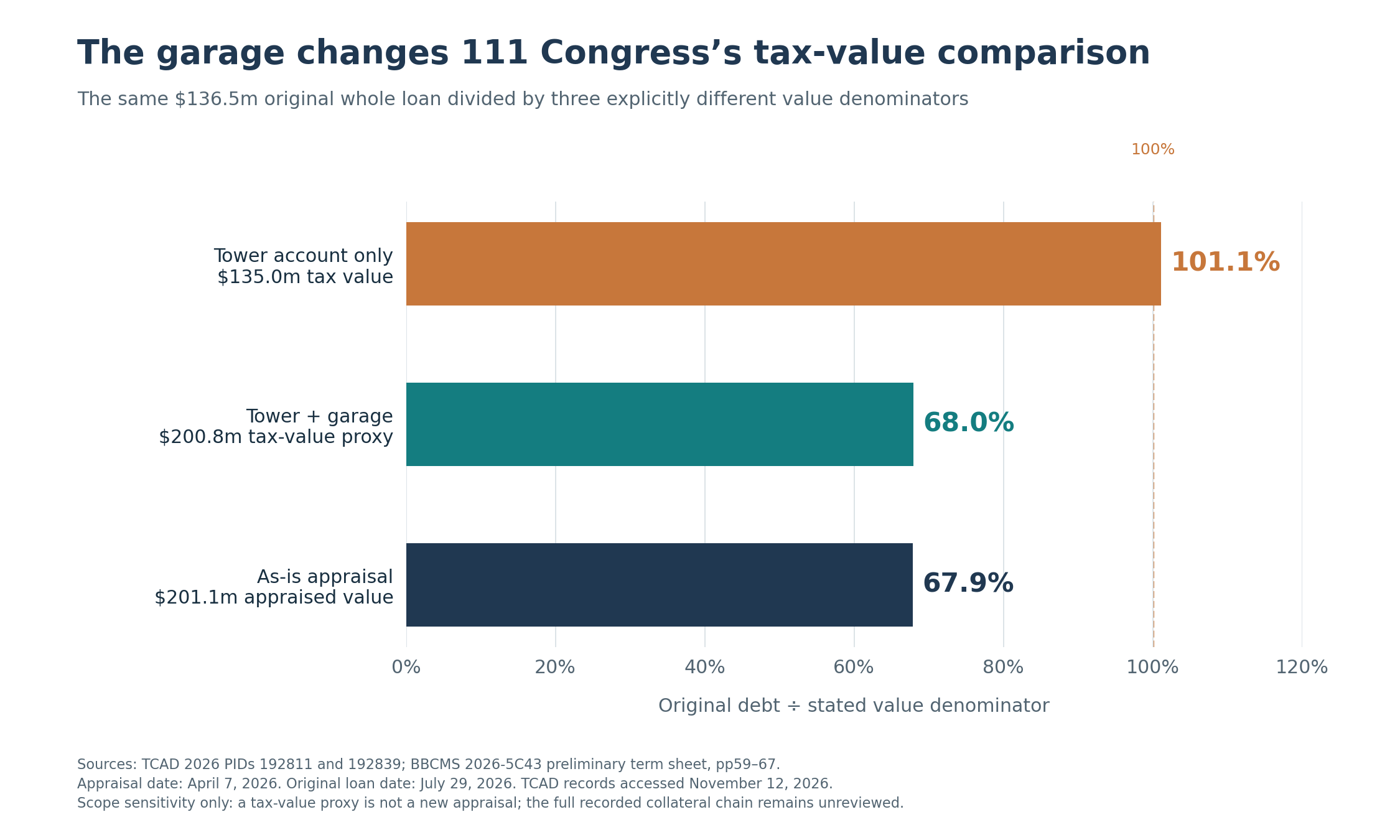
Collateral matching matters just as much. At 111 Congress, comparing the mortgage with the tower’s $135 million tax value alone produces an apparent 101.1% loan-to-value ratio. Including the tax assessment for the garage listed in the CMBS collateral produces a $200.799 million tax-value proxy and approximately 68.0% LTV, close to the lender disclosure’s $201.1 million appraisal and 67.9% LTV.S1, S4
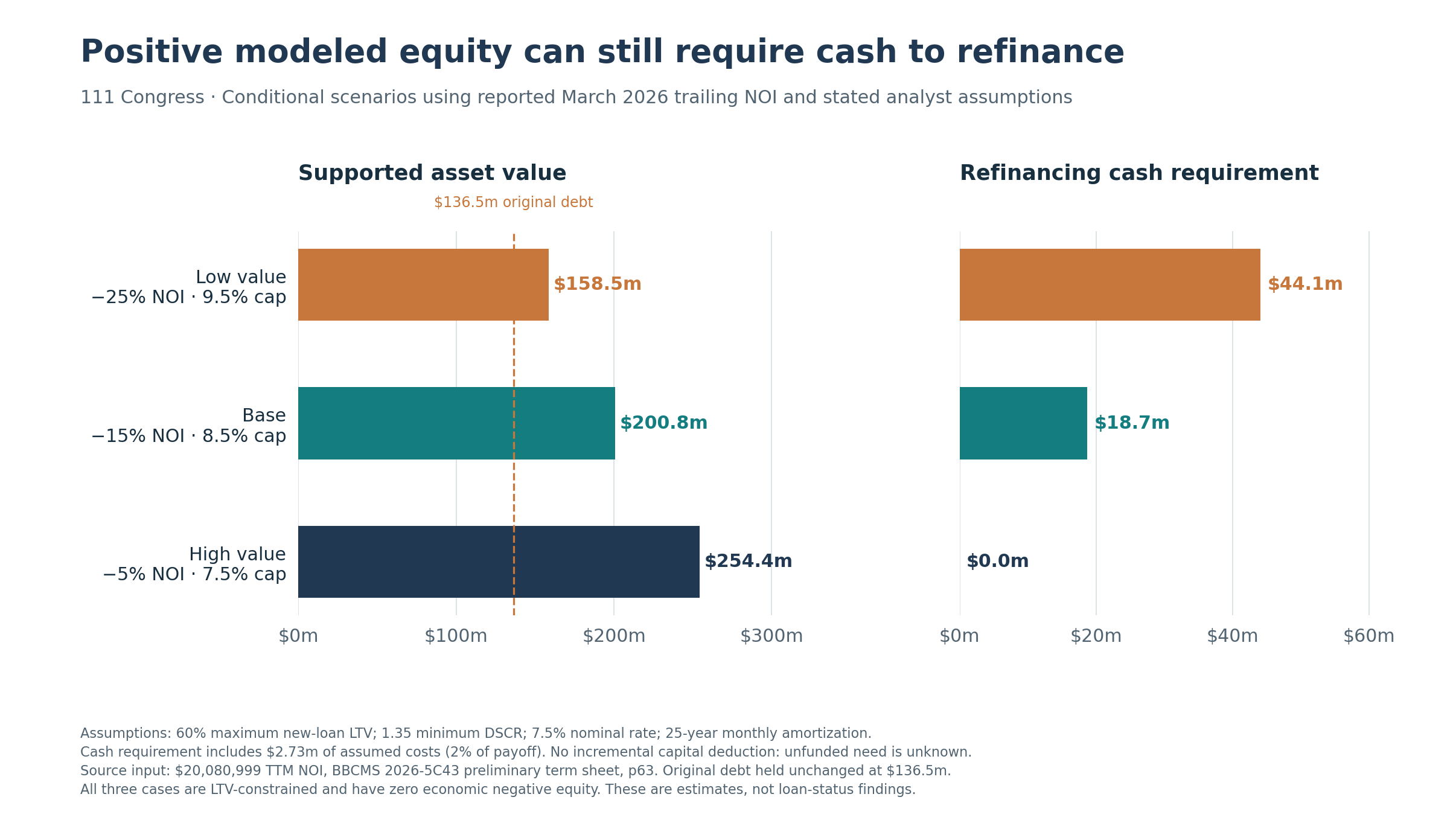
This investigation documents 62 buildings or office components, 60 principal TCAD accounts, and approximately 18.1 million reported square feet. The count describes the inventory examined. Complete citywide balances and an equity shortfall remain unknown. The data identify what remains unknown. A limited model for 111 Congress produces values of $158.5 million–$254.4 million and a hypothetical refinancing cash requirement of $0–$44.1 million, with a $18.7 million base case. The range illustrates how refinancing in 2031 would respond to the model assumptions.
1. What the inventory covers
The starting point is the official TCAD public property search, supplemented by the county’s TCAD map and primary owner, developer, SEC and leasing sources. The delivered inventory associates a stable building identifier with a property ID, the tax-record owner, 2026 market and appraised values, reported area, available construction-year evidence, location, and source dates.S1, S2
| Working geography | Building or component rows | Principal TCAD accounts | Reported area, approximately |
|---|---|---|---|
| Downtown | 40 | 40 | 13.111 million sf |
| Domain | 14 | 13 | 3.346 million sf |
| East Austin | 8 | 7 | 1.648 million sf |
| Documented total | 62 | 60 | 18.104 million sf |
The three study areas use the coordinates below. The downtown screening envelope runs from longitude −97.757 to −97.731 and latitude 30.261 to 30.285; the Domain envelope from −97.732 to −97.710 and 30.389 to 30.411; East Austin from −97.734 to −97.675 and 30.244 to 30.290. Named-property searches supplemented the geographic screen. This captures recognizable commercial clusters within the published coordinates.
The denominator has two important qualifications. First, building-area detail and certified bulk-export downloads were unavailable during retrieval. Areas therefore come from primary property sources. Second, some source measurements are rentable office area, others rounded building area or office components with ancillary uses. The sum measures documented coverage; it is not a standardized estimate of Austin office inventory. Littlefield and Scarbrough exceed 100,000 sf on their quoted whole-building measures, but their office-versus-retail splits remain unverified; they remain under review for the office-only threshold.
The main CSV contains all 62 rows. The following examples show why a single owner-and-value column is inadequate:
| Property | Reported area used | 2026 TCAD market value | What must accompany that value |
|---|---|---|---|
| Frost Bank Tower | 535,078 sf | $247.000m | Tax owner CSHV-401 Congress LLC; current mortgage unresolved |
| 100 Congress | 420,471 sf | $178.427m | MM 100 Congress Owner LLC; June 2026 deed lead and subsequent Barings management appointment |
| 111 Congress | 519,959 sf | $135.000m | Tower account only. The garage is $65.799m |
| 600 Congress / One American Center | 543,521 sf | $176.869m | BCSP 8 600 Property LP; current financing unresolved |
| 816 Congress | 434,801 sf | $94.020m | Current principal remains unknown |
| Colorado Tower | 373,334 sf | $182.959m | Prior mortgage repayment is documented |
| Sail Tower / Block 185 | 804,000 sf | $471.816m | Cousins property; corporate debt and mortgage debt require different treatment |
| Indeed Tower | Approximately 733,000 sf in property marketing | $416.484m | Tax record names University of Texas; operating ownership and ground interest differ |
| 405 Colorado | 205,803 rentable sf | $114.668m | Tax-record interest and the July purchase interest require a ground-lease reconciliation |
| Domain Tower | 309,883 sf | $109.121m | The old $91m CMBS obligation is defeased |
| Springdale Green buildings 1 and 2 | 388,700 and 449,900 sf | $206.713m shared account | Count the tax account once; PACE financing covers a project interest requiring reconciliation |
| Waterline office component | 703,000 sf | $620.643m | Entire mixed-use tax account; office-only value remains unknown |
Source: selected rows from the official 2026 TCAD extract and linked primary area sources in the accompanying source register. Amounts are rounded here; raw values are preserved. These tax values are not asserted to be November transaction values.S1, S2
Several distinctions prevent false precision. A public ground owner can appear in TCAD while another entity owns or finances the leasehold. A completed sale can precede a tax-name update. Indeed Tower’s September 2026 financial reporting area is 758,975 sf, while its property marketing area is approximately 733,000 sf; the dataset identifies each figure by source.S18
Independent construction-year evidence was verified for 19 of the 62 rows. TCAD GIS first-floor-improvement years appear in their own field. They can differ from original delivery years.
Domain 3 and Domain 4 share a principal account. Springdale Green’s two office buildings also share one. ATX Tower has distinct commercial, residential and parking condominium interests. Its residential account is excluded from the office mapping. The $7.812 billion count-once principal-account tax total is an extraction check that mixes whole parcels, partial interests and mixed uses. It is unsuitable as an office portfolio valuation or LTV denominator.
The historical file contains 493 property-year observations across 68 principal and supplemental accounts for 2019–2026. That is an unbalanced panel. New accounts appear, and older property-year rows can carry subsequently updated owner or deed metadata. Annual values can be studied by property year; the accompanying names cannot be treated as a historical title ledger.
2. “Who holds the debt” requires several identities
A recorded lender, an originating bank, a securitization trust, a servicer and an ultimate investor answer different questions. A loan can move from a bank into a trust while the bank continues servicing it or keeps a note. A special servicer can be named in a contract even though the loan has never entered special servicing. An unsecured bondholder has a claim on a company without holding a recorded mortgage on each building it owns.
The financing map lists the borrower, original lender, identified noteholder or trust, master servicer, designated special servicer, and observed servicing status. The trust records leave ultimate CMBS certificate ownership unknown. Syndicate participation and later assignments can also remain private or incompletely disclosed.
| Property or group | Identified capital or creditor relationship | Defensible status at the research cutoff |
|---|---|---|
| 111 Congress | Wells Fargo origination; BBCMS and BANK5 trust notes; residual Wells Fargo notes at the offering cutoff | $136.5m original whole loan; $36.5m independently observed in October remittance data |
| Sixth and Guadalupe | Wells Fargo and Goldman Sachs in the developer’s refinancing announcement | $265m announced; current balance, maturity and exact office collateral remain unresolved |
| Springdale Green | Nuveen Green Capital, through a PACE assessment | $227.5m original assessment; rate, maturity and current principal unavailable |
| Colorado Tower | Cousins corporate financing after payoff of the identified mortgage | $99.2m mortgage repaid September 1, 2026 |
| Domain Tower | Former Bank of America-originated leasehold loan in BANK 2019-BNK21 | $91m trust balance fully defeased; replacement property financing unknown |
| Cousins’ other named Austin holdings | Corporate unsecured creditors; no Austin mortgage in the reviewed secured-debt schedule | Classification based on the corporate debt schedule |
| Indeed Tower | Kilroy corporate creditors; property absent from its reviewed secured-debt schedule | The schedule identifies no mortgage on this property |
| 515 Congress | Historical bank facility shared with an Atlanta property; new owner group after sale | Previous facility cannot be carried forward as the buyer’s mortgage |
Sources: executed loan documents, monthly reports, public-company debt schedules and primary financing announcements.S3, S5, S6, S7, S8, S12, S13, S18, S20, S21
This answers the lender-type question more reliably than classifying every office building as exposure of a Texas bank. Banks appear in origination and syndicated financing; CMBS spreads mortgage risk through trusts; PACE uses assessment financing; and public REIT portfolios rely substantially on company-level capital. The data does not support percentage shares of current Austin debt by lender type.
Ground leases need their own field. Safehold’s Domain Tower case study describes a ground lease alongside a CMBS leasehold loan and a later sale of the leasehold. That relationship helps identify the interests involved, but its historical occupancy language leaves current operating performance unknown.S10
3. 111 Congress: one mortgage, five notes, several reporting dates
The executed July 29, 2026 noteholder agreement documents a five-note mortgage to CC One Eleven Congress Owner LP. Subsequent sale documents confirm an aggregate $136.5 million secured obligation. The October allocation is:S3, S6
| Note | Principal | Identified holder or destination at the October disclosure |
|---|---|---|
| A-1 | $80.0m | BBCMS 2026-5C43 |
| A-2 | $10.0m | Wells Fargo; anticipated later securitization |
| A-3 | $20.0m | BANK5 2026-5YR24 |
| A-4 | $16.5m | BANK5 2026-5YR24 |
| A-5 | $10.0m | Wells Fargo; anticipated later securitization |
| Whole loan | $136.5m | Count once |
The two named trusts account for $116.5 million. Stopping there omits $20 million. Adding the whole mortgage to the trust notes counts the same liability twice. The original agreement allocated A-1 and A-2 differently, at $60 million and $30 million; the later allocation changes their split without changing the total. The agreement allows resizing, but the intervening resizing instrument was not reviewed.S3, S4, S6
The loan has a 7.135% fixed rate, interest-only payments and an August 11, 2031 maturity. The October 19 BANK5 distribution report shows its $20 million and $16.5 million pieces, paid through October 11, with no appraisal reduction for those notes. Its special-servicing section reports no specially serviced loans for that reporting period.S5
The other pieces have different observation dates. The $80 million BBCMS note was documented in the initial collateral materials; an October 30 8-K confirms that the lead note entered BBCMS on October 29. That changed the controlling servicing agreement to one naming Trimont and Rialto. The change reassigned servicing responsibilities. The October 19 report preceded that switch.S11
Consequently, the model’s assumption that the recent interest-only whole loan remains at $136.5 million is a reasonable analytical convention, but it is not a same-date monthly verification of all five balances. The raw files record the original amount and the smaller, explicitly observed remittance amount.
The April 28 rent roll shows 90.1% leased. Workrise accounts for 17.9% of rentable area and 22.7% of underwritten base rent, with a July 2028 expiry; 46,250 sf of its space is subleased to CS Disco. The lease expiration creates rollover exposure before the mortgage matures.S29
The income evidence also has dates and definitions:
| Period | Reported NOI | Reported or underwritten NCF |
|---|---|---|
| 2023 | $17.189m | $15.278m |
| 2024 | $17.863m | $16.411m |
| 2025 | $19.573m | $19.160m |
| Trailing year ended March 31, 2026 | $20.081m | $19.934m |
| Loan underwriting | $21.451m | $20.047m |
The historical and underwriting NCF conventions differ. Underwriting includes future rent steps and deductions for replacement reserves and leasing costs. Those figures are neither November collections nor interchangeable with the appraiser’s cash flow.S4
Interest uses Actual/360. A 365-day annualization is:
$136.5m × 7.135% × 365 ÷ 360 = $9.875m.
Underwritten NCF divided by that annualized service is approximately 2.03 times, consistent with the disclosed underwriting ratio after rounding. Simply multiplying balance by coupon understates this annualized interest convention. Billed interest still depends on the payment period.S5
The garage changes the LTV conclusion
TCAD identifies the tower as property 192811, at $135 million, and the garage at 206 East Cesar Chavez as property 192839, at $65.799 million. The two records have the same tax owner, and the CMBS property description includes the garage. This supports the combined collateral proxy, although the full deed legal descriptions remain an outstanding verification.S1, S4
| Denominator | Value | $136.5m loan divided by value |
|---|---|---|
| Tower tax account alone | $135.000m | 101.1% |
| Tower plus identified garage tax accounts | $200.799m | 68.0% |
| Disclosed April 7 appraisal | $201.100m | 67.9% |
The prospectus also presents a $203 million hypothetical value that excludes a release parcel and assumes specified tenant-improvement, leasing-commission and free-rent obligations are reserved at origination. Its footnote states the $201.1 million as-is value used here. Those definitions should remain attached to the appraisal figures.S29
There is also an unresolved transaction discrepancy. Cousins reports a $208 million July 29 sale; the CMBS sources-and-uses table uses a $198 million purchase price, and its comparable-sale date is inconsistent with the executed transaction chronology. A release parcel exists, but no reviewed document attributes the $10 million difference to it. The workbook shows both figures. The reason for the difference remains unknown.S4, S7
4. Old debt is not necessarily today’s maturity wall
Colorado Tower. Cousins’ third-quarter supplemental and Form 10-Q both report repayment of the $99.2 million remaining mortgage principal. The repayment resolves that loan’s maturity. The owner still has corporate debt; repayment of one property mortgage does not eliminate its company-level obligations.S7, S8
Domain Tower. The October BANK 2019-BNK21 remittance report identifies the former $91 million office loan as fully defeased. The ABS-EE asset record agrees. The bond-side balance survives, but the collateral has changed to the defeasance structure. Carrying the historical property name, appraisal or occupancy forward would turn stale operating fields into a fictitious current office exposure.S9
The Domain monthly report distinguishes an original August 2029 maturity from an adjusted May 2029 maturity; the XML uses the adjusted date. Reading an isolated date without its column heading can create another false mismatch. Since the office collateral is already defeased, neither date belongs in the current property-mortgage maturity table.
515 Congress. KBS’s June 30 notes payable table shows a roughly $160.4 million facility that also covered 201 17th Street in Atlanta. Its 2026 modification imposed an Austin sale deadline and required a release payment. KBS announced the completed sale to a Palmatum/AQUILA/Glendon venture on September 23. Allocating the whole pre-sale facility to Austin, or treating it as the new owner’s debt, would be unsupported.S20, S21, S22
The SEC-filed legal exhibits provide the recording history even though county document images were not obtained. The instrument trace distinguishes the 2018 senior deed of trust, the 2020 junior deed and modifications, and subsequent senior/junior modifications. For example, 2020011688 records the first modification for 515 Congress. 2023020596 and 2023020597 record later senior and junior modifications. The source register identifies the precise recitals and recording dates.S23
Eastbound. Lincoln’s July 2024 recapitalization announcement says new capital paid off the construction loan. It supplies no basis for counting that old construction loan as current. The two-building campus is tracked as an inventory gap until individual building areas and current interests are reconciled.S24
These corrections change the interpretation of headlines about refinancing. A new loan may replace an old loan; a sale may release one property from a portfolio facility; a defeasance may leave bonds outstanding without leaving the building pledged. An amount is not additive until the legal interest and the effective date are matched.
5. Where the distress evidence is strongest—and where it stops
The clearest owner admission of historical pressure concerns 100 Congress. Alony-Hetz’s FY2025 report describes a $140 million whole-property loan, a decline in value to approximately the debt amount, 67% year-end occupancy, and efforts to refinance as an alternative to transferring the property to the lender. It also reports a $66 million 2025 reduction in value. That supports a finding of documented historical equity impairment and refinancing pressure.S14
Whether a payment was missed in November 2026 remains unknown. TCAD now names MM 100 Congress Owner LLC and provides a June 30 deed lead. On July 6, Transwestern announced that Barings had selected it to lease and manage the property. The intervening deed, loan releases, consideration and any replacement debt were not obtained. Carr’s June 2025 debt schedule listed a November 1, 2026 maturity for the old loan. The ownership change leaves that loan’s current status unresolved.S1, S15, S30
The owner report itself contains a valuation-table inconsistency relative to its narrative and previously reported ownership share. That prevents a clean look-through valuation calculation. The report uses the explicit financing narrative for the historical-pressure conclusion and leaves the conflicting table unreconciled.
At Springdale Green, the Texas PACE Authority’s project overview is dated October 28, 2026 and identifies a $227.5 million refinancing assessment from Nuveen Green Capital. This is important current financing evidence. Delinquency, mortgage LTV and the outstanding construction balance remain unknown. Adding the assessment to an old construction-loan announcement without a payoff reconciliation could substantially overstate obligations.S13
The county distinguishes non-tax trustee-sale notices from tax foreclosures. This research did not obtain a verified, in-scope posted trustee-sale notice or completed foreclosure deed for the selected buildings. The direct county record interface did not return usable document images. Notice and foreclosure status therefore remain unknown where no primary record resolves them; an unsuccessful search is not evidence that no notice exists.S16
The type of record determines what it can show.
| Observation | Supported conclusion |
|---|---|
| Owner reports an impairment or refinance negotiations | Historical economic pressure, with the reporting date stated |
| Servicer reports a transfer into special servicing | Special servicing as of the stated report; reason still requires comments |
| Trustee-sale notice identifies the property and instrument | A sale was scheduled; completion still needs confirmation |
| Recorded trustee’s deed or equivalent disposition record | A completed transfer, subject to the document’s terms |
| Large vacancy or marketed sublease | Leasing or rollover exposure; loan status requires a loan record |
No binary distress score is assigned from vacancy, a bank name in a property record, or a stale maturity date.
6. The leasing problem is measurable, but uneven
Two independent third-quarter 2026 brokerage surveys agree that vacancy is substantial. Their precise numbers differ because their inventories, geographic coverage and definitions differ.S17, S19
| Q3 2026 vacancy | CBRE | Cushman & Wakefield |
|---|---|---|
| Austin metro | 23.6% | 27.1% |
| CBD | 30.1% | 33.3% |
| East | 40.1% | 44.4% |
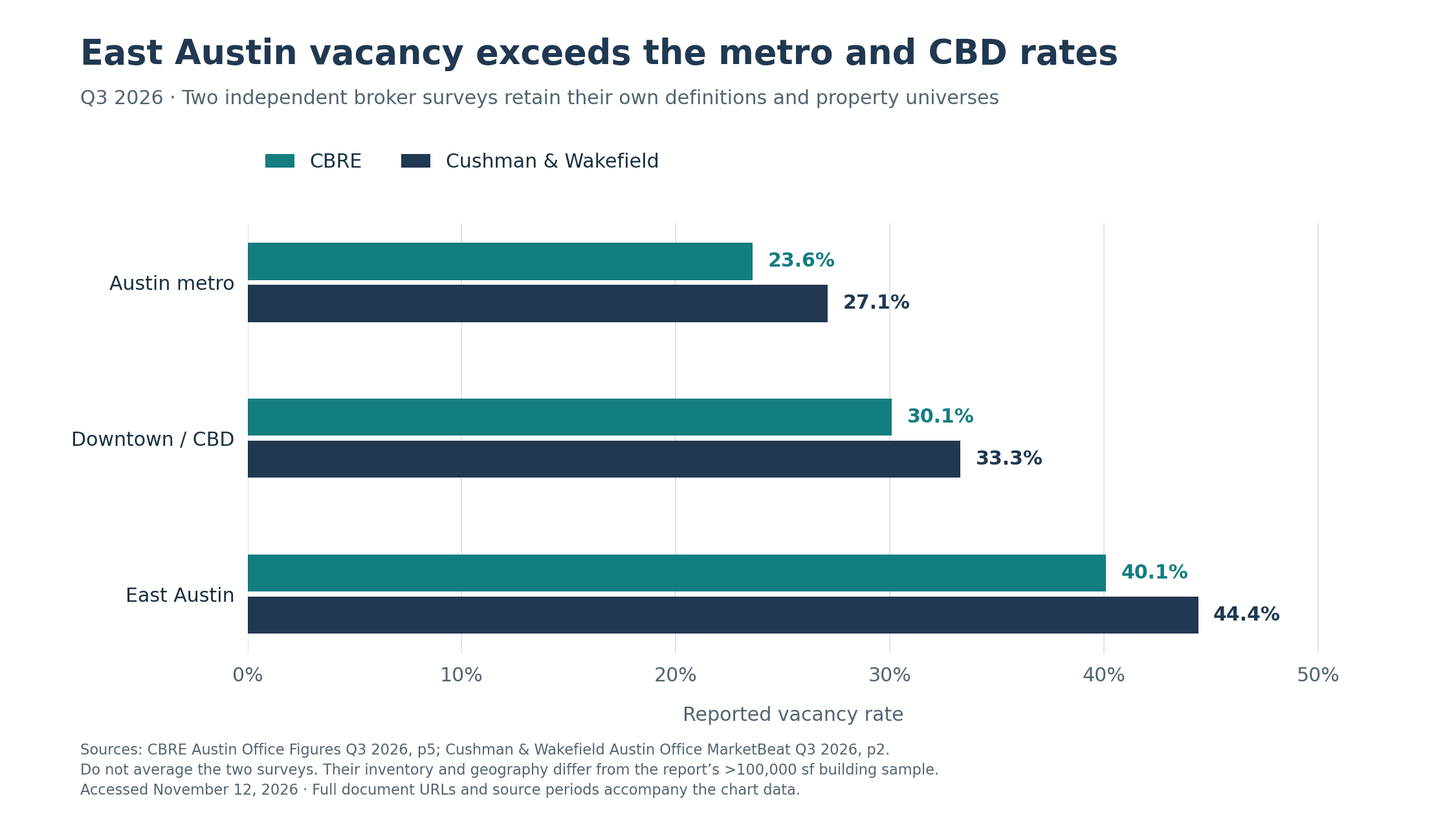
Those series should not be averaged. Neither broker’s East submarket exactly equals this report’s envelope, and CBRE’s Northwest category is not a Domain-only measure. The surveys also report positive quarterly absorption. High vacancy and improving quarterly leasing can coexist when substantial new space has entered the denominator.
CBRE reports CBD asking rent of $68.40 per square foot annually on its full-service basis. That figure reflects advertised asking rents. An underwriting model must account for negotiated rent, expense reimbursements, abatements, tenant improvements, commissions, downtime and recurring building costs before converting a quoted rent into lender cash flow.S17
Owner statistics illustrate the dispersion. Cousins reports its Domain group at 99.6% leased and 97.7% weighted-average occupancy for Q3. Kilroy reports Indeed Tower at 90.4% leased and 84.0% occupied at September 30. These are different metrics, and Cousins’ grouped properties do not provide building-by-building rent rolls.S8, S18
Sublease listings measure a different kind of availability. JLL currently markets up to 158,065 sf at Centro Southern, 1401 East Sixth Street. The listing identifies itself as a sublease offering. Its maximum area includes a sixth-floor component that should not automatically be treated as ordinary enclosed office floor space.S25
A marketed sublease can create a cheaper competitor for direct leases while the original tenant continues paying the landlord. Counting that space as both direct vacancy and lost contractual rent would double-count the immediate problem. The future exposure depends on the head lease, tenant credit, sublease proceeds, termination rights and eventual rollover.
Exact current, first-party corroboration of the widely reported large Meta and Indeed sublease totals was not obtained. The vacancy and building NOI calculations omit those unverified amounts.
7. What current income can support
A transaction anchor: 405 Colorado
Hines and Brandywine independently document the July 9, 2026 sale at $151 million. Hines reports 205,803 rentable sf and 100% leased at acquisition. The seller’s disposition statements provide property revenue and expense adjustments, allowing a transparent historical income calculation.S26, S27
| FY2025 bridge | Amount |
|---|---|
| Property revenue | $19.268m |
| Less property operating expense | ($4.399m) |
| Less real estate taxes | ($2.585m) |
| Accounting NOI calculated from those lines | $12.284m |
| Less disclosed, rounded straight-line-rent adjustment | Approximately ($0.600m) |
| Approximate historical cash NOI | $11.684m |
| Historical cash NOI / $151m price | 7.74% |
The equivalent annualized first-quarter 2026 calculation produces about 7.84%. These are historical cash-income yields calculated from disclosed statements. They are not reported forward capitalization rates and leave open whether another building’s lease duration, parking income, capital needs or ground interest is comparable.S27
The benchmark ties historical income to a completed sale. It also shows why accounting NOI should not be used unadjusted. The property’s TCAD account is not automatically the same economic interest Hines purchased, so the apparent price premium to that tax value depends on matching the tax account to the interest Hines acquired.
111 Congress: low, base and high value cases
The model starts with reported trailing-year NOI of $20,080,999 through March 2026. It applies an explicit analyst haircut to obtain simplified sustainable cash flow and divides by a selected cap rate. The haircuts are aggregate normalization stresses; they are not a tenant-level operating forecast or a reported expense schedule.S4
The low-value case uses a 25% haircut and a 9.5% cap rate; base uses 15% and 8.5%; high uses 5% and 7.5%. The range is informed by the disclosed 111 Congress appraisal rate and the independently calculated 405 Colorado historical yield, while recognizing their different income bases. The base’s proximity to the reported appraisal is partly a consequence of the selected assumptions and is not independent confirmation.
No additional one-time capital deduction is included in the main cases because the documents identify no incremental unfunded obligation. Any newly documented unfunded leasing or repair requirement would need to be added consistently. Existing funded reserves must not be subtracted twice.
| Analyst case | Low value | Base | High value |
|---|---|---|---|
| NOI haircut | 25% | 15% | 5% |
| Normalized NOI proxy | $15.061m | $17.069m | $19.077m |
| Capitalization rate | 9.5% | 8.5% | 7.5% |
| Supported value estimate | $158.534m | $200.810m | $254.359m |
| Original $136.5m loan / modeled value | 86.1% | 68.0% | 53.7% |
| Modeled economic negative equity | $0 | $0 | $0 |
| Maximum modeled replacement debt | $95.121m | $120.486m | $152.616m |
| Cash needed, including assumed refinance costs | $44.109m | $18.744m | $0 |
Replacement financing is constrained by the lower of 60% LTV and a 1.35× modeled NOI-based DSCR, with a 7.5% rate, monthly payments and 25-year amortization. Costs equal 2% of the assumed $136.5 million payoff. Available sponsor cash is assumed to be zero for this incremental-cash calculation. Readers can change these assumptions to see how 2031 financing terms affect the result.
The formulas are:
Value = normalized cash flow ÷ cap rate.
New debt = minimum of (60% × value) and (cash flow ÷ 1.35 ÷ annual mortgage constant).
Economic negative equity = maximum of (payoff debt − value) and zero.
Refinance cash requirement = maximum of (payoff debt + costs − supported new debt − available cash) and zero.
At the selected rate and amortization, the annual mortgage constant is approximately 8.868%. LTV is the binding constraint in all three main cases. Hence the low case still has positive gross property equity while requiring about $44 million of new cash to satisfy the assumed refinance leverage limit.
The NOI-based DSCR test is simpler than the filed lender NCF definition. Another sensitivity deducts the disclosed approximately $1.404 million annual underwriting reserve and tenant-improvement/leasing-commission allowance before sizing debt. This makes DSCR bind in the high-value case, but does not change the three modeled incremental-cash requirements. The allowance is a lender underwriting input.S4
The cash requirement is not a lender loss. An owner could contribute equity, sell, obtain different terms, negotiate an extension or use other financing. Each alternative has a cost and requires evidence before being treated as available. The model evaluates the funding requirement under its stated rules.
Sensitivities that change the conclusion
Holding base cash flow constant, moving the cap rate from 8.5% to 9.5% reduces modeled value by about $21.1 million. At 60% LTV, that cuts replacement-debt capacity by about $12.7 million. Each additional $1 million of sustainable annual cash flow adds approximately $11.76 million of value at an 8.5% cap rate.
Changing the leverage limit also matters. At the base value, 55% LTV implies roughly $28.8 million of incremental cash including the modeled costs; 65% implies roughly $8.7 million, provided the DSCR test still permits that loan. Higher rates or shorter amortization eventually make DSCR the binding test. The workbook exposes the assumptions instead of burying that switch inside a headline LTV.
None of these calculations can be extrapolated to the 62-building inventory. Most properties lack a reconciled current loan, a current cash-flow basis, or both. An empty development also cannot be valued at zero simply because current NOI is zero: it needs a lease-up model, capital budget and timing assumptions that are not supplied by a tax account.
8. What can be said about maturities and aggregate shortfalls
The public evidence supports a narrow contractual maturity observation: 111 Congress’s $136.5 million original whole loan matures in 2031, subject to the all-note current-balance limitation already described. It does not support an office-market maturity histogram filled with assumed dates.S3, S5
| Year or category | Treatment in the delivered schedule |
|---|---|
| 2026 | Colorado Tower is paid; 100 Congress’s old maturity is unresolved after the ownership change; the old KBS facility predates the sale |
| 2027–2030 | No complete current maturity total verified; unknown is not zero |
| 2031 | $136.5m documented original 111 Congress balloon; $36.5m of component balances observed in the October report; full-loan current balance remains an assumption |
| 2032 onward | Unknown for the untraced property debt |
| Undated obligations | Springdale PACE and the announced Sixth and Guadalupe refinancing lack verified maturity schedules in the reviewed records |
The incomplete loan inventory also limits any estimate of an equity shortfall. The workbook calculates the 111 Congress case; the aggregate for the inventory is UNKNOWN. It does not apply average leverage to the $7.812 billion tax extraction total, extrapolate a single building’s gap to all square footage, or allocate a shared credit facility by area without an allocation agreement.
The records document financing events and leave potential Austin bank losses unquantified. A bank call report can help evaluate a lender’s broader concentration once the creditor is matched, but it cannot identify an unnamed building loan or allocate an entire syndicate commitment to its agent.
9. Cross-checks, remaining gaps and what would change the result
Independent checks support three findings.
| Finding | First check | Second check | Practical limit |
|---|---|---|---|
| 111 Congress collateral proxy is approximately $201m | Independent summation of two official TCAD accounts | CMBS property description includes the garage and reports a $201.1m appraisal | Full deed legal descriptions still needed |
| 405 Colorado traded for $151m | Buyer Hines acquisition filing | Seller Brandywine disposition filing and independently recomputed income bridge | Historical yield is not a forward cap rate |
| Identified legacy obligations should leave the office-debt tally | Cousins financial statement and supplemental corroborate payoff | Domain monthly report and the ABS-EE data corroborate defeasance | Same-issuer/reporting-chain checks are not independent credit opinions |
The two formats of a servicer’s data do not constitute two independent witnesses. Their agreement does help detect extraction errors. Similarly, the 111 Congress price discrepancy remains unresolved after cross-checking.
The most valuable missing evidence is specific:
- 100 Congress: the June 30 deed, accompanying release or assignment, transaction consideration and any replacement financing. These would distinguish a negotiated ownership transfer from a sale and show what happened to the old loan.
- 515 Congress: the closing release payment, satisfaction or assignment, and buyer’s new financing. The old portfolio facility cannot substitute for those documents.
- Sixth and Guadalupe: executed collateral descriptions, current principal, lender participations and maturity. The announced amount cannot yet be treated as a fully reconciled office-only mortgage.
- Springdale Green: the recorded assessment agreement and amortization schedule, current principal, remaining conventional debt and the cash flow available after all obligations.
- Untraced large towers: current deeds of trust, assignments, extensions and payoff evidence for buildings including Frost Bank Tower, 600 Congress, 301 Congress, Domain Tower 2 and The Republic.
Updated collections and rent rolls would sharpen the operating cases. Tenant-credit changes, lease expiries and unfunded capital commitments could affect sustainable cash flow and refinancing capacity. A complete improvement-level extract would help reconcile public offices and individual campus buildings, as well as mixed-use and condominium interests.
A substantially higher sustainable cash-flow outlook, lower cap rates or more permissive financing would reduce the modeled cash gap. Weaker collections, tenant departures, larger capital obligations, higher rates or lower advance rates would increase it. A verified notice, special-servicing transfer, missed payment or completed foreclosure would change a particular loan’s status. None should be inferred from a broadly weak leasing market.
Data and workbook
The CSV download includes the building inventory and its links to historical tax records. It also includes the note breakdown, debt instruments and inputs to the market and cash-flow calculations. The source register identifies filing periods and unresolved fields. The map data give parcel points and labeled address interpolations. Buildings that share a parcel can share coordinates. One building has no verified point.
The workbook has tabs for inputs, calculations and outputs. Blank or unknown debt is not converted into zero. Case assumptions are editable; the principal model and comparative calculations link to source inputs. The maturity output expressly distinguishes documented original principal from current verified balances and unavailable totals.
Source notes
All sources below were accessed November 12, 2026. The accompanying CSV source register provides field-level provenance for the complete inventory and supporting data. Printed page numbers are used where available; otherwise the cited item, recital, table or XML tag is the locator.
- TCAD official property search, tower record, garage record. Official public search fields pid, pYear, name (owner), marketValue, appraisedValue; live 2026 property-year records. The raw data include the assessor’s field names. ↩
- TCAD public information and Travis County TCAD GIS. Export availability; GIS PROP_ID, F1year_imprv, deed_num, deed_date and geometry. GIS tax-year unspecified; financial values use S1. ↩
- 111 Congress executed noteholder agreement. Recitals, Exhibit A and §32; July 29, 2026. ↩
- BBCMS 2026-5C43 structural and collateral term sheet. Printed pp59–67, loan 3; October 6, 2026; income through March 2026 and April 7 appraisal. Preliminary document; corroborated against final prospectus S29. ↩
- BANK5 October monthly report and ABS-EE XML. pp15, 17, 23–25; IDs7/7A; October 13 determination, October 19 distribution. ↩
- Executed Wells Fargo loan purchase agreement. Exhibit A and Schedule C, exception17; October 29, 2026. ↩
- Cousins Q3 Form 10-Q. Note7 debt; disposition discussion; September 30, 2026 statements. ↩
- Cousins Q3 supplemental. pp4, 13, 16–17, 25, 28; Q3 2026 operations and debt. ↩
- BANK 2019-BNK21 monthly report and ABS-EE XML. pp14, 16; prospectusID3, loan300801940; asset3 defeasance fields; October 2026. Original identity cross-checked to the 2019 offering. ↩
- Safehold Domain Tower case study. Ground-lease and leasehold structure; undated historical case study. ↩
- BANK5 servicing-change 8-K. Item1.01; October 30 filing describing October 29 lead securitization. ↩
- Lincoln Sixth and Guadalupe refinancing announcement. Owner announcement, 2026; $265m and named financing parties; exact collateral not supplied. ↩
- Texas PACE Authority project list and dated project overview. Springdale Green Office row; October 28, 2026 overview. ↩
- Alony-Hetz FY2025 issuer English report. Description of Business p47/PDF49; contrasting table p38/PDF40; December 31, 2025. Issuer-hosted translation. ↩
- Transwestern 100 Congress appointment. Opening paragraph; July 6, 2026. ↩
- Travis County Clerk notices and real-property records. Non-tax notices and official record-search route; current access. Individual foreclosure findings require property-specific records. ↩
- CBRE Austin Office Figures. p5 market table; p6 definitions; Q3 2026. ↩
- Kilroy Q3 supplemental. Indeed occupancy table and p32 secured-debt schedule; September 30, 2026. ↩
- Cushman & Wakefield Austin MarketBeat. p2 market table; rendered Q3 2026 report, notwithstanding inconsistent PDF metadata. ↩
- KBS completed 515 Congress sale. Opening paragraphs; September 23, 2026 announcement. ↩
- KBS Q2 notes payable. Modified Portfolio Revolving Loan Facility and footnote6; June 30, 2026. ↩
- KBS fifth modification. Austin Project Milestones and release-price provisions; April 2, 2026. ↩
- KBS recorded-instrument recitals. RecitalA; historical recording references. Full instrument-specific chain appears in the companion CSV. ↩
- Lincoln Eastbound recapitalization. Main release and construction-loan payoff statement; July 31, 2024. ↩
- JLL Centro Southern listing. Listing633090; current advertised sublease range, accessed November 12. ↩
- Hines acquisition 8-K. Item8.01; July 9 acquisition, July 13 filing. ↩
- Brandywine disposition pro forma. pp3–5, Note2 and footnote(e); FY2025/Q1 2026 income and July 9 sale. ↩
- BBCMS 2026-5C43 final prospectus, Form 424B2. Cover October 9, filed October 14, 2026; Annex A-3 pp30–36, loan3; cash flow p34, appraisal footnote p30 and comparison p36. ↩
- Carr Properties June 2025 financial statements. Note 6, p19; historical mortgage terms as of June 30, 2025. ↩

Supporting material
- Excel model ↗Sourced inputs, live calculations and reported outputs.
- Source and model data (CSV collection) ↗Data tables, source references and calculation exports.
- Unified source register ↗Download as CSV.
- Office building map data ↗Public parcel points and labeled address interpolations for the office inventory.