Sell the review before you scale the app
A growth channel commits you to a price, a customer and a workload. I model an assisted launch, then test the assumptions that make it win.

Which growth channel can this small product actually support?
The assisted launch wins this declared scenario because price, workload and cash timing fit the operating constraint. Hold price constant and test delivery capacity before treating the result as a channel advantage.
Evidence: Product analytics overview · Inventory reports · About app distribution
Read this alongside Who keeps the value?.
If I were launching an inventory app for Shopify merchants, I would start with a paid, assisted review. I would sit with the person responsible for replenishment, help them complete a real purchasing decision, and charge for a repeatable workflow. The first thing I would try to learn is whether that decision is valuable enough to support the business.
That choice changes what I build. An app sold for $99 has to make setup and routine support cheap. A $399 assisted offer can afford more work, but it has to produce more value. An agency can introduce customers, but its commission only makes sense if those introductions solve a constraint I actually have. A growth channel carries an implied product, price, and operating model with it.
I built a six-period model to make those commitments visible. The assisted offer looks strongest in the starting scenario. Then I hold price constant, and the ranking reverses. That reversal is the most useful result: the spreadsheet gives me a hypothesis to test, and also shows where I have quietly assumed the answer.
Scope and assumptions
Hypothetical company and operating choices, not client history. Six 30-day periods begin after an approved working app exists, with $40,000 cash. Commercial inputs are assumed; current Shopify fee terms are sourced. Deterministic scenarios have no probability weights. No tax, refund, nonpayment or pre-launch cost is modeled.
Start with the decision the merchant already makes
The hypothetical customer here is a merchant with several suppliers, physical inventory, and one person accountable for a weekly replenishment review. The proposed product combines inventory data with supplier lead times, surfaces a short list of exceptions, and records an owner and decision date. The merchant retains purchasing authority. I am assuming an approved, working public app and $40,000 left to fund the next six 30-day periods; the earlier development bill is outside this decision.
Shopify already provides sell-through, inventory coverage, and ABC analysis. An additional chart would have to compete with those native tools. I would begin by watching the operator use what they already have: which supplier dates need reconciliation, which exceptions lead to action, and where the review ends without a decision. Shopify product analytics, inventory reports.
The distinction matters because preparation time and decision quality are different sources of value. A report can save ten minutes and still leave the difficult judgment untouched. A workflow can make the review more orderly without changing what gets purchased. I would want a customer to show me the previous process, the completed decision, and the work the new product actually replaces.
For the first offer, I would keep the promise narrow: one store, one weekly review, merchant-supplied lead times, and a reusable exception process. I would record requests for custom purchasing services or an ERP replacement, but exclude that work from the standard price. Otherwise, a successful sale could hide a different business inside every account.
The higher price has to earn its place
In the model, self-service costs $99 per 30 days and assisted direct costs $399. The agency offer also costs $399, with 25% of gross app billings paid to the agency. These are proposed prices, not observed willingness to pay. I do not have evidence that the same merchant would accept all three offers.
Suppose four reviews in a period each save an hour of an operator's time, valued at an assumed $60 an hour. That is $240 of released capacity. It does not cover a $399 subscription on its own. If the offer is worth more, I need to identify the additional benefit: perhaps an avoided rush purchase, fewer repeated exceptions, or a decision that previously went unmade. I would verify that benefit against the merchant's own records. I would not credit the app with every stockout that happens to disappear during a pilot.
Even the $240 is a value calculation, not necessarily cash savings. A salaried operator may use those hours elsewhere without reducing payroll. That can still be useful, but the buyer has to prefer that use of time enough to pay. The product's value depends on the work the merchant can now complete, not on a theoretical wage multiplied by every minute the app touches.
I would therefore sell the assisted offer with a defined exit: after setup, the merchant should be able to complete the review without a founder interpreting every result. Assistance is useful if it teaches us how to make the workflow repeatable. If it remains essential to every decision, $399 may be the wrong price for the service we are delivering.
Put the work created by each sale into the plan
The team in this example has two founders. One has 60 hours per period for onboarding and support after reserving time for product work. The other has 40 commercial hours. Fixed cash outflow is $6,000 per period, comprising $5,000 in total founder draws and $1,000 in baseline operations. Each billed store adds an assumed $12 of variable cost. A $10,000 cash reserve is the stop line.
All three motions use the same approved public app and compliant billing. Direct selling does not change the app's distribution obligations. Shopify's current terms specify a 2.9% processing fee and, for eligible developers, 0% revenue share on the first $1 million of cumulative gross app revenue earned from January 1, 2025, across associated apps and accounts. The base case assumes eligibility below that threshold; the model also tests a 15% platform share. Distribution, billing requirements, revenue share.
| Per 30-day period | Self-service | Assisted direct | Agency |
|---|---|---|---|
| Price / store | $99 | $399 | $399 |
| Potential paying starts, periods 1–6 | 8, 12, 16, 20, 20, 20 | 3, 4, 5, 5, 5, 5 | 0, 0, 8, 8, 8, 8 |
| Churn of existing stores | 4% | 2% | 2% |
| Setup hours / new store | 1.5 | 4 | 3 |
| Support hours / active store | 0.75 | 0.5 | 0.75 |
| Cash acquisition cost / start | $150 | $150 | $50 |
| Commercial hours / new start | 0 plus 6h ad work | 3 | 1 plus recruitment |
| Agency share of gross billings | 0% | 0% | 25% |
All commercial inputs assumed. Agency fixed delivery work is 12, 12, 4, 4, 4, 4 hours; fixed commercial work is 24, 24, 6, 6, 6, 6. The model contains these complete inputs. Both founder budgets and existing-customer support bind admission.
The new-start rows represent potential paying starts after qualification and conversion. Acquisition costs and commercial hours include unsuccessful work averaged across customers won. Spending is paced to the starts the team can accept. If ads continue running while onboarding is full, the real cash result will be worse.
I reserve support for existing customers before admitting new ones. With self-service, the period-four retained base needs 25.12 hours. A new store needs 1.5 onboarding hours plus 0.75 support hours in its first period. Fifteen new stores fit; sixteen would use more than 60 hours. Twenty potential starts therefore become fifteen paid starts. The following periods admit eleven and eight as the installed base claims more time.
This is why a customer target alone is a poor operating plan. A retained customer contributes revenue and reserves future work. The support assumption can become more consequential than the acquisition assumption once enough cohorts accumulate.
What the starting scenario actually says
The model applies churn before adding each period's new stores. It bills each admitted store for a full period, pays current acquisition and variable costs immediately, and receives net app collections one period later. The 30-day billing interval is available in Shopify's subscription system; the one-period collection lag is my planning assumption, not a promised payout schedule. Actual payouts depend on merchant payment and partner payout timing. Subscription billing, partner payments.
| Offer | Active stores | Contribution | Period 6 delivery | Ending cash |
|---|---|---|---|---|
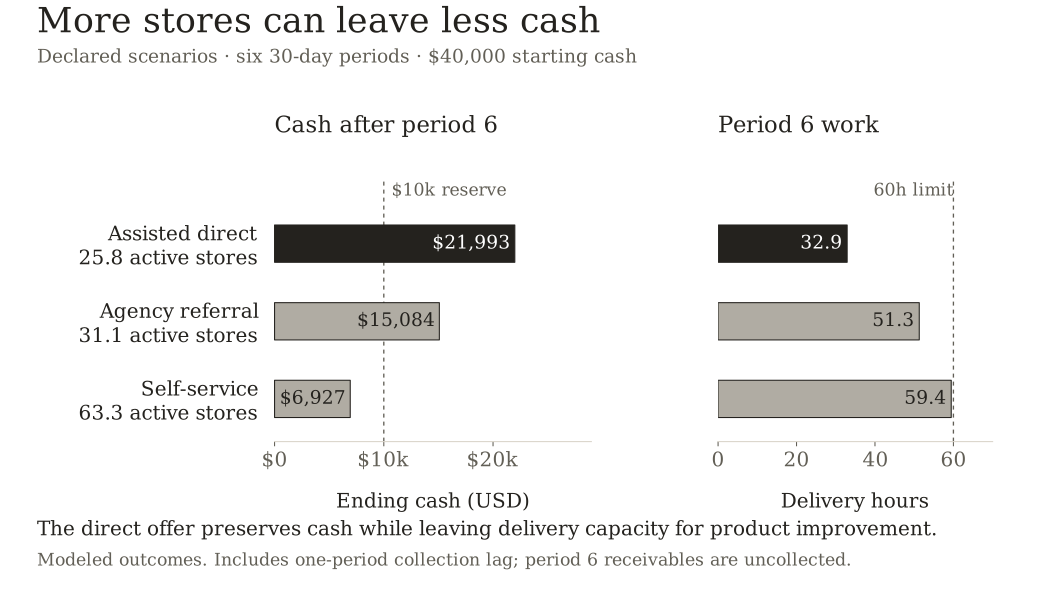
| Assisted direct | 25.81 | $27,993 | 32.90 / 60h | $21,993 |
| Agency referral | 31.05 | $20,018 | 51.29 / 60h | $15,084 |
| Self-service | 63.25 | $9,008 | 59.44 / 60h | $6,927 |
Declared scenarios, USD. Contribution precedes fixed outflows. Cash starts at $40,000 and reflects one-period collection lag; final-period net receivables remain uncollected. Fractional store balances are deterministic expected values.
Assisted direct produces $27,993 of contribution before fixed outflow. It ends with $21,993 in cash and uses 32.90 delivery hours in period six. Self-service reaches 63.25 expected active stores but ends with only $6,927. The larger customer base brings more acquisition spending and support work than the lower price can comfortably fund over this horizon.
None of the starting motions funds all $36,000 of fixed outflow during the test. Direct's contribution leaves an $8,007 gap before collection timing. Its sixth-period contribution does exceed that period's fixed outflow by $2,940. I read those results as a bounded investment in finding a viable recurring business. They are not accounting profit: founder draws are included as cash outflows, and the model excludes taxes, refunds, nonpayment, and pre-launch development.
The direct plan also leaves commercial capacity unused. Five new starts require fifteen of forty commercial hours in the final periods. If those buyers are difficult to find at $399, more delivery capacity does not help. The next constraint is qualified demand at a price that makes the work worthwhile.
Hold price constant before calling it a channel advantage
The starting comparison gives direct sales a price four times as high as self-service. It also assumes better retention and lower ongoing support. Those differences may be earned by a better-defined customer and more careful setup. They may also be assumptions that make my preferred option win.
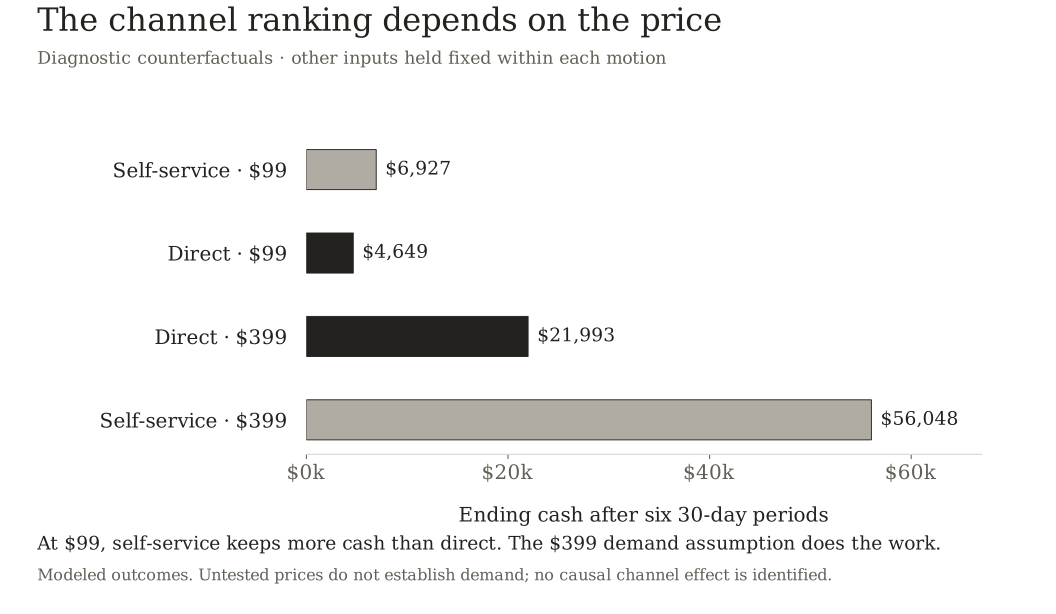
I reran the model with direct priced at $99, leaving its other inputs unchanged. It ends with $4,649, less than self-service's $6,927 at the same price. I also priced self-service at $399 while retaining its original demand, churn, and support inputs. It ends with $56,048, far above the original direct result. Neither scenario establishes a feasible commercial offer; both expose the importance of price to the ranking.
| Motion | Price | Ending cash | Meaning |
|---|---|---|---|
| Self-service | $99 | $6,927 | Original offer |
| Assisted direct | $99 | $4,649 | Loses to self-service at this price |
| Assisted direct | $399 | $21,993 | Original offer |
| Self-service | $399 | $56,048 | Wins if original demand survives this price |
Diagnostic counterfactuals, not feasible-demand forecasts. Demand, retention, support and acquisition are held fixed within each motion. A causal price or channel effect is not identified.
The test I need is therefore more specific than “does direct selling work?” I need merchants to pay for the assisted scope, renew after they understand it, and complete reviews with less founder involvement. If that happens, the offer may earn its price and support advantage. If it does not, the comparison gives me no reason to prefer direct.
I would avoid testing this by giving one offer to large merchants and another to tiny stores, then attributing the difference to the sales motion. I would record store complexity, purchasing frequency, existing tools, accountable buyer, offered scope, and price for each account. With a small pilot, I cannot estimate a precise channel effect. I can still identify whether the underlying customer and product promise are coherent.
A good partner can change the order
The agency's base case includes two periods of recruitment before referrals begin. If a qualified agency is already ready, with modeled potential starts of four, then eight per period, ending cash rises to $28,210. That exceeds assisted direct. The conclusion changes because the partner removes the wait for demand, not because a referral is inherently a better customer.
I would also ask what the 25% commission buys. In the starting direct plan, commercial time is not full. Reducing sales hours from three to one per new store has limited immediate value if those saved hours do not produce something useful. Reliable access to suitable merchants can justify a commission; unused sales capacity cannot justify it by itself.
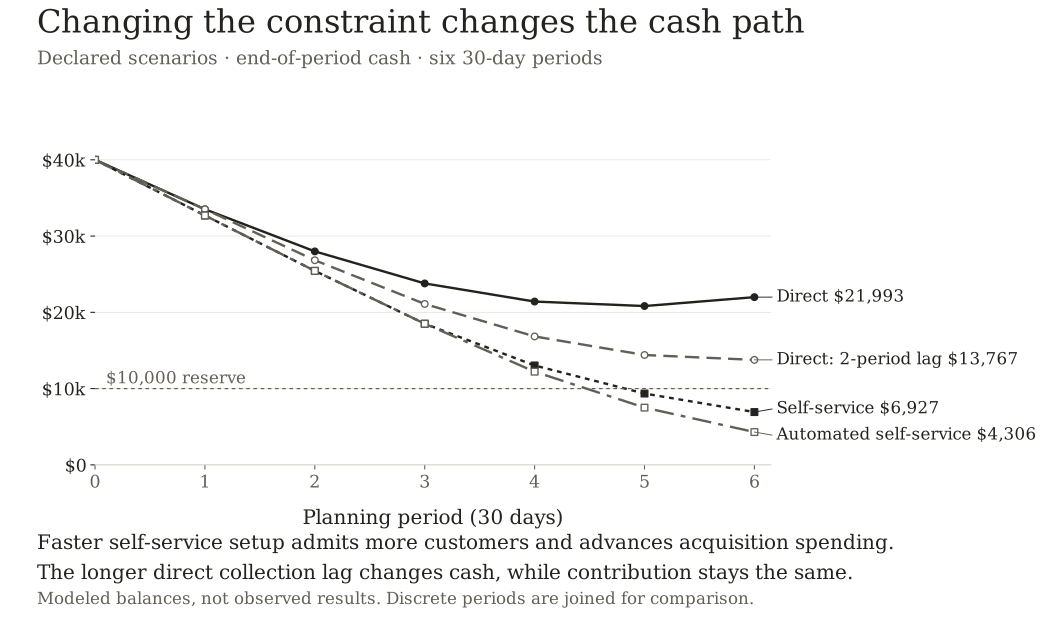
The apparent alternative of automating self-service also needs a cash check. Reducing onboarding to half an hour and support to a quarter-hour admits all 96 modeled starts. Ending cash falls to $4,306. Faster admission advances acquisition spending before enough retained billings arrive to repay it. I would still want cheaper delivery, but I would pace acquisition while the lower-priced offer proves that it can fund growth.
Collection timing deserves its own gate. Extending direct collections from one to two periods leaves contribution unchanged but reduces ending cash to $13,767. The work can be economically attractive and still require more financing. I would use actual payout and receivable records to manage that boundary, including account holds and nonpayment. Partner revenue agreement.
Buy the next answer before buying more growth
For the first two periods, I would aim for the modeled three and four assisted starts. The company has to fund $13,169 of gross outflow during that interval, partly offset by collections. That is the cost of the operating test in this scenario. It gives me a concrete budget against which to judge the information gained.
Each account would have a baseline review, a defined exception workflow, and a record of time spent by both merchant and founders. I would track whether the merchant acted, whether the workflow repeated, which decisions still required interpretation, and whether the merchant renewed at the quoted price. A founder completing the review successfully is weaker evidence than the merchant completing it successfully.
| Decision point | Evidence to collect | Action |
|---|---|---|
| Before first paid start | Native-tool baseline; buyer; repeated decision; accepted scope and price | Stop if the existing tools already complete the job |
| After first 3 starts | Merchant decisions and renewals; all setup and support time; cash received | Continue only with a repeatable paid workflow |
| After the next 4 starts | Use without founder interpretation; cost and value by account | Narrow the customer or reprice work that stays bespoke |
| Before more acquisition spending | Capacity admission and collections; forward cash reserve | Pace starts; stop new commitments before breaching $10,000 |
| Before agency recruitment | Qualified buyer access, commission and founder work actually removed | Advance only if the partner changes the current constraint |
Authored operating gates, not validated thresholds. Replace assumed work and churn with paid-cohort evidence. Preserve support capacity for existing customers before admitting new starts.
The numerical sensitivities explain why I would keep those gates. At $299, holding the base customer path fixed, direct's sixth-period surplus falls to $433. At $249 it becomes an $820 shortfall. Keeping the $399 price but finding only three new starts every period also leaves period six just below break-even. The business cannot solve weak willingness to pay simply by being efficient at onboarding.
Those price tests hold quantities fixed; a real price change can alter conversion, retention, support expectations, and acquisition cost. I would update those inputs together once paid use provides evidence. I would not lower price in the model, preserve every favorable customer assumption, and call the result conservative.
The product I would try to earn
I would start with assisted direct because it gives this hypothetical team a workable budget and a chance to see the decision closely. I would spend that proximity on learning how to remove founder involvement. The offer would need to survive native substitutes, a real price, renewal, and the merchant's ability to run the process.
If a ready agency brings suitable buyers sooner, I would change the sequence. If merchants want a cheap tool they can use unaided, I would redesign setup, support, and acquisition spending around that offer. If the work stays bespoke, I would price it as bespoke work or stop pretending it is a scalable app.
The channel choice is useful when it forces those commitments into the open. It determines whose problem I see, what I can charge, what each customer expects, and which work compounds as the customer base grows. I would choose the first channel for the business it lets me test, then make the next growth decision from what paid use has taught me.
Sources
- Product analytics overview
Shopify Help Center · Primary product documentation
Verified Oct 12, 2026
Establishes native inventory-related measures as a substitute to test. It does not establish demand for the proposed app.
- Inventory reports
Shopify Help Center · Primary product documentation
Verified Oct 12, 2026
Describes inventory reports and the recent-sales basis of inventory-remaining estimates. No universal plan-availability claim is made.
- About app distribution
Shopify · Primary developer documentation
Verified Oct 12, 2026
Public distribution supports multiple merchants and requires approval. Acquisition channel is a separate choice from app distribution type.
- App Store requirements, section 1.2
Shopify · Primary platform requirements
Verified Oct 12, 2026
Controls the billing assumption for a reusable paid App Store app. Requirements can change; launch approval is assumed, not demonstrated.
- Subscription billing with the Billing API
Shopify · Primary developer documentation
Verified Oct 12, 2026
Establishes 30-day and annual time-based intervals. The six synchronized cohorts are a modeling simplification.
- Partner Program Agreement, section 3.2
Shopify · Updated February 27, 2026 · Primary agreement
Verified Oct 12, 2026
Merchant-payment dependency and twice-monthly payout periods. One- and two-period collection lags are scenario assumptions, not quoted platform guarantees.