Financial systems
What shareholders get when companies leave Delaware
Reincorporation can change who can sue and what shareholders can propose. The event data show no dependable valuation premium.
A move changes the shareholder’s legal bargain. The event data leave a general valuation premium or penalty for leaving Delaware unproven. For a large company, the disclosed incorporation-tax saving is usually too small to carry the investment thesis. The consequential question is whether measurable operating, insurance and litigation savings exceed the value of the accountability and remedies shareholders surrender.
Three findings support that answer. First, contemporary event estimates change substantially when other corporate news is screened out, and uncertainty remains wide. Second, adopted documents differ even within Texas: Tesla and Dell chose percentage thresholds for derivative suits, while ArcBest preserved a one-share threshold. Third, a reported $250,000 annual tax saving capitalizes to only $3.125 million at an illustrative 8% discount rate, before transition costs. These are respectively an empirical limitation, a documented legal difference and a valuation calculation.events, tesla2025, arcbest, dell, teslaproxy
The premise is current. Recent filings include AppLovin’s proposed Nevada conversion, disclosed in November 2026 after controller consent in October. Texas has an operating Business Court and an operating stock exchange. Neither a Texas headquarters nor a Texas exchange listing proves Texas incorporation: Texas Capital’s shareholders rejected reincorporation in April, and the company subsequently transferred its listing to TXSE.app, tcbi, txse
Coverage qualification. The accompanying register contains 150 filing-linked records, including 119 Delaware-to-Texas/Nevada proposal records from 114 issuers (31 Texas attempts and 88 Nevada attempts), with verification status attached to each row. The register covers the proposals identified in the searches since 2018. The event analysis independently recomputes aggregates from publicly released abnormal returns; it does not independently estimate returns from daily prices. A complete one-year matched-multiple panel and lawsuit census could not be sourced. The data mark which fields remain unknown.census
For an analyst, the base case is therefore no automatic domicile premium, explicit credit for evidenced savings, and an assessment of the rights each company adopted. That starting point leaves room for the savings and governance effects documented at an individual company.
1. What is being counted—and what remains incomplete
The intended observation is one public-company proposal attempt, beginning January 1, 2018, to change incorporation to Texas or Nevada. The main comparison is departures from Delaware. The register keeps non-Delaware origins as comparators, a record for each unsuccessful or repeated attempt, and a category for public partnerships and LLCs. A conversion of organizational form is not interchangeable with a corporation changing governing law.
A preliminary proxy, definitive proxy, vote report and effectiveness filing are linked stages of one attempt. A second proposal after failure is another attempt. An IPO registration that merely describes a pre-IPO move does not become a public-company proposal. Board approval, shareholder approval and legal effectiveness require their own filing evidence.
The search covered nine EDGAR query runs and 4,106 unique filing/document candidates, including false positives. The search retrieved all result pages for those queries. Other terms or filing forms could yield additional records. The work combines directly read historical filings with a frozen, filing-linked contemporary registry. Imported fields are explicitly marked where not independently reaudited. Of the 119 core attempts, 37 were verified against primary proposal/completion documents and eight imported records received primary date/vote corrections. The other 74 remain filing-linked imports. Only 41 have a populated first-proxy date, 22 extracted reasons, one public ISS recommendation and two public Glass Lewis recommendations in the reviewed register. Even populated fields can reflect an imported value or a scheduled date. Unverified and unavailable fields remain explicit in the accompanying metadata.
Even primary filings can contain errors. Revelation’s January 2025 8-K initially describes its proposals as approved, but its specific reincorporation section says the proposal failed. ArcBest’s initial completion 8-K still listed Delaware on the cover; the adopted charter and a subsequent correction confirm Texas. A filename containing a meeting or document date is not necessarily the SEC filing date.revb, arcbest
Selected cases show the economic and procedural variety:
| Company / attempt | Destination and outcome | Proposal-period control or approval | Decision-relevant rationale or complication |
|---|---|---|---|
| A. H. Belo, 2018 | Texas; effective June 29 | Dual-class voting power; meeting approval | Texas connection; annual director elections bundled with the change |
| Tripadvisor, 2023 proposal | Nevada; effective April 29, 2025 | Liberty TripAdvisor held 56.1% of votes at proposal | Liability/governance rationale; implementation coincided with parent acquisition |
| Fidelity National Financial, 2024 | Nevada; failed June 12 | 50.65% of votes cast supported, below majority of outstanding | The register includes the failed proposal and records the later attempt separately |
| Tesla, 2024 | Texas; effective June 13 | Public vote, with a tally excluding Elon and Kimbal Musk | Texas alignment, tax saving and governance arguments; CEO-pay vote on same ballot |
| The Trade Desk, 2024 | Nevada; effective November 15 | Jeff Green described as controller; 48.6% voting power | Predictability and director/officer protections |
| Dropbox, 2025 | Nevada; effective March 5 | Houston trusts’ consent represented 77.3% of voting power | Liability, governance flexibility and predictability |
| Coinbase, 2025 | Texas; effective December 15 | Founders/trusts’ consent represented 78.40% of voting power | Legal predictability and Texas alignment; changed officer and litigation provisions |
| Texas Capital, 2026 | Texas proposal rejected April 21 | Meeting vote; majority of votes cast opposed | Shareholders rejected the governance package. The exchange move followed the vote |
| ArcBest, 2026 | Texas; effective May 15 | Meeting approval | Adopted one-share derivative threshold and opted out of proposal restriction |
| Dell, 2026 | Texas; effective July 1 | Controller-influenced voting structure | 3% derivative gate; proposal restriction added the following day |
| AppLovin, 2026 | Nevada; consent approved, completion unverified at cutoff | October 29 consent represented approximately 67% of voting power | First public 8-K November 4 also carried quarterly results |
Sources are the relevant proxy/information statements, Item 5.07 vote reports and adopted exhibits. This is not a claim that every field in the broader register has been fully verified.belo, trip, fnf, teslavote, ttd, dropbox, coin, tcbi, arcbest, dell, app
Management cites “Predictability,” headquarters alignment, recruiting directors and reducing litigation as objectives. The financial benefit of each remains unquantified. A controller’s support makes the overall vote less informative about outside shareholders’ preferences.
2. What the shareholder vote counts
Tesla’s June 13, 2024 reincorporation vote recorded 2,000,873,803 for, 293,910,071 against, 15,485,016 abstentions and 335,111,943 broker non-votes. Support was 87.19% of for-plus-against votes. The tally excluding Elon and Kimbal Musk was 1,588,203,007 for, with the same against and abstention totals: 83.70% of that tally’s for, against and abstain votes, or 84.38% excluding abstentions. The tally excludes only the named holders.teslavote
Fidelity National Financial’s June 2024 Nevada proposal illustrates the opposite denominator trap. It received 110,277,692 for and 107,467,828 against: 50.65% of votes cast. But only 40.36% of the 273,238,230 outstanding shares voted for it. The majority-outstanding requirement was not met. Revelation’s January 2025 proposal similarly failed despite the issuer’s description of approximately 97% support among voting participants. Non-participation can defeat a conversion without a majority of votes cast opposing it.fnf, revb
Texas Capital’s April 2026 proposal received 18,181,458 for and 22,047,429 against, or 45.20% support among for-plus-against votes. Its advisory proposal on heightened shareholder-proposal requirements received 5,209,051 for and 35,015,189 against: 12.95% on the same denominator. Each ballot has its own result.tcbi
The judicial record supplies a conditional minority comparison. In Maffei v. Palkon, the Delaware Supreme Court states that, assuming the controlling holdings all voted for conversion, the minority-support figures were 5.4% for Tripadvisor and 30.4% for Liberty TripAdvisor. The opinion calculated those percentages under that assumption.maffei
Dropbox and Coinbase authorized the moves through written consents from controlling shareholders. The reviewed filings provide no outside-holder tally for either move.dropbox, coin
Proxy advice is another incomplete field. Tesla publicly disclosed ISS support for reincorporation and Glass Lewis opposition. Those positions concerned the move; their recommendations on CEO compensation concern another vote. The underlying subscriber reports were not obtained. For other proposals without a public adviser report or attributable public disclosure, the register shows UNKNOWN. An adviser’s general policy is not evidence of its recommendation on an individual ballot.advisers
3. What the event study measures
The three dates measured by the study
A credible design distinguishes the first public announcement, the proxy filing and the vote result. Tesla makes the problem visible: its retrospective SEC presentation dates Musk’s public commitment to seek a Texas vote to January 31, 2024; its preliminary proxy arrived April 17 and definitive proxy April 29. Coinbase’s board approval on October 29, 2025 and consent on November 4 preceded the public November 12 announcement and preliminary information statement. Board and consent dates are not automatically public information dates.teslatimeline, coin
The accessible SMU release instead selects the first SEC disclosure associated with an announcement, vote or effectiveness milestone. A preliminary proxy may occupy its “announce” slot. A vote’s legal date and the trading session when its 8-K becomes public can differ. After-market filings roll to the next session. The source provides no definitive-proxy return panel matching the requested three-clock design. The tables below therefore say “first SEC filing,” “vote disclosure” and “effectiveness disclosure.” Calling all three an independently completed announcement/proxy/vote study would be inaccurate.events
Data, model and independent checks
The frozen September 8, 2026 statistical release has a factor calendar through July 31, 2026. It contains 243 bound event rows, including exclusions and duplicate milestones. The relevant scored Delaware-to-Texas/Nevada subset comprises 45 first filings, 33 vote disclosures and 18 effectiveness disclosures: 96 scored event observations. They are not 96 different companies. The release’s broader 51-firm Delaware-outbound first-filing sample includes other destinations and is not the denominator used here.
The released market-model CARs sum daily residual returns over [−1,+1] and [−5,+5] trading sessions. The disclosed estimation interval is [−180,−21], with at least 100 observations. In compact notation:
AR_it = R_it − [R_ft + α̂_i + β̂_i × (R_mt − R_ft)]
CAR_i[a, b] = Σ AR_it for t = a through b
The frozen cohort release publishes derived CARs from CRSP/Compustat data; its underlying daily security-return panel was not obtained. A Tesla replication page advertises daily closes available on request, which is not an openly downloadable price panel for this frozen release. No request was made. Consequently, the independent checks cover aggregation and classification of the released results. Re-estimating returns would require the underlying prices and adjustments. Across 108 published aggregate arithmetic checks, recomputed means, medians and weighted means agreed within approximately 0.0000000002 in return units. The released JSON, extraction code, exclusions and calculation files accompany the report.replication
The following confidence intervals are new 20,000-draw market-date-cluster bootstrap percentile intervals for the mean, with seed 20261112. They are exploratory and unadjusted for multiple comparisons. They differ from the source’s median statistics and company/date clustering. A confidence interval measures sampling uncertainty conditional on this dataset and method; it does not remove selection or simultaneous news.
| Disclosure stage | Destination | n | Mean 3-day CAR | 95% mean interval | Mean 11-day CAR | 95% mean interval |
|---|---|---|---|---|---|---|
| First SEC filing | Texas | 16 | −5.72% | [−16.75%, +1.56%] | −18.51% | [−45.67%, −1.85%] |
| First SEC filing | Nevada | 29 | +1.60% | [−3.14%, +7.67%] | +1.01% | [−7.31%, +11.21%] |
| Vote disclosure | Texas | 13 | −7.89% | [−21.75%, +0.90%] | −21.40% | [−63.40%, +1.26%] |
| Vote disclosure | Nevada | 20 | +0.59% | [−2.68%, +3.30%] | +3.35% | [−2.21%, +9.14%] |
| Effectiveness disclosure | Texas | 7 | −12.52% | [−34.88%, −0.48%] | −38.15% | [−109.05%, +4.93%] |
| Effectiveness disclosure | Nevada | 11 | +5.02% | [+1.04%, +9.55%] | +5.73% | [−2.56%, +12.99%] |
Author calculations from released event CARs; all source-scored observations in the specified destination/stage. The CSV includes dates, flags and provenance.
These large averages should not be read as an investable domicile spread. Eightco’s first-filing CAR is −78.70% over three days and −204.95% over eleven; Nuburu’s is +64.22% and +108.65%. An additive abnormal-return sum can fall below −100%; it is not a compounded investor wealth return. PAMT’s tender and Jade’s merger are additional confounded observations. Removing extreme observations because they are inconvenient would also be wrong; their corporate context needs an ex ante rule.
The available source-flag screen changes the first-filing result sharply:
| First filing, no source confound flag | n | Mean 3-day CAR | 95% mean interval | Mean 11-day CAR | 95% mean interval |
|---|---|---|---|---|---|
| Texas | 12 | −0.32% | [−4.21%, +3.76%] | −4.12% | [−9.73%, +1.23%] |
| Nevada | 20 | −2.52% | [−4.70%, −0.49%] | −2.74% | [−8.29%, +2.14%] |
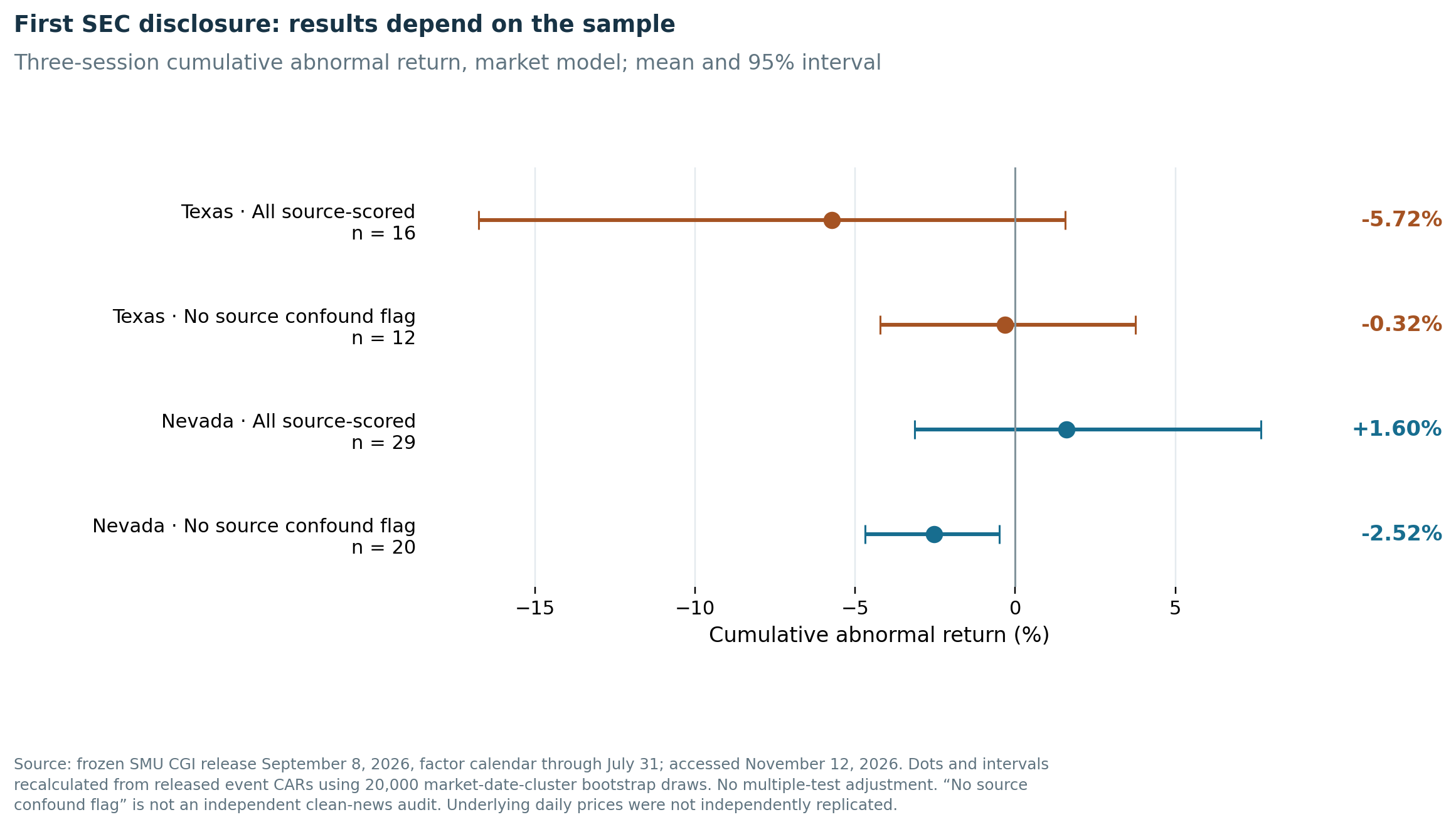
The Nevada three-day screened interval excludes zero under this exploratory procedure. The result applies to that screened sample. The screen changes both composition and sample size, is incomplete, and forms part of many comparisons. “No source flag” does not mean no confounding news: Tesla’s vote also ratified its CEO award, and Tripadvisor’s effectiveness coincided with its parent transaction.
The source’s own median three-day first-filing estimates are −3.2% for Texas and −1.2% for Nevada, with reported intervals [−4.1%, +4.5%] and [−2.9%, +0.3%]. None of its 27 main cells survives its family-wise correction. It also fails to demonstrate equivalence within ±1.5 percentage points. The tests leave open how much the legal changes matter for valuation.events
Controller classification changes the result being estimated
Primary-filing review corrected or filled seven control labels. Dillard’s Class B structure elects two-thirds of the board; Brilliant Earth reported 90.7% voting control by Just Rocks. Tripadvisor, AMC Networks, Sphere, Tempus and HWH had primary evidence of controlling votes where the source label was unknown. The first-filing split changes from 11 controlled / 20 source-not-controlled / 14 unknown to 18 / 18 / 9 under majority-vote or majority-board-election control.controlaudit
A broader sensitivity includes Tesla’s transaction-specific judicial controller finding and The Trade Desk’s issuer-described controller despite Green’s 48.6% voting stake, producing 20 / 16 / 9. The remaining group can include firms that are not “widely held.” The corrections cover eleven firms. The control audit gives each filing, page, date and definition.broadcontrol
Under the narrower corrections and source-flag screen, first-filing three-day means are:
| Group | n | Mean | Exploratory 95% mean interval |
|---|---|---|---|
| Texas, controlled | 6 | +1.37% | [−4.13%, +6.68%] |
| Texas, other source-not-controlled | 6 | −2.02% | [−6.94%, +4.08%] |
| Nevada, controlled | 10 | −1.89% | [−4.47%, +0.36%] |
| Nevada, other source-not-controlled | 6 | −3.33% | [−7.41%, −0.65%] |
These estimates do not identify a stable controller-specific loss. Missing status is uneven across destinations; controller choice, firm size and distress are not randomized. Comparing overlapping intervals is also not a formal test of a difference. The workbook and CSVs include three- and eleven-day results, original labels and corrected definitions. Proposal-time strata must not be mistaken for current ownership: Tripadvisor’s control changed at its 2025 parent acquisition.
4. The rights shareholders received
State law defines the available options. The charter and bylaws show which options each company adopted. A before/after comparison needs both, dated to the particular amendment.
| Issuer | Before | Adopted change | Timing and practical implication |
|---|---|---|---|
| Tesla | Delaware documents; no reviewed 3% derivative ownership gate | 3% aggregate holder/group threshold; Texas Business Court Third Division/Austin forum hierarchy; jury waiver | Adopted May 2025, after June 2024 conversion. Do not assign these later terms to the initial move |
| Coinbase | Delaware charter exculpated directors only; Delaware internal-claim framework | Texas officer protection; 3% derivative threshold; First Division/Dallas forum hierarchy; jury waiver | December 2025 conversion package expands officer protection and changes litigation access |
| Dropbox | Director-only Delaware charter; Chancery forum; majority removal standard in old bylaws | Nevada director/officer liability standard; Clark County/Eighth Judicial District forum; two-thirds removal threshold | Effective March 2025. No Texas-style 3% derivative gate found in the reviewed Nevada documents |
| The Trade Desk | Delaware charter Article VIII covered directors only | Nevada Article VIII expressly includes officers; Article IX selects Nevada state courts, with federal exceptions | Effective November 2024. Compare adopted exhibit with old charter reproduced in proxy |
| Dell | Delaware framework; pre-conversion documents | 3% derivative ownership threshold and a Texas proposal restriction the company elected | Conversion July 1, 2026; proposal bylaw changed July 2 |
| ArcBest | Delaware framework; no stockholder special-meeting call right in reviewed comparison | One-share derivative threshold; explicit proposal-rule opt-out; forum/jury clauses; 25% special-meeting call right | Adopted May 15, 2026. Texas incorporation need not adopt maximum ownership barriers |
The governance audit links old and new documents and records both adopted and merely proposed terms. Texas Capital’s rejected package is not coded as an adopted right.tesla2025, coin, dropbox, ttd, dell, arcbest, tcbi
Texas SB29, effective May 14, 2025, permits qualifying listed corporations to choose a derivative ownership threshold up to 3%, with aggregation. It also authorizes forum selection and internal-claim jury waivers, and strengthens statutory business-judgment protections. The threshold is elective; it does not bar every kind of suit. A derivative claim brought on behalf of the company is different from a direct claim or a federal securities action.tx29
Texas SB1057, effective September 1, 2025, supplies an elective shareholder-proposal rule. Eligible exchange-listed corporations must also have a Texas principal office or list on a qualifying Texas-headquartered exchange. The ownership alternative is $1 million in market value OR 3% of voting shares, held for six months before and through the meeting; the provision also requires solicitation of holders of 67% of voting power and contains exceptions. This is not an unavoidable 3% proposal threshold for every Texas company. Dell elected the provision; ArcBest expressly opted out.tx1057, dell, arcbest
Federal interaction is live. On September 16, 2026, the SEC proposed rescinding Rule 14a-8, with comments due November 20. At this report’s cutoff, the proposal remained open. Staff had stopped responding to Rule 14a-8 no-action requests in August, but required exclusion notices remained. The reviewed cases contain no controlling judgment resolving every conflict between Texas’s rule and the federal regime. An issuer’s adopted interpretation is not judicial validation.secproposal
Nevada’s NRS 78.138(7) generally requires rebutting the business-judgment presumption and proving a breach involving intentional misconduct, fraud or a knowing legal violation for director/officer damages, unless the articles impose greater liability. Its 2025 amendments also address controllers and jury-trial elections. These protections are substantial, but “no fiduciary liability” is inaccurate shorthand.nevada
Delaware is a moving counterfactual too. Its March 2025 SB21 reform changed interested/controller transaction safe harbors and inspection rights. In February 2026, Rutledge v. Clearway rejected the certified Delaware constitutional challenges to section 144’s safe harbors and retroactive application. A 2026 mover is not choosing between current Texas and permanently frozen 2023 Delaware.delawarelaw
5. Litigation: a mechanism is visible; a one-year saving is not
The Delaware Supreme Court’s February 2025 Maffei v. Palkon decision rejected the proposition that speculative reductions in future litigation exposure necessarily created the material nonratable benefit alleged in the Tripadvisor conversion challenge. The decision supports business-judgment review in the circumstances considered. It leaves open whether every conversion benefits shareholders, that existing claims disappear, or that all conflicts are immaterial.maffei
A more concrete post-move example is Guillaume v. Armstrong, decided by the Texas Business Court on October 2, 2026. A Coinbase shareholder sued in April over alleged 2021–23 conduct, before Coinbase’s December 2025 move. The court assumed without deciding that Delaware law governed the merits, but applied Texas law to the shareholder’s authority to bring the derivative action. It dismissed without prejudice for failure to make a written presuit demand. The misconduct merits were not reached, and the 3% ownership threshold was not the decided ground.guillaume
That is an observed change in the conditions for bringing a derivative suit; the opinion treats the demand requirement as substantive. It is not a measured reduction in total legal expense, nor proof that meritorious claims cannot proceed. The Trade Desk’s filings also disclose conversion/inspection litigation continuing after the move. The selected litigation file contains four dated cases; it does not claim a four-case universe or a comprehensive incidence rate.guillaume, ttdlitigation
A one-year comparison needs claim-level state and federal coverage, filing and disposition dates, claim type, pre-move conduct, settlement/expense data and a consistent rule for related cases. Disclosure in an annual report is not a complete docket census. An unreported case cannot be coded as zero, and a falling case count can reflect reduced wrongdoing, reduced enforcement or different disclosure. Those mechanisms have opposite implications for shareholder value.
6. Low, base and high: what would have to be worth money?
The model uses a simple value bridge:
Δ V=(T+L) / (r)-C-Eg,
where T is annual net domicile-tax saving, L recurring legal/insurance or other evidenced saving, r the discount rate, C one-time cost, E pre-move equity value and g an assumed governance markdown. This is an illustrative pre-tax perpetuity, with no growth. The governance markdown g is a scenario input.
The reported anchor is Tesla’s approximately $250,000 annual Delaware franchise-tax saving, with its Texas franchise-tax position not expected to change simply because it reincorporated. The proxy’s adviser used its own framework to estimate a different tax-related present value; this report does not claim to replicate that valuation. Delaware’s large-corporate-filer statutory cap independently cross-checks the annual scale. The tax bill must be checked before assigning that amount to another issuer.teslaproxy, charges
| Input or output | Low case | Base case | High case |
|---|---|---|---|
| Illustrative equity value | $10bn | $10bn | $10bn |
| Annual net tax saving | $0.25m | $0.25m | $0.25m |
| Annual legal/insurance saving—assumption | $0 | $0 | $2.00m |
| Discount rate—assumption | 8% | 8% | 8% |
| One-time cost—assumption | $1.00m | $1.00m | $1.00m |
| Governance markdown—assumption | 1% | 0% | 0% |
| Calculated net value change | −$97.875m | +$2.125m | +$27.125m |
| Change as percentage of equity | −0.97875% | +0.02125% | +0.27125% |
The low case asks what happens if rights changes are worth a 1% equity discount. The base books the tax anchor but no undisclosed legal saving. The high requires $2 million of recurring benefit and no offsetting agency loss. Each value follows from its stated assumptions.
Sensitivity clarifies scale. At 5%, 8% and 12% discount rates, the gross value of a $250,000 perpetuity is $5.000 million, $3.125 million and $2.083 million. A ten-year stream at 8% is only about $1.678 million before the assumed $1 million cost. Deductibility, destination charges and finite duration would alter net cash flow; the workbook leaves annual saving editable instead of pretending these are known for every company.
For a $10 billion company, a 1% markdown is $100 million. At 8%, offsetting that markdown plus $1 million upfront requires $8.08 million annually in total recurring savings, or $7.83 million beyond the $250,000 tax anchor. That is the disclosure an analyst should seek before accepting a broad “lower litigation costs” valuation claim.
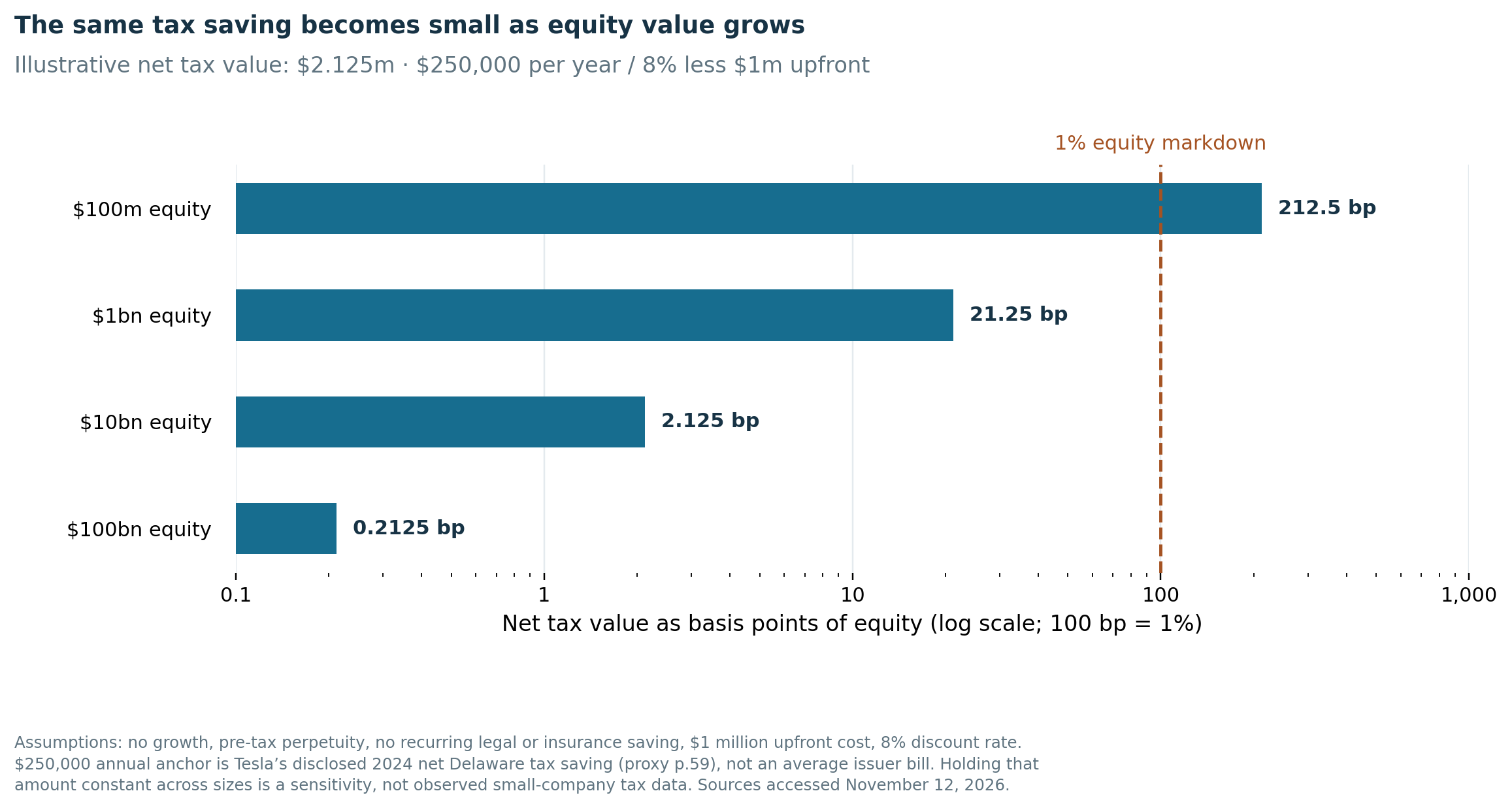
Size is decisive. With the same anchor and cost, the base-case $2.125 million equals 2.125% of $100 million equity, 0.2125% of $1 billion, 0.02125% of $10 billion and 0.002125% of $100 billion. But a smaller company may not pay the maximum Delaware tax. The sensitivity holds savings constant across company sizes.
7. One-year peer multiples: the requested outcome remains unmeasured
A price reaction, a buy-and-hold abnormal return and a valuation multiple are different outcomes. A stock can outperform because earnings grew while its earnings multiple contracted. Likewise, changes in margins or financing can move the EV/revenue ratio.
The requested one-year matched-multiple comparison requires dated prices, diluted shares, cash, debt and trailing financials for movers and a defensible peer set. For enterprise value, leases, preferred stock and minority interests need consistent treatment. Loss-making firms make P/E and often EV/EBITDA unsuitable; banks require a different comparison from software companies. Historical peers must be selected using information available before the proposal, without excluding failures or delistings later.
No comprehensive panel meeting those conditions was obtained. The package therefore does not present a fabricated one-year premium, substitute six-month abnormal returns or splice current market caps onto historical fundamentals. The exact missing figures are date-aligned firm/peer multiples and the adjustment for operating performance, leverage and industry repricing.
There is also mechanical censoring. Coinbase’s December 15, 2025 conversion had not reached its first anniversary by November 12, 2026. Neither had ArcBest’s May 2026 or Dell’s July 2026 conversions. AppLovin’s completion remained unverified. Tesla, The Trade Desk, Dropbox and Tripadvisor have mature calendar horizons, but mature time alone does not supply missing peer observations. This gap prevents a claim that short-window results persist for a year.
An investable extension would preselect industry/size/profitability peers, calculate the change in each mover’s log multiple relative to the peer median, report unmatched and undefined observations, and pair that result with margins, growth, capital structure and litigation costs. It should preserve separate proposal, effective-date and later-rights-amendment analyses.
8. How the published findings compare
The literature asks several different questions. Cross-sectional domicile comparisons, changes in state law and a particular company’s decision to move are not interchangeable treatments.
| Research | Finding relevant here | Limits of the finding |
|---|---|---|
| Daines, 2001 | Historical Delaware firms had higher Tobin’s Q and takeover incidence in a 1981–96 sample | A causal value loss from a contemporary outbound move |
| Subramanian, 2004 | Earlier Delaware premium concentrated in small firms in 1991–96; absent later and among larger firms | A permanent, universal Delaware premium |
| Barzuza and Smith, 2014 | Nevada firms were 30–40% more likely to report results requiring restatement, with substantial self-selection | A 30–40% valuation discount, or that a move itself caused misreporting |
| Eldar, 2018 publication; free 2017 version examined | Table 5 three-day Delaware-origin CAR −0.474%, n=36, t=−0.22; excluding splits/share-capital increases, +0.82%, n=24, t=0.36 | A precisely estimated modern Texas/Nevada effect; neither cited subsample shows a significant gain |
| Khoo and Tallarita, August 2026 revision | Abstract reports −1.2 percentage points around Delaware’s SB21 reform, with additional controller/dual-class differences | A direct estimate of moving from Delaware to Texas or Nevada |
| Duarte-Silva and Dolgoff, April 2025 | Simpler S&P 500 comparison reports no statistically discernible SB21 effect | A controlled replication of the different-sample, different-window study above |
The original papers, free author versions or university abstracts are linked below. Eldar’s broader results are more positive than the three-day rows alone suggest: his screened seven-session [−1,+5] window reports +11.5% across origins (n=47, t=2.42) and +6.42% for Delaware origins (n=23, t=2.05, marked significant at 10%). This supports heterogeneous benefits for self-selecting firms, with the general effect unresolved. These exact Table 5 figures come from the free 2017 working paper; their identity to the final journal table was not independently verified. The latest Khoo–Tallarita abstract reports additional −1.4 percentage points for controlling blocks of at least 15% and −2.3 for dual class. Its earlier 2025 overall −1.4% estimate is a different version. Exact confidence intervals from the full latest revision remain a gap.daines, subramanian, barzuza, eldar, khoo, duarte
The Trade Desk’s proxy reproduces a paid board memorandum with selected company plots, including a failed Fidelity National Financial proposal. Tesla’s proxy also describes adviser comparisons of incorporation states and prior moves. They document board reasoning and can generate hypotheses; selected descriptive plots do not resolve selection and confounding.ttdmemo, teslaproxy
Source provenance matters for the contemporary release. SMU discloses that Goodwin advised Tesla’s committee on the 2025 CEO award, states he had no role in the 2024 redomestication, and records an Archer board presentation in 2026. The affiliations and the source’s published corrections reinforce the case for preserving versions and independently checking inputs.disclosures
9. Delaware’s tax base and Texas’s charges
Delaware’s reported net corporate franchise-tax receipts were $846.8 million in FY2018, $1,382.3 million in FY2023, $1,301.8 million in FY2024, $1,304.2 million in FY2025 and $1,307.4 million in FY2026. The latest figure is about 0.25% above FY2025 and 5.42% below the FY2023 peak. It is approximately 54.4% above FY2018. These calculations use one defined series, with historical revisions included.derevenue
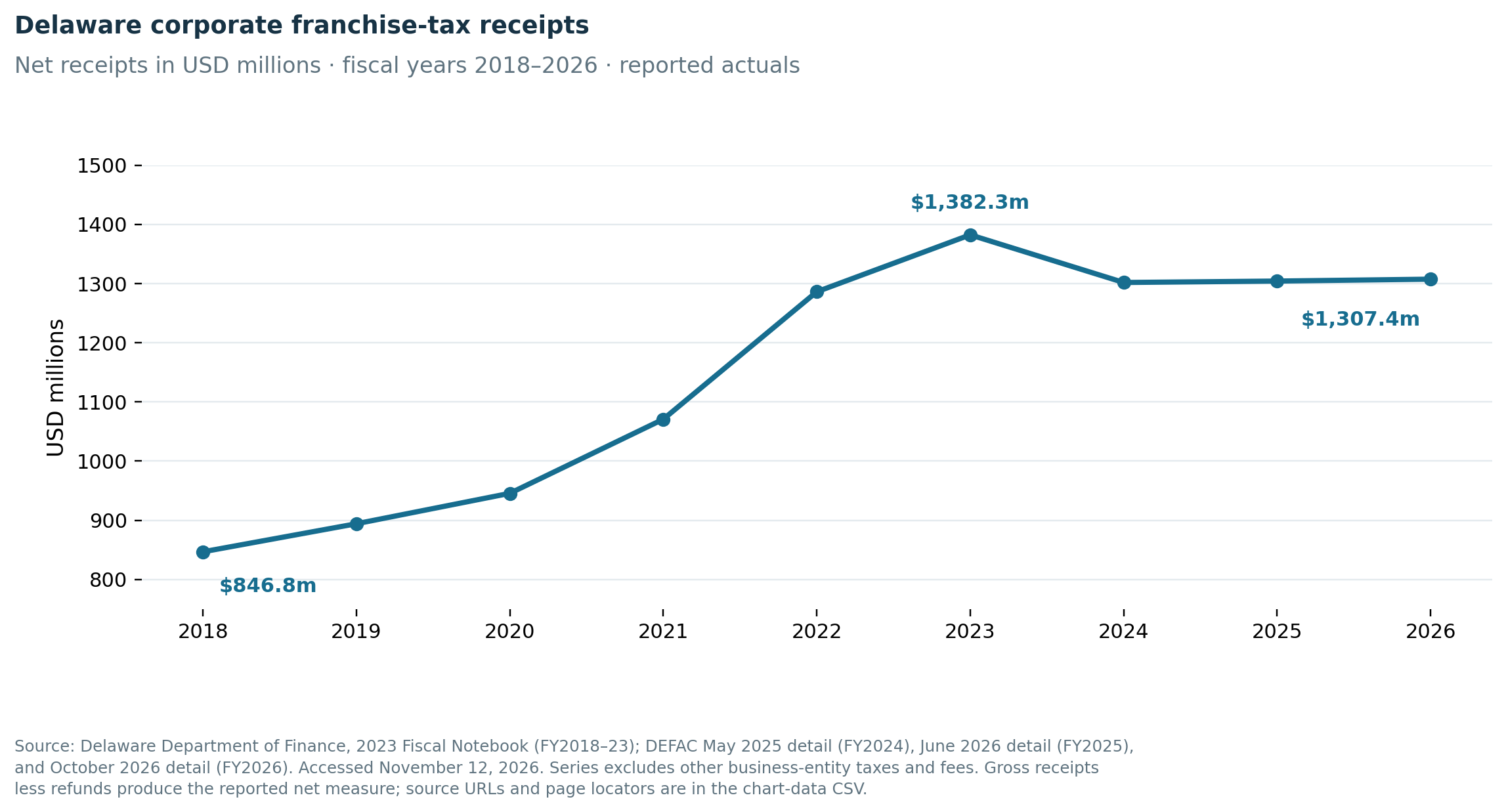
This is not the roughly $2 billion total often associated with Delaware’s business-entity revenues: that wider measure includes other entity taxes and fees. The selected corporate-tax series shows no recent collapse. New formations and tax-base changes can offset revenue lost from departing companies, so the series leaves the cost of exits unquantified.
Ten, fifty or one hundred departing companies, each hypothetically paying the $250,000 large-filer cap, imply $2.5 million, $12.5 million or $25 million annual lost receipts—approximately 0.19%, 0.96% or 1.91% of FY2026 net corporate franchise tax. The calculation shows the effect if each hypothetical departure costs the full statutory cap.
Texas generally charges $300 for conversion plus $300 for formation of a for-profit corporation; professional expenses are additional. Texas determines franchise tax liability by nexus and apportionment. For report years 2026–27, the published no-tax-due revenue threshold is $2.65 million, with standard rates of 0.375% for retail/wholesale and 0.75% for other taxable margin. Nevada’s $500 annual corporate business-license fee is only one charge; annual-list and other fees also matter. Leaving Delaware does not eliminate state business taxes.charges
10. Courts and exchanges: operating institutions, incomplete performance proof
The Texas Business Court’s FY2025 report, covering September 2024–August 2025, records 185 filings and 60 dispositions. Of those dispositions, its age table places 32 within 90 days, 20 within 91–180 days and eight within 181–365 days. The distribution covers cases the court disposed of during the year.txcourt25
The report through April 30, 2026 is internally inconsistent: its headline gives 409 cumulative filings, while its judge table and monthly series total 400, and the four-month grouping totals 401. The dataset preserves those observations and vintages. It reports 221 active pending cases, 82 written opinions and eight completed trials—three jury and five bench. The reported average of 12 months and one day from a defendant’s first appearance to trial is not a median time from filing to final decision.txcourt26
Delaware Chancery’s FY2025 civil figures are 1,404 filings and 1,466 dispositions; estate matters appear in their own series. Comparing those totals with a new court of different jurisdiction, case mix and age does not identify which court is faster or produces better outcomes. The precise gap is a consistent case-level duration and outcome panel, including pending cases and appeals.decourt
TXSE’s status is clearer. SEC registration was approved September 30, 2025; the exchange reported completion of its trading rollout July 31, 2026. Exchange-traded-product primary listings followed in September and the Energy Transfer group’s corporate listings on October 5. Texas Capital transferred on October 8 and began trading under TXCP on November 9. TXSE is operational at this cutoff. Nasdaq Texas and NYSE Texas are different venues.txse
Listing competition may affect fees, services and the surrounding corporate ecosystem. Headquarters, domicile, primary listing and secondary listing can each differ. Estimating the effect of state incorporation law requires isolating the domicile change.
11. What would change the result?
Three cross-checks sustain the central assessment. The public event release’s corrected multiple-test conclusions, older Nevada event evidence and newly verified sensitivity to outliers leave any general premium uncertain. The Texas statute, restrictive adopted documents and ArcBest’s explicit opt-out independently show that a destination label is an incomplete description of shareholder rights. Tesla’s reported tax saving, Delaware’s published cap and the audited value bridge confirm the small-dollar scale for a large issuer.
The conclusion would change with a repeatable effect after accurately timing announcements, proxies, votes and later amendments; independent daily-return replication; complete controller coding; and predeclared treatment of concurrent news. It would also change with documented, recurring reductions in legal or insurance expense large enough to clear the model’s break-even hurdle, without offsetting losses to outside holders.
A matched one-year multiple panel could reveal persistent repricing that short windows miss. A comprehensive docket/cost panel could distinguish less litigation waste from less accountability. Final federal rulemaking or controlling judgments could alter the value and availability of proposal rights. Until those observations exist, the appropriate analyst action is to value cash flows and adopted rights company by company, carrying unmeasured benefits and costs as explicit sensitivities.
Sources and methodology
November 12, 2026, was the research cutoff and source access date. Periods and page, article or filing-item locators are specified here; the CSV registries provide additional row-level detail. Statistics, scenario values and percentages are author calculations from identified inputs. No paid access, outreach or information request was used.
- SMU Corporate Governance Initiative, The Reincorporation Price Study—Results and public statistical JSON, release timestamp 2026-09-08T12:55:05.926808Z; tags design, cells, per_leg, summary, step8b; factor calendar through 2026-07-31. The recomputed tables use the JSON from the dated release. ↩
- SMU CGI, Tesla v2 replication page, replication kit and daily-close manifest; accessed version lists daily prices as available on request. Aggregate checks and bootstrap methods accompany the reproduction scripts. ↩
- Proposal-period sources: Dillard’s July 18, 2025 PRE14A, ownership p.48 and director-election comparison; Brilliant Earth October 30, 2025 PRE14C, pp.34–35, footnote 3; Tripadvisor’s April 26, 2023 DEF14A, p.5; AMC Networks April 11, 2025 PRE14A, p.140; Sphere April 3, 2025 PRE14A, pp.11/148; Tempus March 28, 2025 PRE14A, p.57; HWH October 10, 2025 PRE14C, notice and pp.1/13. Definitions and subsequent-control cautions accompany the control CSV. ↩
- Delaware Chancery, Tornetta v. Musk, January 30, 2024, p.2 and controller analysis concerning the compensation transaction; The Trade Desk September 23, 2024 PRE14A, reasons and ownership p.42, footnote 5. The classification uses the proposal-period evidence. ↩
- Tesla, 2024 definitive proxy, April 29, 2024; Proposal 3, pp.31–34, 52, 59; Annexes B/C and Special Committee report. The tax estimate applies to Tesla’s 2024 move. ↩
- Tesla, June 2024 8-K, Item 5.07, Proposal 3 and disinterested-holder table; meeting June 13, 2024. Completion is confirmed in the Q2 2024 10-Q, Note 1, period June 30, filed July 24, 2024. Calculated denominators exclude broker non-votes unless stated. ↩
- Tesla, May 24, 2024 DEFA14A, slide 7, January 31 announcement timeline; April 17 preliminary proxy. Retrospective issuer dating is distinguished from SEC acceptance metadata. ↩
- Tesla, May 15, 2025 bylaws, exhibit 3.1, Articles 11.1–11.3, pp.33–34; derivative ownership, forum and jury provisions. ↩
- Coinbase, November 12, 2025 PRE14C, November 24 DEF14C, consent discussion, pp.16, 20–21, Appendices C–F; November 12 announcement; December 16 completion 8-K, Item 8.01. Board October 29, consent November 4, effective December 15, 2025, 5 p.m. Eastern. ↩
- Dropbox, 2025 DEF14C, pp.7–8, 12; Appendices C–F, old/new bylaws section 3.11; completion 8-K, Items 3.03/5.03; effective March 5, 2025, consent January 28. ↩
- The Trade Desk, October 3, 2024 DEF14A, voting-power discussion, Appendix F, Article VIII/F-10; November 18 8-K, Items 5.07/8.01; adopted charter, Articles VIII–IX. Vote November 14; conversion November 15, 2024. ↩
- Tripadvisor, April 2023 DEF14A, voting discussion p.5 and conversion proposal; 2025 10-K, Liberty transaction/reincorporation discussion. Proposal April 2023; meeting June 6, 2023; conversion/acquisition April 29, 2025. ↩
- A. H. Belo, April 23, 2018 8-K, merger plan; vote 8-K, Item 5.07, Proposal 3; completion, Items 3.03/5.03, June 29, 2018. First PRE14A March 20. ↩
- Fidelity National Financial, June 14, 2024 8-K, Item 5.07, record-date shares and Proposal 2; June 12 meeting. Counts and failure stated expressly. ↩
- Revelation Biosciences, January 21, 2025 8-K, Item 5.07, Proposal 2 and record-date shares; January 17 meeting. Specific proposal section controls over inconsistent introductory summary. ↩
- Texas Capital, April 2026 vote 8-K, Item 5.07, reincorporation and advisory-threshold proposals; April 21 meeting. DEF14A, filed March 12, 2026, comparison and proposed documents. Filename date differs from filing date. ↩
- AppLovin, November 4, 2026 8-K, Items 2.02/5.07/8.01, October 29 consent and conversion conditions. Consent is not legal completion. ↩
- ArcBest, May 15, 2026 adopted certificate, Articles XII–XIII; bylaws, section 2.3(a); 2026 proxy, p.84 and Appendix C; May 18 cover correction, explanatory note. ↩
- Dell, conversion 8-K, Item 3.03 and charter Article XVI, July 1, 2026 effectiveness; July 2 bylaw amendment, Article II shareholder-proposal provisions and effective-date redline. ↩
- Tesla, May 2024 DEFA14A, Glass Lewis response; May 31 ISS-related solicitation, reincorporation recommendation. The evidence comes from public issuer disclosures. ↩
- Texas Legislature, SB29 enrolled, effective May 14, 2025; BOC 2.115, 2.116, 21.419, 21.552. Written demand under 21.553 applies alongside the elective ownership threshold. ↩
- Texas Legislature, SB1057 enrolled, BOC 21.373, effective September 1, 2025; eligibility, ownership alternatives, holding period, solicitation and exceptions. ↩
- SEC, Release 34-106383, September 16, 2026, p.1 and proposed repeal; comments due November 20. August 14 staff statement, paragraphs 3–5 and footnote 2. Status November 12, 2026. ↩
- Nevada Legislature, NRS Chapter 78, 78.046, 78.138(7), 78.240; 2025 Chapter 142/AB239, effective May 30, 2025. Issuer elections are documented in the filings. ↩
- Delaware Legislature, SS1 for SB21, enacted March 25, 2025, DGCL 144/220; Delaware Supreme Court, Rutledge v. Clearway, February 27, 2026, pp.3–6, certified questions and disposition. ↩
- Delaware Supreme Court, Maffei v. Palkon, February 4, 2025, p.12/footnote 33 (conditional minority voting), pp.54–55 (holding), p.63/footnote 265 (stock-price identification). ↩
- Texas Business Court, Guillaume v. Armstrong, 2026 Tex. Bus. 70, October 2, 2026, paragraphs 6, 10, 18–24; conduct 2021–23, filed April 16, 2026. Illustrative case. ↩
- The Trade Desk, Q3 2026 10-Q, filed November 9, 2026, Note 11, p.16, “Litigation Related to Reincorporation.” Selected disclosures are not a complete docket census. ↩
- Robert Daines, Does Delaware Law Improve Firm Value?00086-1), JFE 62(3), 2001, pp.525–558; accessible abstract, 4,481 exchange-traded U.S. firms, 1981–96. Exact coefficients/intervals not extracted from paid full text. ↩
- Guhan Subramanian, The Disappearing Delaware Effect, JLEO 20(1), 2004, pp.32–59; university-hosted abstract, 1991–2002 sample. ↩
- Michal Barzuza and David C. Smith, What Happens in Nevada? Self-Selecting into Lax Law, RFS 27(12), 2014, pp.3593–3627; author-university abstract. Exact panel dates, n and confidence intervals unverified in accessible material. ↩
- Ofer Eldar, free 2017 working paper, Table 5, printed p.43/PDF p.44, 1996–2013 Nevada reincorporations; 2018 journal identity. Exact table figures are from free version. ↩
- Kenneth Khoo and Roberto Tallarita, The Price of Delaware Corporate Law Reform, SSRN 5318203, revised August 4, 2026, current accessible abstract; event is 2025 SB21. Latest full PDF and exact confidence intervals not obtained. ↩
- Tiago Duarte-Silva and Aaron Dolgoff, Did SB21’s Changes to Delaware Corporate Law Harm Shareholders?, April 16, 2025, main analysis/footnotes 3–6; February–March 2025 comparison. Equal-weight S&P 500 analysis omits size, beta and industry controls. ↩
- Steven Davidoff Solomon, memorandum in The Trade Desk DEF14A, Appendix E, E-1, E-12 paragraphs 45–47, footnote 77; August 25, 2024 memo, January 2021–August 2024 universe. Paid board engagement. ↩
- SMU CGI, Disclosures, Tesla 2025/Archer 2026 entries; Texas/Nevada correction memorandum, corrections to statistical/causal claims. Live pages at cutoff. ↩
- Delaware Finance, 2023 Fiscal Notebook, pp.31–32/historical chart p.109, FY2018–23. Franchise-tax detail: May 2025, printed p.2/PDF p.7, FY2024 reported; June 2026, printed p.2/PDF p.8, FY2025 reported; October 2026, printed p.2/PDF p.8, FY2026 reported; worksheet cross-check. USD millions, net receipts; FY2026 gross $1,329.4m less $22.0m refunds. ↩
- Delaware Revenue, Franchise Taxes, caps and report fee. Texas SOS Conversion FAQs explain filings. BOC Chapter 4 sets fees in 4.151(5)/4.152(1). The Texas Comptroller’s Franchise Tax page gives 2026–27 rates and thresholds. Nevada NRS76 addresses licensing and fees at 76.100/76.130. ↩
- Texas OCA, Business Court FY2025 report, pp.7–11. The original report covers September 1, 2024–August 31, 2025. ↩
- Texas OCA, Business Court midyear report, pp.5–10, September 2024–April 30, 2026; conflicting totals/revised monthly observations included. ↩
- Delaware Judiciary, FY2025 Statistical Information Report, p.10, Chancery civil filings/dispositions, FY2024–25. Estate activity appears in another series. ↩
- SEC, TXSE registration, Release 34-104146, September 30, 2025; TXSE July 31 trading rollout, September 16 ETP listings, October 5 primary listings, November 9 Texas Capital release; Nasdaq March 5, 2026 Texas launch. NYSE Texas: SEC Release 34-106798, November 2, 2026, p.2. ↩
- Author register from SEC EDGAR proxies, information statements, merger filings and 8-Ks, 2018-01-01 through 2026-11-12. Discovery input: SMU public registry JSON, snapshot generated 2026-11-12T01:03:59Z. Individual primary documents and locators appear in the supplied source ledger. The totals reflect the classifications in the register. ↩
Supporting material
- Excel model ↗Sourced inputs, live calculations and reported outputs.
- Source and model data (CSV collection) ↗Data tables, source references and calculation exports.
- Report sources ↗Download as CSV.
- Proposal register ↗Download as CSV.